Pre-Summer Sale - 70% Discount Offer - Ends in 0d 00h 00m 00s - Coupon code: dm70dm

3V0-23.25 Advanced VMware Cloud Foundation 9.0 Storage Questions and Answers

Questions 4

An administrator wants to protect a site from disaster and re-protect after fail-over. Industry regulations require to change the primary site every six months.

Which two options are required during the inventory mapping and while running the recovery plans to fulfill this requirement? (Choose two.)

Options:

A.

Once fail-over is successful, reconfigure vSAN data protection to reverse replication.

B.

Use “Prepare reverse mappings” during inventory mapping creation.

C.

Use a test recovery plan.

D.

Once the fail-over is successful, re-protect from VMware Live Site Recovery.

E.

Extend the network between both sites.

Buy Now
Questions 5

An administrator has been tasked with suggesting storage models for a new VMware Cloud Foundation (VCF) Private Cloud. The following information has been provided:

• All existing implementations of VMware vSphere use the existing third-party block-based storage solution.

• The block-based storage solution only has sufficient scale, capacity and IOPS to cater for the new workload storage requirements.

• There is a dedicated and highly resilient storage area network connecting hosts to the provided block-based storage.

• There are 5 existing hosts with enough CPU and RAM resources and resilient Host Bus Adapters (HBAs) to cater for the new workload resource requirements only.

• There is sufficient budget to purchase some hardware, however the solution must re-use the existing hardware where possible.

The administrator suggests the following high-level solution:

• Single VCF Instance with a single Workload Domain.

• Deploy 4 new servers to create a Management Domain.

• Repurpose the 5 existing servers to create a single cluster in the Workload Domain.

Which two storage models should the administrator recommend? (Choose two.)

Options:

A.

iSCSI should be the supplemental storage solution for the VCF Workload Domain.

B.

iSCSI should be the principal storage solution for the VCF Management Domain.

C.

Fibre Channel should be the principal storage solution for the VCF Workload Domain.

D.

VMware vSAN should be the principal storage solution for the VCF Management Domain.

E.

VMware vSAN should be the principal storage solution for the VCF Workload Domain.

Buy Now
Questions 6

An administrator is tasked designing a vSAN storage solution while respecting the following requirements:

• Must use vSAN ESA

• Must be stretched between two data centers

• Must configure Failures to tolerate = 1

• Must configure Erasure Coding

How many components per Virtual Machine (VM) will be created?

Options:

A.

4

B.

3

C.

1

D.

2

Buy Now
Questions 7

An administrator is tasked with designing a highly available vSAN ESA two-node cluster for a remote VMware Cloud Foundation (VCF) workload domain. The solution should be able to survive the failure of any disk group in addition to a host failure without data loss.

What is the minimum total number of nested fault domains required for the design?

Options:

A.

6

B.

4

C.

7

D.

2

Buy Now
Questions 8

An administrator has been tasked with adding supplemental storage to an existing VMware Cloud Foundation (VCF) Workload Domain. The supplemental storage will add capacity for backup data and ISO images without impacting the principal storage used for live production workloads.

What should the administrator recommend meeting the requirement?

Options:

A.

Migrate Management Domain storage to a new cluster.

B.

Increase the VMFS principal storage allocation.

C.

Attach additional NFS volumes or iSCSI datastores.

D.

Replace all existing datastores with NVMe devices.

Buy Now
Questions 9

A cache drive failed on one of the vSAN OSA nodes in the cluster.

When the drive failed, vSAN started a resync to ensure the health of the data, and all objects are showing a healthy and compliant state.

The vSAN administrator needs to replace the failed cache drive.

Which set of steps should the vSAN administrator take?

Options:

A.

Place the disk group into maintenance mode, and select Full Data Migration. Then, physically replace the failed cache device. Afterwards, vSAN will rebuild the disk group automatically.

B.

Physically replace the failed cache device, and vSAN will automatically allocate the storage.

C.

Remove the existing vSAN disk group, and physically replace the device. Then, check to verify that the ESX host automatically detects the new device. Afterwards, manually recreate the Disk Group.

D.

Physically replace the failed cache device, and vSAN will automatically create a new disk group. Then, remove the disk group with the failed device.

Buy Now
Questions 10

An administrator has been tasked with providing additional storage to an existing VMware Cloud Foundation (VCF) instance. The administrator decides to configure cross-cluster capacity sharing so that multiple independent vSAN HCI Clusters can consume storage of adjacent vSAN storage resources within the same workload domain.

What is a requirement of cross-cluster capacity sharing?

Options:

A.

Ensure vSAN client Cluster latency to vSAN server Cluster is minimum 10 milliseconds.

B.

All objects that make up a VM must reside on multiple vSAN datastores.

C.

Configure vSphere HA failure response for Datastore with APD to be set to Power off and restart VMs.

D.

Client and Server vSAN Clusters must have different vSAN architectures.

Buy Now
Questions 11

A storage architect has been called into a meeting with the accounting team who is trying to determine why 20% of their raw capacity is not available for consumption. Their vSAN cluster was created with the following characteristics:

• 2 x 2 TB NVMe disks in 6 hosts in their vSAN cluster.

• FTT=1, RAID-1 for the default policy.

• Host Rebuild Reserve not activated for this cluster.

Which two items should the Architect say accounts for most of the unusable capacity? (Choose two.)

Options:

A.

Encryption overhead

B.

RAID Overhead

C.

Operational Reserve (policy changes, rebalancing, data movement)

D.

Host upgrade overhead

E.

VM swap overhead

Buy Now
Questions 12

An administrator is managing a local vSAN 3-node cluster running the Express Storage Architecture (ESA) as part of a VMware

Cloud Foundation (VCF) Workload Domain.

The following parameters apply at the cluster level:

• HA is enabled

• Reserved Failover Capacity = 25% for both CPU and Memory

The administrator is tasked with configuring the VSAN storage policy so it will tolerate the maximum number of failures.

What two protection levels can the administrator configure? (Choose two.)

Options:

A.

RAID-I (Mirroring) 3 Failures.

B.

RAID-I (Mirroring) 2 Failures.

C.

No data redundancy.

D.

RAID-6 (Erasure Coding) 2 Failures.

E.

RAID-1 (Mirroring) 1 Failure.

F.

RAID-5 (Erasure Coding) 1 Failure.

Buy Now
Questions 13

A firm is migrating to VMware Cloud Foundation (VCF) and will leverage its existing enterprise Fibre Channel SAN for workload domain storage.

Their priorities include seamless integration into VCF, automated lifecycle management via VCF Operations, consistent VM-level performance control, and alignment with best practices for large-scale VI environments. Management does not require vSAN, and operational simplicity is critical.

Which design meets all of the specified requirements?

Options:

A.

Dedicate FC LUNs to the Management Domain only, and utilize local SSD and HDD drives in each VI workload domain for operational workloads with automatic VM placement.

B.

Designate VMFS datastores on the existing FC SAN as principal storage for each workload domain, then assign multiple Storage Policies based on array and LUN performance tiers to enable automated VM placement and enforce QoS.

C.

Mount a single, high-capacity vSAN datastore from the existing storage solution to all clusters and automatically allocate VMs to this datastore, and let the array handle VM-level performance control.

D.

Import FC LUNs into the management cluster as vVol datastores for each workload domain, then assign multiple Storage Policies based on array and LUN performance tiers to enable automated VM placement and enforce QoS.

Buy Now
Questions 14

A storage architect is designing a VMware Cloud Foundation (VCF) Workload Domain with the following requirements:

• vSAN File Services hosting multiple file shares.

• Each department requires distinct protection levels and placement rules.

Which option satisfies the requirements?

Options:

A.

Create multiple IP Pools and bind each to a file server to be able to assign different storage policies.

B.

Separate file shares by creating individual File Service clusters per department.

C.

Make sure the file share server VMS are tied to a vSphere Compute Policy during creation.

D.

Assign different vSAN Storage Policies to each file share during creation.

Buy Now
Questions 15

An administrator is working on a VMware Cloud Foundation (VCF) Workload Domain that was configured to use vSAN for principal storage. The administrator wishes to create and configure a datastore cluster to host tenant VMs using that vSAN backed storage across multiple clusters, mixed OSA and ESA, in the domain.

What should the administrator consider?

Options:

A.

When using vSAN datastores, Datastore Clusters are not supported. Each VM must be placed manually on the vSAN datastore.

B.

When using vSAN as the underlying datastore, an administrator must create the datastore cluster via vCenter APIs, include the vSAN datastore(s) in it, enable Storage DRS, and ensure the VM Storage Policies reference the appropriate vSAN-capable datastore.

C.

A datastore cluster can combine different storage types, such as vSAN, FC, and NFS datastores, as long as they are in the same vCenter; Storage DRS will treat them uniformly.

D.

vSAN OSA and ESA based datastores must be added to a datastore cluster tag and then selected as part of a single storage policy.

Buy Now
Questions 16

An administrator is preparing to enable vSAN Data-at-Rest Encryption and must verify that the identity and key provider prerequisites are met before proceeding with the configuration.

Which two requirements must be met? (Choose two.)

Options:

A.

OSA requires a trusted KMS identity before encryption can be enabled.

B.

ESA requires Trusted Platform Modules (TPMs).

C.

OSA does not support external KMS integration.

D.

ESA requires a trusted KMS identity before encryption can be enabled.

E.

OSA requires Trusted Platform Modules (TPMs).

Buy Now
Questions 17

An enterprise is planning to deploy a new vSAN ESA enabled cluster to their existing VMware Cloud Foundation (VCF) Private Cloud Workload Domain. The following requirements have been given:

• 2 x 4 TB NVMe disks per host

• FTT=1/RAID-5 for all deployed Virtual Machines

• Expected dedupe/compression ratio = 1.5 (50%)

• Reserve enough capacity to rebuild a host completely in case of a failure (Host Rebuild Reservation)

• Operational Reserve of 10%

• Expected overhead for filesystem, object, etc. of 25%

How many hosts are required to meet a minimum usable capacity of 12 TB?

Options:

A.

6 hosts

B.

3 hosts

C.

4 hosts

D.

5 hosts

Buy Now
Questions 18

An administrator is tasked with enabling vSAN Data Protection.

Which action is required to enable vSAN Data Protection?

Options:

A.

Enable vSAN advanced options

B.

Deploy VMware Live Recovery (VLR)

C.

Deploy Data Services Manager

D.

Deploy vSphere Replication

Buy Now
Questions 19

An administrator needs to quickly test a possibly destructive change to a Virtual Machine (VM) in production. The VM is currently protected by vSAN Data Protection.

Which feature of vSAN Data Protection can be leveraged to achieve this objective?

Options:

A.

Immutable snapshots

B.

Multiple snapshot schedules

C.

Protection group

D.

Linked clone

E.

Replication

Buy Now
Questions 20

A VMware Cloud Foundation (VCF) Workload Domain is requested to be deployed with the following information:

. 6 blade style hosts with no local storage beyond the operating system.

. 4 25 Gb networking cards installed in each host.

. A 30 TB external array configured to support NVMe/TCP only.

. 2 dVS switches, one configured for storage isolation and one for all other traffic.

. NVMe/TCP multi-path configuration required.

. Existing Management Domain is deployed with VCF.

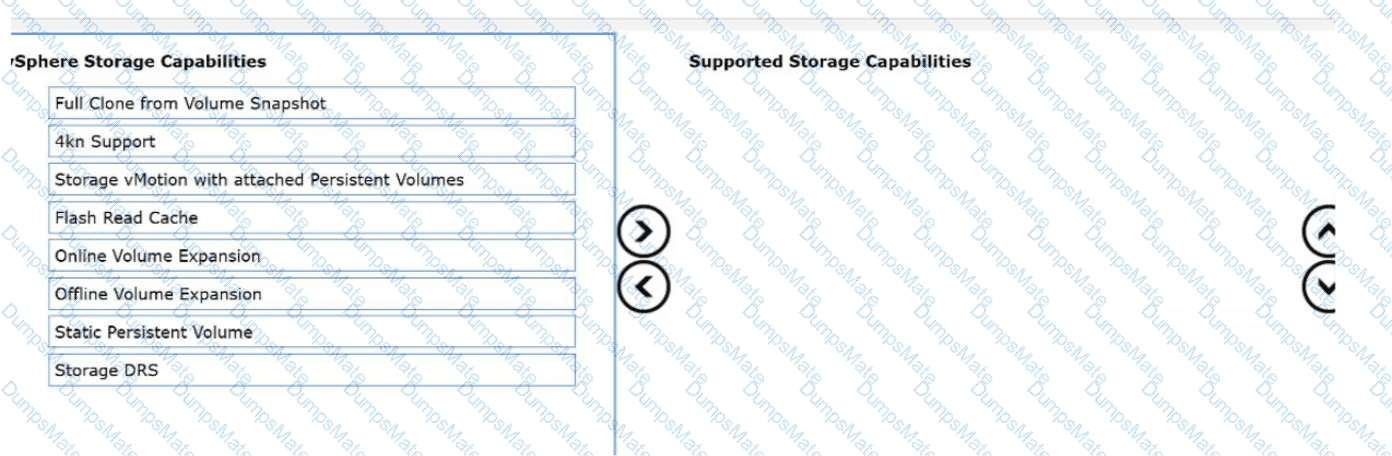
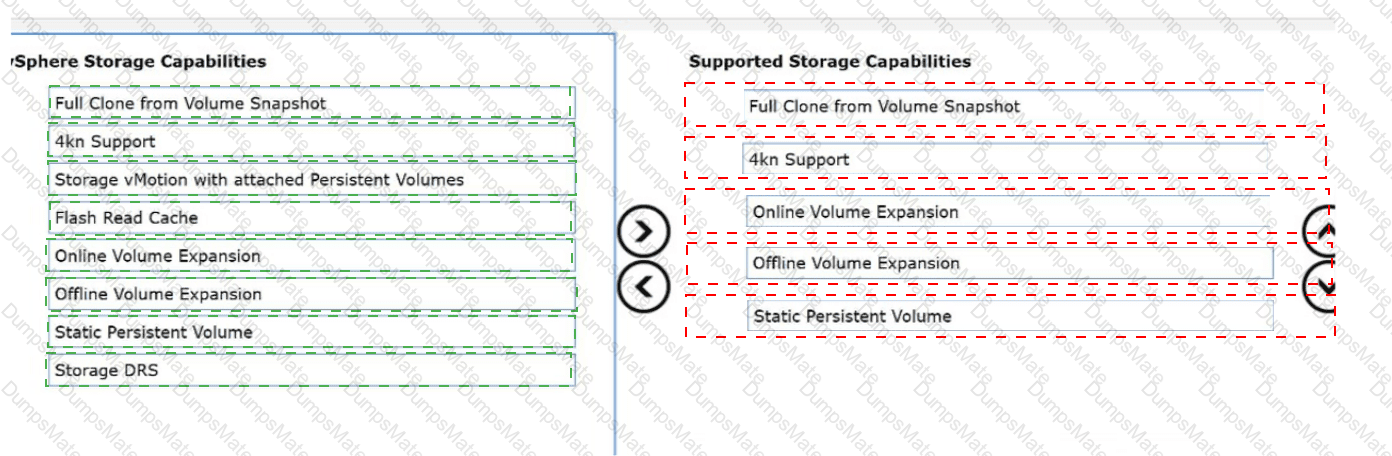
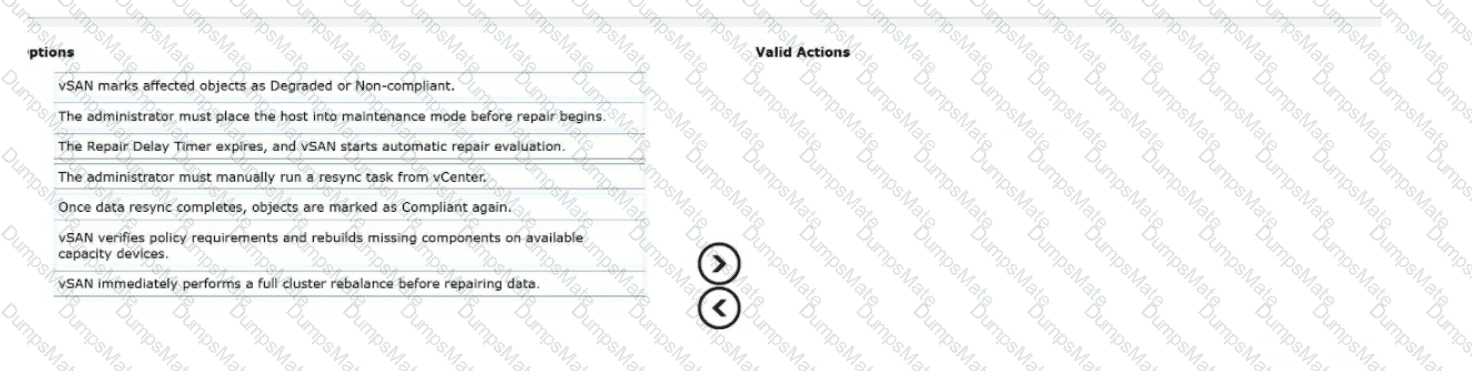
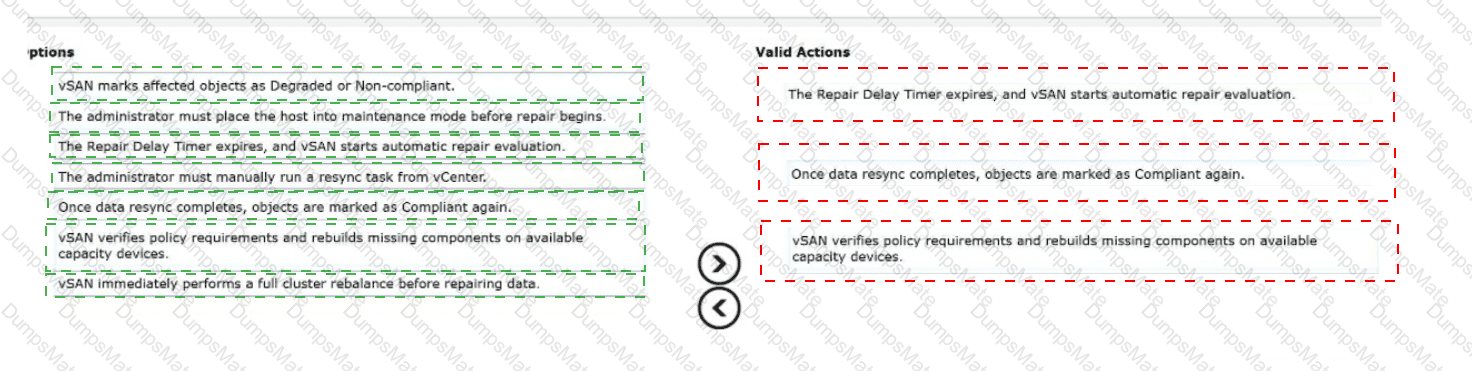
Place the steps for importing VCF on to this configuration.

3V0-23.25 Question 20

Options:

Buy Now
Questions 21

An administrator reports that after rebooting one host in a vSAN cluster configured with Data-at-Rest Encryption using an external Key Management Server (KMS), the host shows all vSAN disk groups as unmounted.

The KMS is online and reachable from all hosts.

In vCenter, the host displays the following event:

“Failed to retrieve encryption key from KMS.”

Key ID:

All other hosts in the cluster remain healthy and show “Encryption: Enabled.”

Why did the encryption key retrieval fail for this host?

Options:

A.

The host’s trust relationship or certificate with the KMS is invalid or missing.

B.

The cluster requires a Deep Rekey operation to restore access to the encrypted disks.

C.

The vCenter Server has not been restarted to refresh the encryption key cache.

D.

The TPM on the host failed to unlock the data encryption keys.

Buy Now
Questions 22

An administrator is managing a stretched vSAN ESA cluster where each site has three hosts.

The following parameters apply to the storage policy being configured at the datastore level:

• The policy is configured at the datastore level

• Site disaster tolerance = Site mirroring - stretched cluster

• Failures to tolerate = 1 failure - RAID-1 (mirroring)

• Number of disk stripes = 1

When inspecting some of the Virtual Machines (VMs), why do objects have 3 disk stripes?

Options:

A.

ESA in RAID-1 always uses 3 stripes.

B.

Site mirroring has been configured.

C.

Each Virtual Machine has 3 objects.

D.

There is a policy configured at the Virtual Machine level.

Buy Now
Exam Code: 3V0-23.25
Exam Name: Advanced VMware Cloud Foundation 9.0 Storage
Last Update: May 23, 2026
Questions: 76

PDF + Testing Engine

$49.5  $164.99

Testing Engine

$37.5  $124.99
buy now 3V0-23.25 testing engine

PDF (Q&A)

$31.5  $104.99
buy now 3V0-23.25 pdf
dumpsmate guaranteed to pass

24/7 Customer Support

DumpsMate's team of experts is always available to respond your queries on exam preparation. Get professional answers on any topic of the certification syllabus. Our experts will thoroughly satisfy you.

Site Secure

mcafee secure

TESTED 23 May 2026