Winter Sale - Special Limited Time 65% Discount Offer - Ends in 0d 00h 00m 00s - Coupon code: dpm65

3V0-25.25 Advanced VMware Cloud Foundation 9.0 Networking Questions and Answers

Questions 4

An administrator encountered a failure with one of the NSX Managers in a VCF Fleet. The administrator has successfully re-deployed an NSX Manager from SFTP backups. However, after replacing the failed manager node, the new node joins successfully, but the cluster status remains "Degraded".

• The get cluster status command on the leader still shows the old UUID with state "REMOVED".

What is the command to resolve the issue?

Options:

A.

detach node

B.

delete node

C.

detach node then delete node

D.

detach node

Buy Now
Questions 5

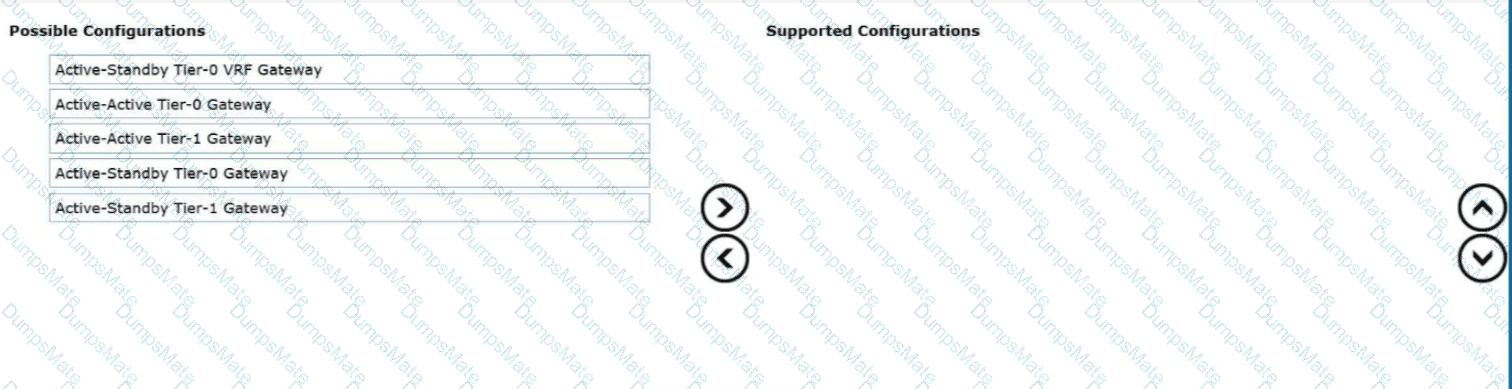
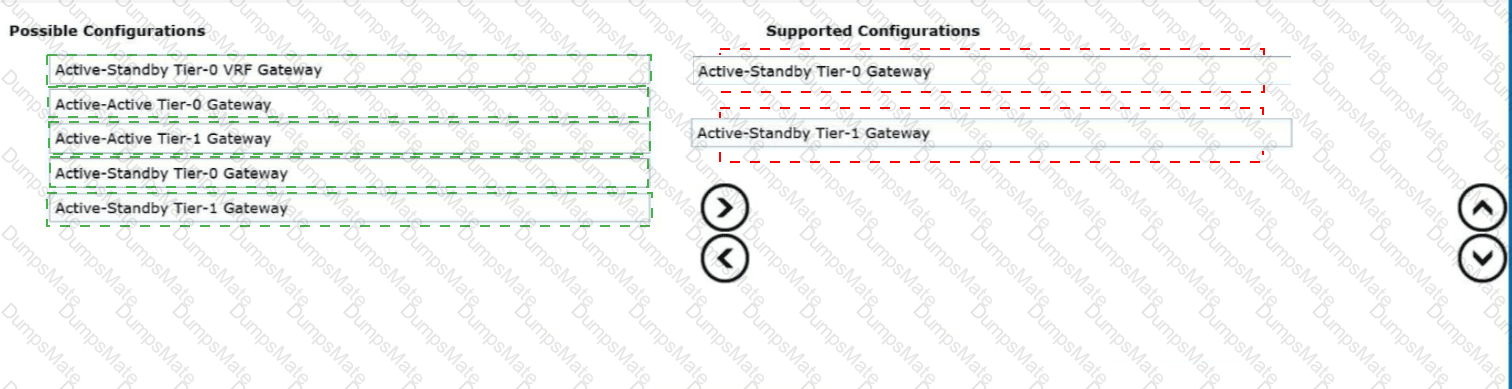
An administrator is responsible for the management of a VMware Cloud Foundation (VCF) Fleet that consists of two VCF instances that are located in different physical locations. The administrator has been tasked with configuring a VPN between the two locations and has been tasked with identifying the two supported NSX Gateway configurations for an IPSec VPN. Drag and drop two items from the list of Possible Configurations into the list of Supported Configurations in any order.(Choose two.)

3V0-25.25 Question 5

Options:

Buy Now
Questions 6

An administrator has a vSphere 8 Update 1a with NSX 4.1.0.2 environment. What option can the administrator use to converge this vSphere with NSX environment into a VMware Cloud Foundation (VCF) Workload Domain?

Options:

A.

Use the VCF installer to automatically converge the vSphere with NSX environment into a new VCF Workload Domain.

B.

Upgrade NSX to version 9 into the vSphere 8 environment and use the VCF installer to converge the vSphere 8 with NSX environment into a new VCF Workload Domain.

C.

Upgrade the environment version and use the VCF installer to converge the vSphere environment into a new VCF Workload Domain.

D.

Upgrade the environment and use VCF Operations to converge the vSphere environment into a new VCF Workload Domain.

Buy Now
Questions 7

An administrator has observed an NSX Local Manager (LM) outage at the secondary Site. However, the NSX Global Manager (GM) in secondary Site remains operational. What happens to data plane operations and policy enforcement at the secondary site?

Options:

A.

All traffic is blocked until secondary site LM recovers.

B.

Only local policies work; global policies cease to apply on the secondary site.

C.

The data plane operates normally until LM recovery and reconnection.

D.

Secondary site must failover all workloads to Primary site.

Buy Now
Questions 8

An administrator needs to prevent the datacenter from advertising any internal prefixes toward a new VPC, while still ensuring the VPC receives a default route learned from the datacenter's upstream network. Where should the routing policy be applied?

Options:

A.

On each segment default gateway.

B.

On the Tier-1 gateway.

C.

On the VPC transit gateway.

D.

On the provider Tier-0 neighbor.

Buy Now
Questions 9

An architect is designing a VMware Cloud Foundation (VCF) solution. The following information was gathered during the assessment phase:

• There is a critical application used by the Finance Team.

• The critical application has an availability and recoverability SLA of 99.999%.

• The critical application is sensitive to network changes.

Which two configurations should the architect include in their design? (Choose two.)

Options:

A.

Configure multiple static routes on Tier-1 gateway.

B.

Configure Tier-0 gateway for eBGP and ECMP.

C.

Enable BFD on the Tier-0 gateway.

D.

Configure Tier-1 gateway for eBGP and ECMP.

E.

Install and configure hosts with 100Gbps physical NICs.

Buy Now
Questions 10

An administrator is troubleshooting BGP flapping in a VMware Cloud Foundation (VCF) 9 environment. A Tier-0 Gateway is running in Active/Active mode with two Edge nodes. BFD is enabled on the eBGP sessions to the upstream routers. Each Edge node uses its own uplink IP for BGP. After some network maintenance, one BGP session starts flapping every few minutes. The other BGP sessions stay stable. On the affected Edge node, the command get bfd-sessions shows:

• State: Down

• Diag: Detect Time Expired

Symptoms:

• The upstream router also shows the BFD session as Down with control Detection Time Expired.

• There are no interface errors, no packet loss for normal traffic, and clearing the BFD session temporarily brings it back up - but it flaps again after few minutes.

What is the root cause?

Options:

A.

BFD timers are mismatched between Tier-0 Gateway and the upstream routers.

B.

The MTU does not match on the end-to-end between Tier-0 Gateway and upstream routers.

C.

BFD is configured in echo mode on the upstream routers.

D.

The Edge nodes are undersized and are experiencing high contention on CPU and drops BFD packets.

Buy Now
Questions 11

An administrator is troubleshooting an issue where workloads connected to a Tier-1 Gateway named T1-App can no longer reach external North/South destinations.

• The Tier-1 is connected to an Active/Standby Tier-0 Gateway named T0-Prod.

Symptoms observed:

• VMs on segments attached to T1-App can ping each other.

• VMs on T1-App cannot reach any external IP outside T0-Prod.

• From a VM on the segment, ping to the T1-App Distributed Router (DR) IP succeeds.

• Ping from the VM to the T1-App Service Router (SR) fails.

• The Edge cluster hosting the T1-App SR shows both Edge nodes Up and Healthy.

• No failover has occurred — the same Edge node is still shown as Active for T1-App.

What is the most likely cause of this issue?

Options:

A.

The overlay network between DR and SR has an MTU mismatch.

B.

Route advertisement from T1-App to T0-Prod for 100.64.x.x/31 is disabled.

C.

Static default route is missing on the Tier-1 DR component.

D.

Localized control plane is enabled on the Tier-1 causing the SR to remain admin-down.

Buy Now
Questions 12

Which two requirements are part of the registration process for Local Manager (LM) to a Global Manager (GM) in NSX for centralized management of network and security services across different workload domains deployed in separate locations? (Choose two.)

Options:

A.

The LM will validate the GM license to perform the GM registration.

B.

The external load balancer VIP is used for NSX Managers without requiring node API certificate updates.

C.

The LM Cluster VIP / FQDN is provided for GM-LM communication.

D.

The IP / FQDN of any of the 3 LM must be used for registration.

E.

The GM-Active requests the LM IP / FQDN and admin credentials for registration.

Buy Now
Questions 13

In an NSX environment, an administrator is observing low throughput and intermittent congestion between the Tier-0 Gateway and the upstream physical routers. The environment was designed for high availability and load balancing, using two Edge Nodes deployed in Active/Active mode. The administrator enables ECMP on the Tier-0 gateway, but the issues persist. Which action would address low throughput and congestion?

Options:

A.

Convert Tier-1 gateways to be edgeless.

B.

Disable NAT on the Tier-0 gateway.

C.

Add an additional vNIC to the NSX Edge node.

D.

Deploy additional Edge nodes.

Buy Now
Questions 14

An administrator is tasked to configure NSX Federation between separate VMware Cloud Foundation (VCF) Fleets. Which requirement must all sites meet before being added to a Global Manager (GM) for NSX Federation?

Options:

A.

All Sites must use the same VTEP VLAN and IP pools.

B.

All sites must use identical Tier-0 gateway BGP autonomous system numbers.

C.

All sites must be managed by the same VCF instance.

D.

All sites must have the same NSX version and build.

Buy Now
Questions 15

When using a DHCP Relay on a segment, which design restriction must be considered?

Options:

A.

DHCP settings, DHCP options, and static bindings cannot be configured on the segment.

B.

DHCP client requests cannot be relayed to the external DHCP servers.

C.

DHCP settings, DHCP options, and static bindings can be configured on the segment.

D.

DHCP Relay service is available to all the other segments in the network.

Buy Now
Questions 16

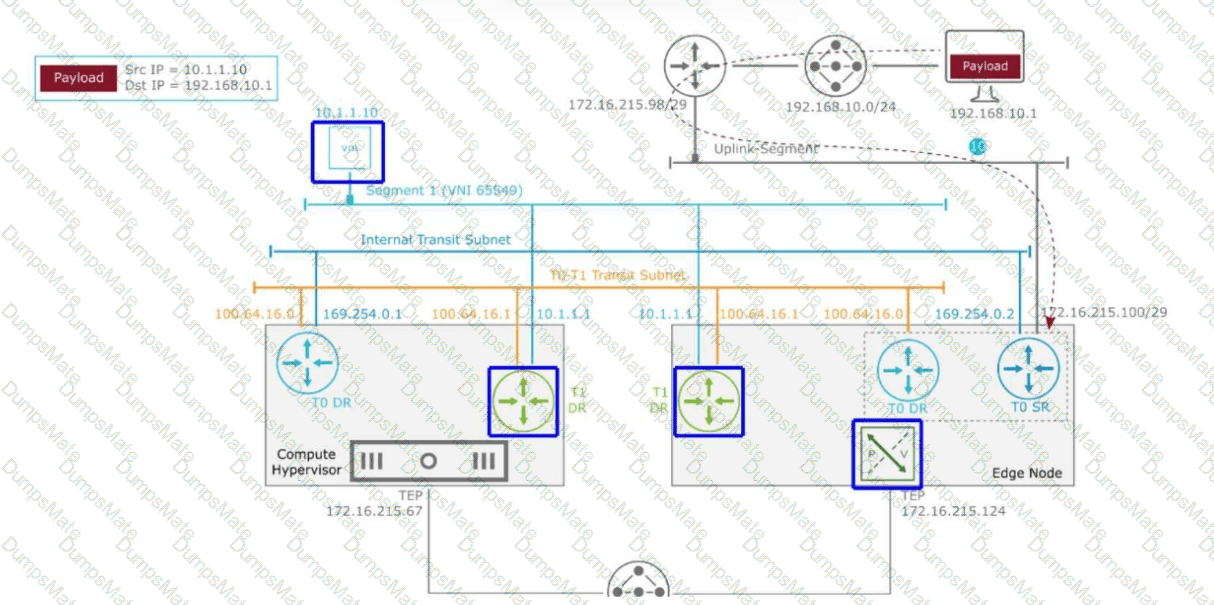
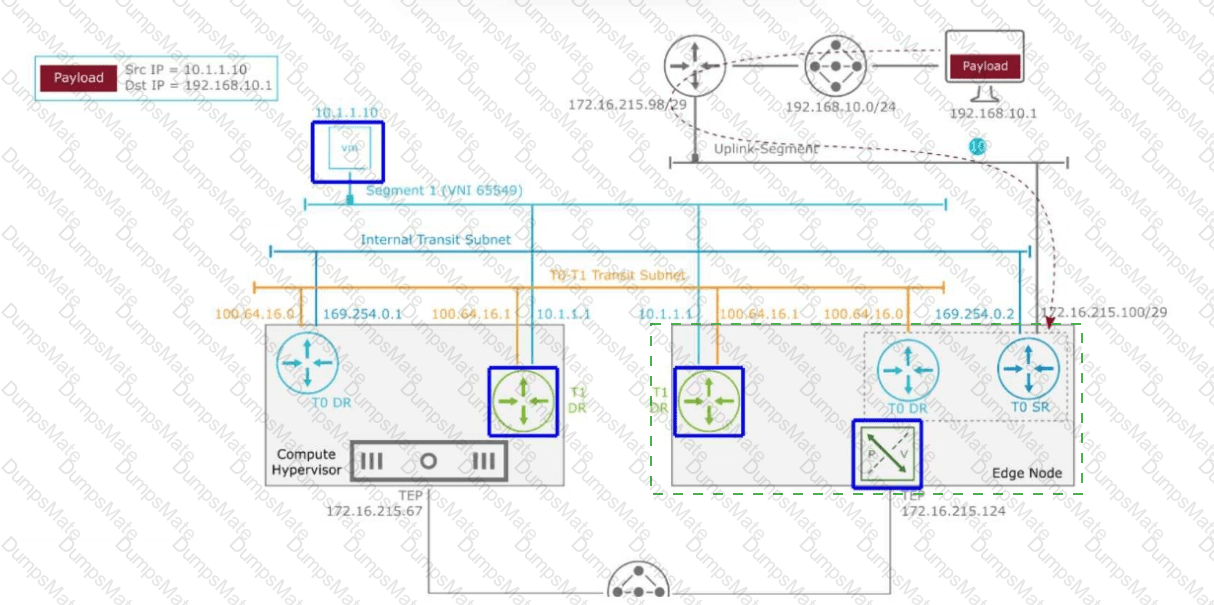
An administrator is troubleshooting the packet flow of an incoming response to an ICMP Reply payload destined for 10.1.1.10 in the diagram.

The packet arrived at the Tier-0 SR at 172.16.215.100/29.

Which highlighted location identifies the next hop in the path to the destination?

3V0-25.25 Question 16

Options:

Buy Now
Questions 17

How should the Global Managers (GMs) and Local Managers (LMs) be distributed to ensure high availability and optimal performance in a multi-site NSX Federation deployment comprised of three sites? (Choose two.)

Options:

A.

Each NSX site must have its own LM cluster that reports to the GM.

B.

LMs are only needed on the primary site. Secondary sites can manage their local data plane directly via the GM.

C.

LMs should only be deployed as single nodes to reduce overhead.

D.

The GM cluster should be deployed across three sites.

E.

The GM should be a single appliance placed in a central cloud environment to simplify connectivity, relying on vSphere HA for availability.

Buy Now
Questions 18

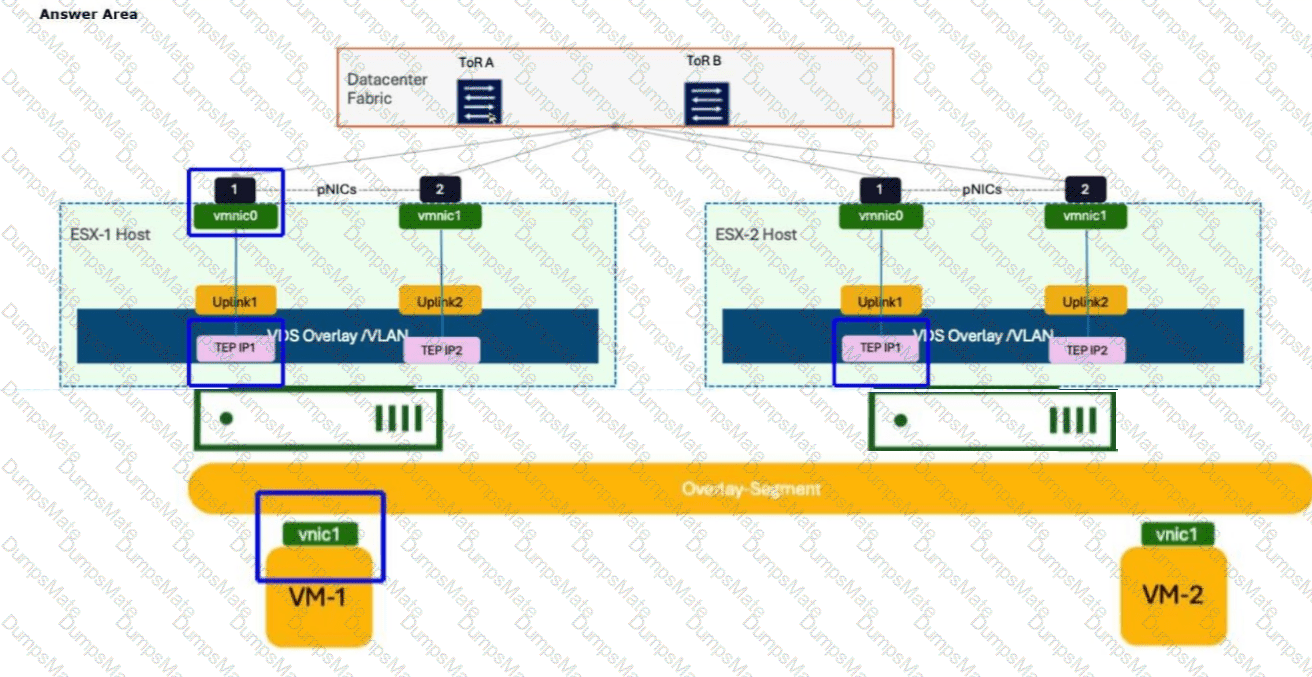
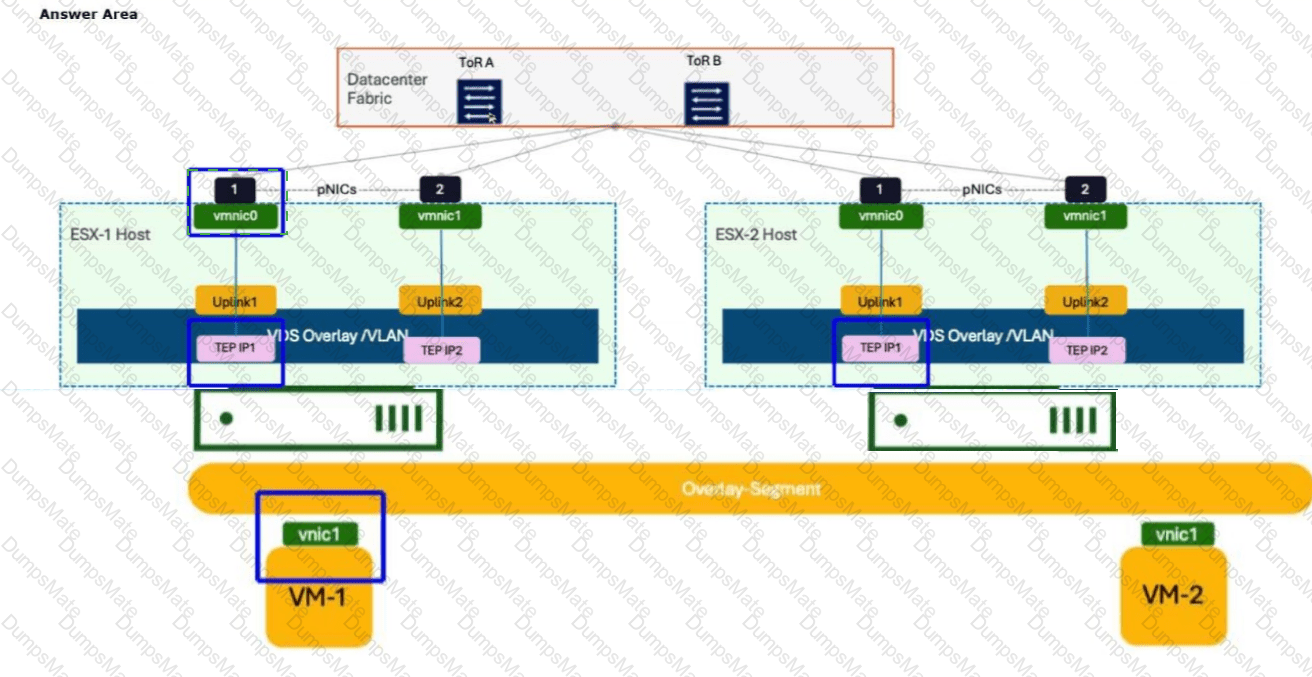
The administrator is working to ascertain the encapsulation of GENEVE by reviewing the capture on Wireshark.

The administrator instructed VM-1 to send a continuous ICMP request directed at VM-2.

Click to highlight where the administrator should observe the GENEVE encapsulated packet.

3V0-25.25 Question 18

Options:

Buy Now
Exam Code: 3V0-25.25
Exam Name: Advanced VMware Cloud Foundation 9.0 Networking
Last Update: Feb 3, 2026
Questions: 60

PDF + Testing Engine

$57.75  $164.99

Testing Engine

$43.75  $124.99
buy now 3V0-25.25 testing engine

PDF (Q&A)

$36.75  $104.99
buy now 3V0-25.25 pdf
dumpsmate guaranteed to pass

24/7 Customer Support

DumpsMate's team of experts is always available to respond your queries on exam preparation. Get professional answers on any topic of the certification syllabus. Our experts will thoroughly satisfy you.

Site Secure

mcafee secure

TESTED 03 Feb 2026