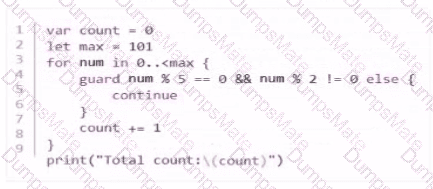
This question belongs to Swift Programming Language , especially the domains covering control flow , loops , logical operators , and guard . The loop runs through 0.. < max, and since max = 101, the values of num are 0 through 100. Inside the loop, the guard statement keeps only values that satisfy both conditions:
num % 5 == 0 → the number must be divisible by 5
num % 2 != 0 → the number must be odd
So the code counts numbers from 0 to 100 that are odd multiples of 5 . Those values are:
5, 15, 25, 35, 45, 55, 65, 75, 85, 95
That gives a total of 10 numbers. Therefore count becomes 10, and the printed output is:
Total count: 10
The key Swift concept here is that guard ... else { continue } skips any loop iteration that does not meet the required condition. Only matching values reach count += 1. This is a standard use of guard for early exit and of the remainder operator % for divisibility checks. Therefore, the correct answer is B .