Weekend Sale Special - 75% Discount Offer - Ends in 0d 00h 00m 00s - Coupon code: 75only

CCAR-P Claude Certified Architect - Professional Questions and Answers

Questions 4

You are building an ethics-review checklist for deployments supported by artificial intelligence.

Which two checks belong on the list? (Select two.)

Each correct answer presents a complete solution.

Options:

A.

Confirm that vendor licensing terms permit the planned production use of the model.

B.

Verify that outputs do not rely on generalizations about people that the underlying data does not support.

C.

Confirm that high-impact decisions retain human accountability rather than being attributed to the model.

D.

Restrict ethics review to outputs that exceed a defined model-confidence threshold.

E.

Confirm that latency and throughput targets are met across supported user populations.

Buy Now
Questions 5

You are comparing patterns for a batch document-classification job that follows fixed steps: extract metadata, classify, summarize, and persist.

Which pattern is the best fit and why?

Options:

A.

A workflow pattern, because agentic patterns do not support tool invocations and therefore cannot execute the persist step that writes results to the downstream store.

B.

An agentic pattern, because the open-ended planning capability of agents produces more consistent structured outputs than a fixed workflow graph on classification tasks.

C.

An agentic pattern, because agents are categorically more accurate than workflows and therefore always preferable regardless of step predictability.

D.

A workflow pattern, because the steps are well-defined and predictable per-request token cost is preferred over flexibility.

Buy Now
Questions 6

You are listing characteristics of robust guardrail design for an enterprise deployment.

Which two characteristics belong on the list? (Select two.)

Each correct answer presents a complete solution.

Options:

A.

Centralized log retention for guardrail violations with quarterly review by the security team.

B.

Per-role tool allow-lists enforced at the orchestration layer before any tool call executes.

C.

User feedback channels that route reported guardrail failures into the product backlog for triage.

D.

Periodic refresh of the system prompt wording to keep refusal language current and clear.

E.

Adversarial-input coverage in the evaluation set with regression tracking on guardrail performance.

Buy Now
Questions 7

You are integrating Claude Code into the team’s pull-request workflow. The team wants AI-assisted review without removing human approval.

Which integration design best fits this requirement?

Options:

A.

Claude Code reviews the pull request and posts a structured analysis as a comment, while a human reviewer retains the approval decision under the existing branch-protection rules.

B.

Claude Code merges every pull request automatically after completing its analysis, bypassing human approval and the existing branch-protection rules.

C.

Claude Code disables all existing branch-protection rules to streamline the merge process, removing human approval as a required gate.

D.

Claude Code silently deletes pull requests it assesses as low quality without posting a comment or notifying the author.

Buy Now
Questions 8

You are explaining the precedence of Claude Code configuration scopes to the team.

Which precedence ordering, from highest to lowest, is correct?

Options:

A.

Local → managed → user → command-line arguments → project

B.

Project → user → managed → local → command-line arguments

C.

Managed → command-line arguments → local → project → user

D.

User → project → local → command-line arguments → managed

Buy Now
Questions 9

You are supporting a team whose Claude Code sessions consistently load 60 or more MCP tools from many servers, exhausting context budget before the session begins.

Which adjustment most directly addresses this issue without removing capability?

Options:

A.

Enable Tool Search so tool definitions are deferred and discovered on demand rather than loaded into context upfront.

B.

Disable every MCP server in the configuration to free up context budget, accepting that the team loses all tool access and cannot perform any MCP-dependent task in the session.

C.

Increase the prompt’s verbosity with additional instructions and context, which consumes more of the context budget rather than reducing the tool-definition overhead causing the issue.

D.

Add additional MCP servers to give the team more capability, which increases rather than reduces the number of tool definitions loaded into the session’s context budget.

Buy Now
Questions 10

You are configuring tool permissions for a Claude-based assistant. The assistant’s defined responsibilities require read access to a knowledge base and write access to a draft queue, and nothing else.

Which scoping design best applies least privilege?

Options:

A.

Allow access to all tools with read permissions globally and restrict write permissions to the draft-queue tool, without scoping to only the specific tools required for defined tasks.

B.

Per-role allow-list of exactly the read-knowledge-base and write-draft-queue tools, enforced at the orchestration layer.

C.

Allow access to every tool in the catalog and rely on the model to decline tools it should not use.

D.

Disable all tools entirely to achieve a minimal permission surface, accepting that the assistant can no longer perform the read-knowledge-base or write-draft-queue tasks it was designed for.

Buy Now
Questions 11

You are diagnosing a Claude Code session whose subagent uses 50,000 tokens of context before the engineer types a single message.

Which root cause is most likely?

Options:

A.

The developer's keyboard layout or input-method configuration is the cause of the elevated context consumption, introducing extra tokens before the engineer types any message.

B.

Many MCP servers are configured, each contributing tool definitions to the context budget; Tool Search is not enabled, so all definitions load upfront.

C.

The model has internal personal preferences or default behaviors that silently consume large portions of context budget before any user message is processed, independent of tool configuration.

D.

The font rendering or display-scaling settings of the IDE are converting visual output into additional context tokens, causing the high pre-session context consumption.

Buy Now
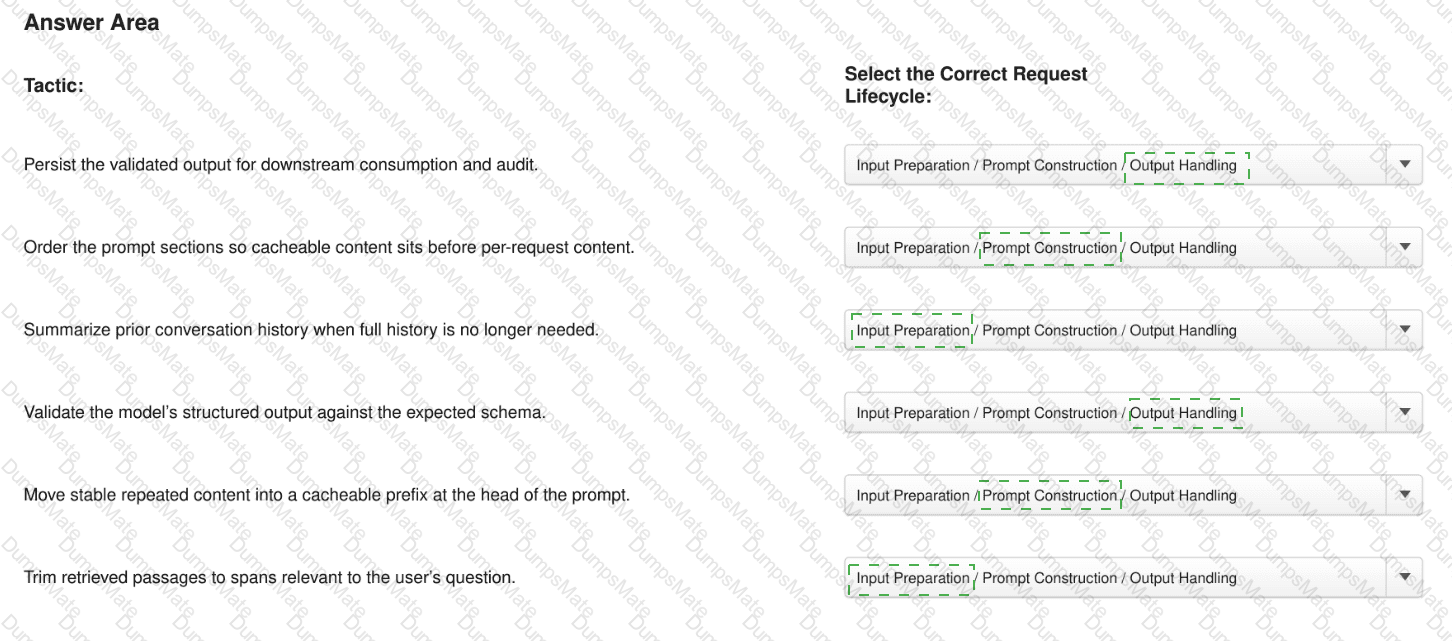
Questions 12

You are identifying the highest-impact optimization for a deployment whose token cost is dominated by a long, repeated system prompt and a large retrieved context per request.

Which optimization most directly targets the dominant cost driver?

Options:

A.

Increase retrieval depth on every request to maximize recall, worsening the dominant cost driver by adding more retrieved tokens per request rather than reducing them.

B.

Add additional repeated content to the system prompt to give the model more guidance.

C.

Move the long, repeated system prompt into a cacheable prefix and trim retrieved context to the spans relevant to each query.

D.

Switch every request to the heaviest available model to maximize output quality, accepting that higher per-request inference cost compounds rather than addresses the dominant cost driver.

Buy Now
Questions 13

The platform team at Trenova Systems, Inc. needs to reduce per-query cost and p95 latency for a high-volume Claude pipeline without degrading output quality on the core use case.

Which two optimizations directly target both cost and latency simultaneously? (Select two.)

Options:

A.

Enable prompt caching on the static system-prompt prefix to reduce billable input tokens on repeated calls.

B.

Route straightforward query types to a smaller, faster Claude model and reserve the full model for complex cases.

C.

Increase max_tokens to reduce the frequency of truncated responses requiring follow-up calls.

D.

Add a retrieval step that fetches the full source corpus into the context window before generation.

E.

Expand the system prompt to include additional few-shot examples on every request.

Buy Now
Questions 14

You must present an architectural recommendation to deploy a Claude-based contract review assistant to a steering committee that includes the CFO, the general counsel, and the CIO. Each stakeholder cares about different aspects of the decision.

How should you structure the recommendation document?

Options:

A.

Lead with the technical architecture diagram and the full component list before any other section.

B.

Lead with detailed cost projections across the full multi-year horizon before the rationale section.

C.

Present the same dense narrative throughout with no stakeholder differentiation in any section.

D.

Lead with the architectural decision, then address each stakeholder’s primary concerns directly.

Buy Now
Questions 15

You are operating an interactive assistant whose dominant performance constraint is per-turn latency. Quality on routine turns is already acceptable.

Which configuration adjustment most directly improves latency without disproportionately damaging quality?

Options:

A.

Disable prompt caching entirely to ensure fresh context processing on every request, preventing stale prefix content from affecting latency-sensitive interactions.

B.

Reduce retrieval depth to the top-k passages that historically cover the answer, and cache stable system-prompt content.

C.

Increase retrieval depth to the corpus maximum to improve recall regardless of latency.

D.

Switch every turn to the heaviest available model to maximize output quality, accepting that the increased model latency will worsen the per-turn SLO rather than improve it.

Buy Now
Questions 16

You are evaluating an evaluation set used to score a Claude-based hiring-support tool. The set is drawn from one geographic region and one tenure band.

Which response is most appropriate?

Options:

A.

Discard all quantitative evaluation and replace it with qualitative impressions collected from a small, convenience-selected group that may not represent the tool’s full user population.

B.

Expand the evaluation set to cover the geographic regions and tenure bands the tool will serve, and rescore the system on the expanded set before broader release.

C.

Reduce the evaluation set further to a single demographic subgroup to simplify score interpretation, narrowing coverage rather than expanding it to match the intended user population.

D.

Continue using the narrow evaluation set drawn from one region and one tenure band because the existing benchmark scores are already high on that subset.

Buy Now
Questions 17

You are reviewing a peer’s draft system prompt that contains contradictory instructions: one section says never to speculate beyond the supplied source, while another says to confidently fill in any gaps.

Which response is most appropriate?

Options:

A.

Add a priority instruction directing the model to evaluate all instructions and apply whichever appears most contextually appropriate on each request.

B.

Remove or rewrite the gap-filling instruction so the prompt consistently constrains the model to source-supported content.

C.

Increase temperature so output randomness masks the contradiction.

D.

Keep both instructions and rely on the model to decide which one to follow on each request.

Buy Now
Questions 18

You are a platform architect designing an internal Claude-based assistant that serves both finance analysts and external auditors. Each population must access only documents permitted by its role.

Where should role-based access control be enforced in the pipeline?

Options:

A.

Inside the system prompt as a natural-language instruction for Claude to ignore unauthorized documents.

B.

At the retrieval layer, before any role-restricted content reaches the prompt-construction step or the model.

C.

Nowhere in the pipeline; rely on the model’s general refusal behavior to reject unauthorized document access without any enforced access control.

D.

After the response is generated, by post-filtering content that should not have been retrieved.

Buy Now
Questions 19

A Claude architect at a health services organization is defining evaluation metrics for a clinical-summary pipeline. The pipeline must remain within a per-query cost ceiling and must never surface patient data to unauthorized roles.

Which two metrics directly address these requirements? (Select two.)

Options:

A.

BLEU score computed against a human-annotated reference summary set

B.

Role-based access-control enforcement rate measured on a red-team dataset

C.

Throughput measured as successful requests processed per minute

D.

Per-query token cost measured against the defined cost ceiling

E.

Response latency at the 95th percentile across a one-week sample window

Buy Now
Questions 20

You are designing a content moderation classifier that processes high volumes of user-generated comments under a tight per-message latency budget using well-defined classification labels.

Which model selection best aligns with the workload?

Options:

A.

Opus, because every moderation decision requires maximum reasoning depth regardless of classification complexity.

B.

Haiku, because its latency and cost profile align with high-volume classification workloads that require limited reasoning depth.

C.

Sonnet, because larger general-purpose models are preferred even when workload latency requirements are strict.

D.

Sonnet with extended thinking enabled, because deeper reasoning should be applied to every moderation request to improve edge-case handling.

Buy Now
Questions 21

A Claude architect is designing a HIPAA-compliant pipeline that processes patient records.

Which two design decisions directly support HIPAA compliance requirements? (Select two.)

Options:

A.

Setting max_tokens to a low value to minimize the volume of text generated per request.

B.

Selecting the highest-capability Claude model to maximize diagnostic accuracy.

C.

Enforcing role-based access controls so that PHI is retrievable only by authorized personnel.

D.

Ensuring patient data is never included in training feedback loops sent to the model provider without a BAA in place.

E.

Using streaming responses to reduce perceived latency for clinical users.

Buy Now
Questions 22

You are preparing an operational runbook for a Claude-based service.

Which content is essential to include in the runbook?

Options:

A.

Dashboard and log references only, without alert definitions, triage steps, escalation paths, or rollback procedures for the on-call engineer to act on.

B.

Common alerts and their triage steps, escalation paths, rollback procedures, and references to the relevant dashboards and logs.

C.

Alert definitions and triage steps only, without escalation paths, rollback procedures, or references to dashboards and logs for on-call use.

D.

Escalation paths and rollback procedures only, without alert definitions, triage steps, or dashboard references to guide initial incident response.

Buy Now
Questions 23

You are a solution architect designing a Claude-based assistant with access to 60 internal tools across multiple business domains. Loading every tool definition on every request increases token usage and time to first response.

Which design pattern best addresses this issue without sacrificing capability breadth?

Options:

A.

Apply progressive tool discovery so a curated initial subset is exposed and additional tools are loaded on demand based on the task.

B.

Use a separate model call to summarize all 60 tool definitions before each user turn.

C.

Increase the maximum context length and load all 60 tool definitions on every request, accepting the higher token cost and latency as necessary for full capability.

D.

Hard-code a fixed set of five tools per request to reduce token usage, regardless of whether those tools are relevant to the current task.

Buy Now
Questions 24

You are supporting an EU-based deployment with GDPR obligations.

Which combination of measures best supports the deployment’s GDPR posture?

Options:

A.

enterprise-tier deployment with a signed Data Processing Addendum, defined data-retention configuration, redaction of personal data not needed for the task, and documented data-subject-rights handling

B.

disabling all data-retention configuration, redaction controls, and data-subject-rights handling to simplify day-to-day operations, accepting the resulting GDPR compliance exposure

C.

using a personal Claude account tier for processing EU personal data at scale, with no signed Data Processing Addendum and no documented data-subject-rights handling procedure

D.

pasting full EU personal data into every prompt to “give Claude complete context” without considering purpose limitation, data minimization, or the organization’s Data Processing Addendum obligations

Buy Now
Questions 25

Engineering leadership wants to roll out Claude Skills to 280 developers across 14 teams. Skills will encode internal coding standards, code-review checklists, and incident-postmortem templates. Leadership has asked how to govern Skill authorship so that Skills remain trustworthy without bottlenecking on a single central team.

Which governance model should you recommend?

Options:

A.

Per-developer authorship across the 280 engineers with no team-level coordination required.

B.

Centralized authorship by a single platform team responsible for every Skill produced.

C.

Fully decentralized authorship across the 14 teams with no review before publication.

D.

Federated authorship across the 14 teams with a central review and publication gate.

Buy Now
Questions 26

You are building a feedback-and-alignment routine for a multi-stakeholder deployment.

Which two practices belong in the routine? (Select two.)

Each correct answer presents a complete solution.

Options:

A.

Record each session and distribute the recording to stakeholders who could not attend live.

B.

Escalate any disagreement among stakeholders to the executive sponsor for binding resolution.

C.

Rotate facilitation among the participating stakeholder groups to share ownership of the routine.

D.

Set a regular cadence for revisiting expectations and assumptions as conditions evolve over time.

E.

Reconcile divergent stakeholder positions explicitly rather than papering over them in the moment.

Buy Now
Questions 27

A Claude architect observes that after a recent model-version upgrade, grounded responses began including claims not supported by the retrieved source documents.

Which mitigation is most directly targeted at this failure mode?

Options:

A.

Constrain responses to source-supported content, require citations, and add a verification step.

B.

Score each new model version against a stable adversarial evaluation set.

C.

Replace the shared API key with per-user OAuth tokens to restrict data access.

D.

Treat retrieved data as untrusted and apply input classifiers at ingestion time.

Buy Now
Questions 28

You are compiling a diagnostic toolkit for Claude Code operational issues.

Which two diagnostic actions belong in the toolkit? (Select two.)

Each correct answer presents a complete solution.

Options:

A.

Increase the model sampling temperature so that intermittent issues surface more frequently for analysis.

B.

File a support ticket with vendor support before any local reproduction or evidence collection.

C.

Reproduce the issue with a minimal reproduction case that isolates one variable at a time.

D.

Roll back to the previous Claude Code version immediately to confirm whether the issue is version specific.

E.

List the configured Model Context Protocol (MCP) servers and inspect server status to identify connection failures.

Buy Now
Questions 29

You are a solution architect designing a Claude-based assistant with access to 60 internal tools across multiple business domains. Loading every tool definition on every request increases token usage and time to first response.

Which design pattern best addresses this issue without sacrificing capability breadth?

Options:

A.

Apply progressive tool discovery so a curated initial subset is exposed and additional tools are loaded on demand based on the task.

B.

Use a separate model call to summarize all 60 tool definitions before each user turn.

C.

Increase the maximum context length and load all 60 tool definitions on every request, accepting the higher token cost and latency as necessary for full capability.

D.

Hard-code a fixed set of five tools per request to reduce token usage, regardless of whether those tools are relevant to the current task.

Buy Now
Questions 30

A pilot AI assistant for procurement specialists shows 89 percent first-response acceptance, but follow-up surveys reveal that specialists frequently override the assistant’s vendor recommendations after considering criteria the assistant did not evaluate. The pilot owner wants to ship the assistant unchanged because of the strong acceptance rate.

Which two Discernment-competency observations should you raise BEFORE approving the launch? (Select two.)

Options:

A.

The acceptance rate alone proves readiness for general production use.

B.

The survey response rate may not be statistically representative of all specialists.

C.

The unconsidered criteria represent a scope gap in the assistant’s input space.

D.

Acceptance does not establish whether recommendations remain correct after specialist review.

E.

The pilot duration was probably too short to demonstrate reliability across the full year.

Buy Now
Questions 31

A Claude architect needs to ensure that a security-hardening flag cannot be disabled by any individual engineer after it is set.

Which configuration scope correctly enforces this requirement?

Options:

A.

User scope (~/.claude/settings.json) on each engineer’s machine

B.

Environment variable defined in the CI/CD pipeline only

C.

Managed configuration applied centrally and marked as non-overridable

D.

Project scope (.claude/settings.json) committed to the repository

Buy Now
Questions 32

You are building an evaluation pipeline for a Claude-based deployment and must complete the specification steps before running the deployment against the dataset.

Which two steps must be completed BEFORE running the deployment against the evaluation dataset? (Select two.)

Each correct answer presents part of the solution.

Options:

A.

Publish the aggregated metrics to a dashboard and gate releases on threshold checks.

B.

Curate and label the evaluation dataset to match the defined slices.

C.

Review failure cases with subject matter experts to refine the scoring rubric.

D.

Define the metrics and slices the framework will report across representative, edge, and adversarial cases.

E.

Score the deployment outputs against the reference labels and aggregate the metrics.

Buy Now
Questions 33

A security audit uncovers two issues: (1) all end users share a single API key, and (2) tool calls are executed without logging the initiating user.

Which two mitigations directly address these specific findings? (Select two.)

Options:

A.

Validate structured outputs against a schema before downstream actions are executed.

B.

Enforce RBAC at the retrieval layer before content enters the model context.

C.

Move credentials out of the prompt context and resolve them from a server-side secret store.

D.

Add actor attribution to tool-call logs so each call records the initiating user identity.

E.

Replace the shared API key with per-user OAuth tokens carrying scope-restricted permissions.

Buy Now
Questions 34

You are reviewing a peer’s Claude Code permission rules for an enterprise rollout. The rules grant unrestricted Bash access to all projects across all developers.

Which response is most appropriate?

Options:

A.

Add unrestricted access to additional tool categories as well, so that Bash is not asymmetrically more permissive than other tools, expanding the attack surface further in the name of consistency.

B.

Approve the unrestricted Bash access as written on the grounds that narrowing the rules would add configuration complexity, accepting the full attack surface for all engineers across all projects.

C.

Replace unrestricted Bash with narrowly scoped tool patterns that allow only the specific commands the workflows require, and add explicit deny rules for sensitive operations.

D.

Disable all permission rules for the enterprise rollout so every command across every project runs without any tool-pattern scoping or explicit deny rules for sensitive operations.

Buy Now
Exam Code: CCAR-P
Exam Name: Claude Certified Architect - Professional
Last Update: Aug 22, 2026
Questions: 114

PDF + Testing Engine

$41.25  $164.99

Testing Engine

$31.25  $124.99
buy now CCAR-P testing engine

PDF (Q&A)

$26.25  $104.99
buy now CCAR-P pdf
dumpsmate guaranteed to pass

24/7 Customer Support

DumpsMate's team of experts is always available to respond your queries on exam preparation. Get professional answers on any topic of the certification syllabus. Our experts will thoroughly satisfy you.

Site Secure

mcafee secure

TESTED 23 Aug 2026