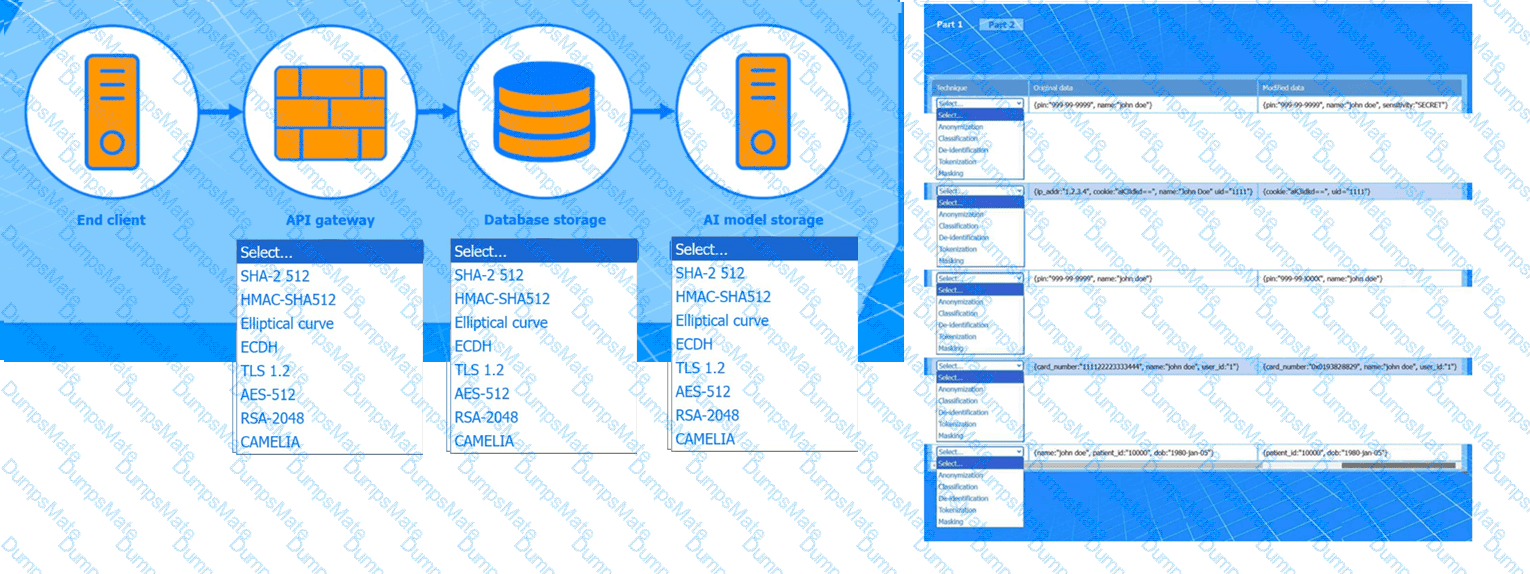
Part 1 — Select the protocol or cipher
System component
Select
API gateway
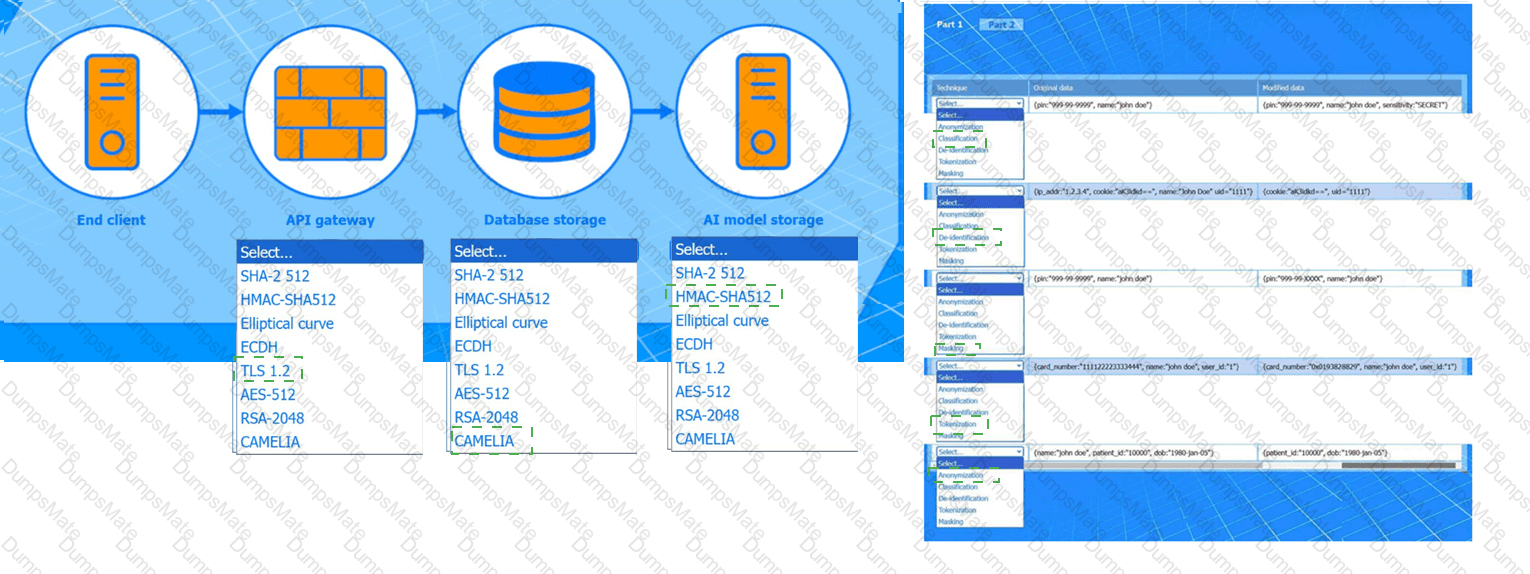
TLS 1.2
Database storage
CAMELLIA
AI model storage
HMAC-SHA512
Part 2 — Select the data-protection technique
Enter the techniques from the first row to the fifth row in this exact order:
Row Data modification Select
1 The name field is removed, while patient_id and dob remain De-identification
2 ip_addr and name are removed, leaving cookie and uid Anonymization
3 The card number is replaced by 0x0193828829 Tokenization
4 sensitivity: " SECRET " is added Classification
5 Part of the PIN is replaced by XXXX Masking
See Explanation
Why these are the intended answers
API gateway → TLS 1.2
The API gateway handles data moving between the client and backend systems. TLS is the only listed transport-security protocol and therefore protects the data in transit . OWASP recommends encrypting sensitive data in transit by using TLS with secure parameters.
Database storage → CAMELLIA
CAMELLIA is a symmetric block cipher suitable for encrypting substantial quantities of stored data. It is therefore the valid storage-encryption choice among the listed options.
Do not select AES-512 . AES-512 is not a standardized AES variant. NIST defines only AES-128, AES-192, and AES-256 .
AI model storage → HMAC-SHA512
The scenario separately emphasizes protection against loss or modification of intellectual property. HMAC-SHA512 supplies message authentication and integrity verification, allowing unauthorized modification of the AI model to be detected. HMAC is not confidentiality encryption, but it is the most appropriate listed additional control for protecting model integrity. OWASP specifically identifies HMACs as cryptographic controls for stored-data integrity.
Why the other options are not selected
Elliptical curve: A family of cryptographic techniques, not a specific storage or transport protocol.
ECDH: Used for key agreement, not direct bulk-data encryption.
AES-512: Invalid AES key size.
RSA-2048: Primarily used for asymmetric encryption, signatures, or key transport; inefficient for bulk database or model encryption.
CAMELLIA: Appropriate symmetric encryption for stored data.
HMAC-SHA512: Integrity and authenticity, not confidentiality.
Final Part 2 order
Anonymization
Tokenization
Classification
Masking
Explanation
De-identification removes an explicitly identifying field—in this case, the person’s name—while retaining other fields needed for processing. The remaining patient ID and date of birth could potentially permit re-identification when combined with other information, so this is de-identification rather than complete anonymization. OWASP describes de-identification as deleting, scrambling, or pseudonymizing direct and indirect identifiers.
Anonymization removes identifying attributes so that the displayed record is not directly tied to the named individual. Here, both the name and IP address are removed.
Tokenization substitutes a sensitive value with a non-sensitive representative token. The original payment-card number is replaced with the hexadecimal-style value 0x0193828829. OWASP recognizes tokenization as a method for reducing exposure of stored sensitive data.
Classification labels information according to sensitivity. Adding sensitivity: " SECRET " does not conceal or transform the PIN; it categorizes the record so appropriate controls can be applied. OWASP recommends classifying processed, stored, and transmitted data and applying controls based on that classification.
Masking obscures only part of a sensitive value while preserving its general format. Changing 999-99-9999 to 999-99-XXXX is partial masking.