Big Cyber Monday Sale - 70% Discount Offer - Ends in 0d 00h 00m 00s - Coupon code: dm70dm

EFM Certified - Electronic Fetal Monitoring Questions and Answers

Questions 4

Maternal-fetal oxygen transfer takes place in the:

Options:

A.

Intervillous space

B.

Spiral arteries

C.

Umbilical vein

Buy Now
Questions 5

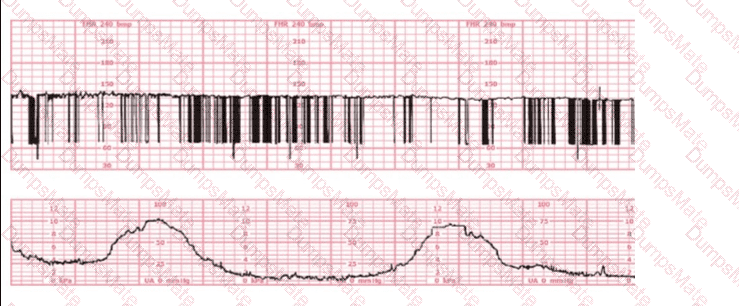
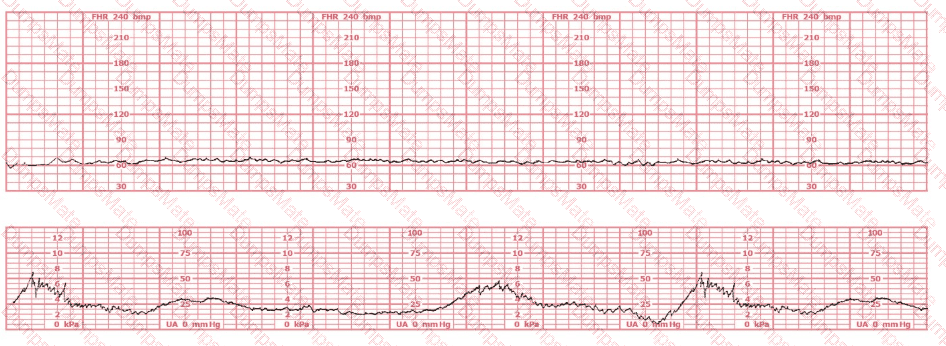
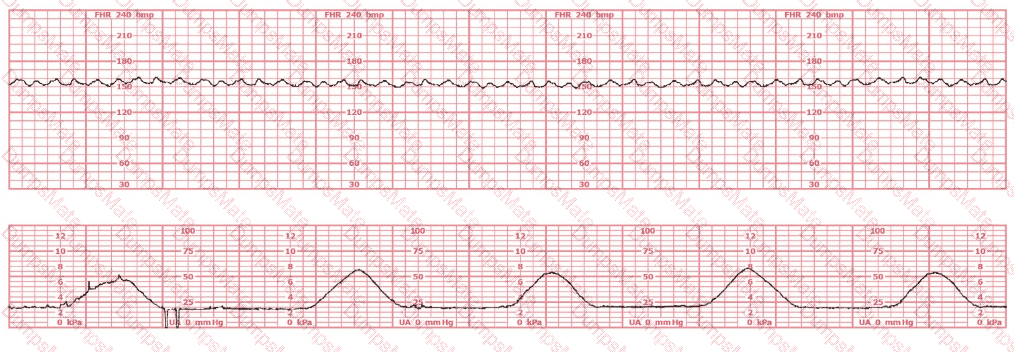
This fetal heart rate tracing is obtained upon the woman's admission to labor and delivery. This tracing is most reflective of:

EFM Question 5

Options:

A.

Atrial flutter

B.

Complete heart block

C.

Fetal dysrhythmia

Buy Now
Questions 6

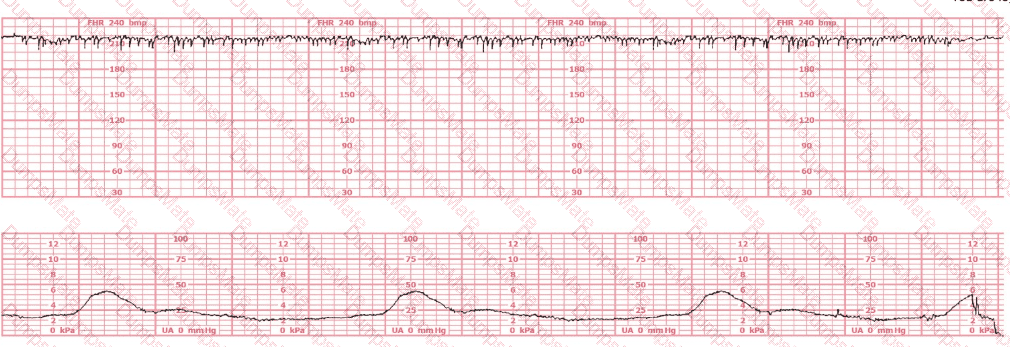
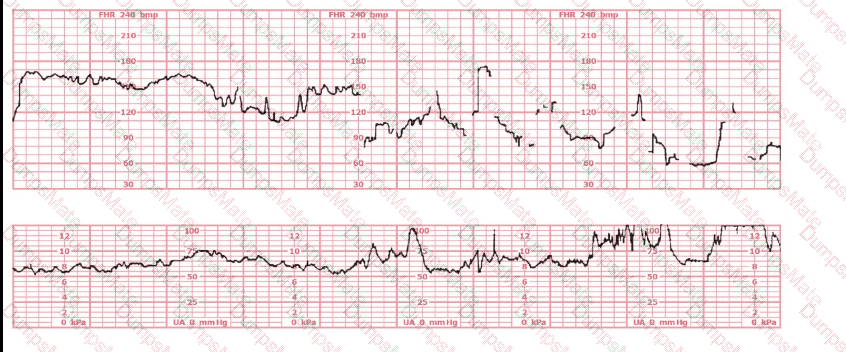
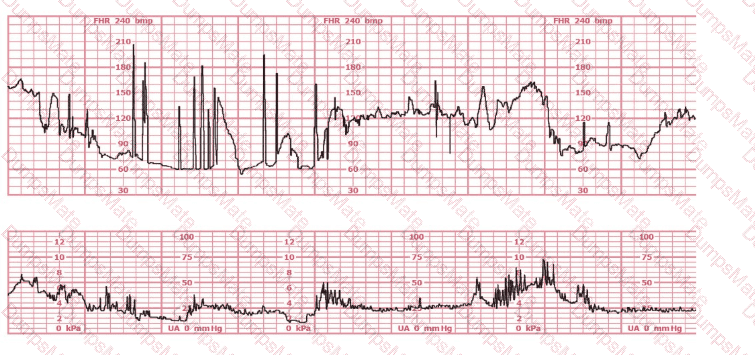
The fetal heart rate tracing shown is consistent with

EFM Question 6

Options:

A.

artifact

B.

half counting

C.

supraventricular tachycardia

Buy Now
Questions 7

An electronic fetal monitoring factor that best correlates with fetal well-being is:

Options:

A.

Absence of decelerations

B.

Baseline heart rate 140–150 bpm

C.

Presence of variability

Buy Now
Questions 8

When the fetal heart rate is measured by a Doppler transducer and the intervals between heart beats are persistently identical, this shows as

Options:

A.

absent variability

B.

bradycardia

C.

normal baseline

Buy Now
Questions 9

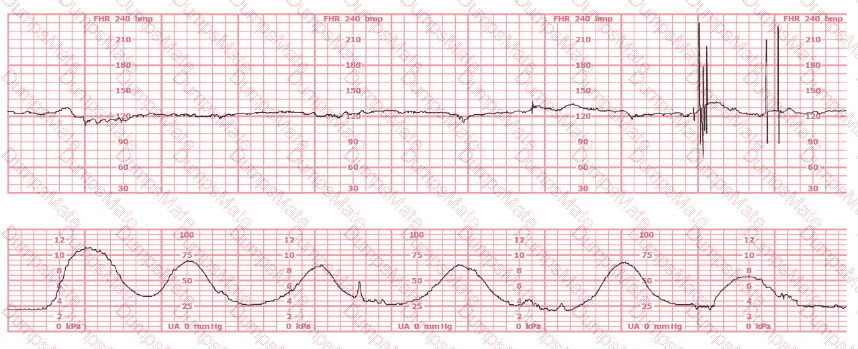
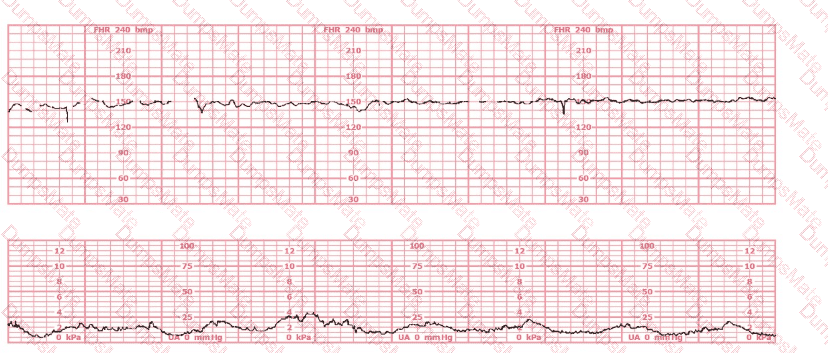
A woman at 41-weeks gestation is being induced. She is 2 cm dilated and is on oxytocin at 8 milliunits/minute. Based on the fetal heart rate tracing shown, the best initial response is to:

EFM Question 9

Options:

A.

Continue to observe

B.

Decrease the oxytocin

C.

Place a fetal spiral electrode

Buy Now
Questions 10

Prenatal diagnosis shows that a fetus has renal agenesis. During delivery, what type of electronic fetal heart rate pattern is most likely to be seen due to a common complication associated with this syndrome?

Options:

A.

Fetal heart block

B.

Late decelerations

C.

Variable decelerations

Buy Now
Questions 11

(Full question)

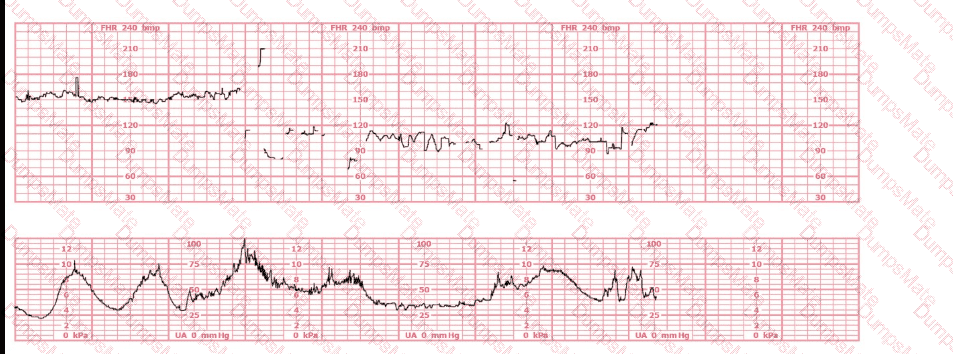
This tracing would be categorized as a

EFM Question 11

Options:

A.

Category I

B.

Category II

C.

Category III

Buy Now
Questions 12

(Full question statement)

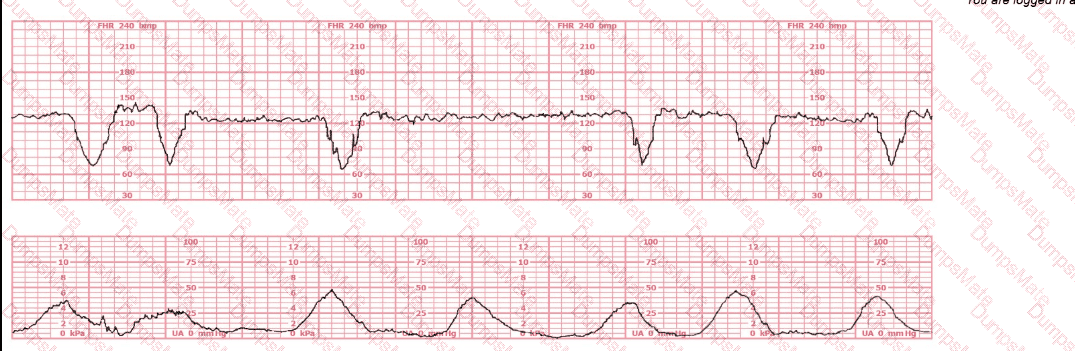
The fetal heart rate tracing shown is obtained upon the woman's admission to labor and delivery. This tracing is most consistent with what maternal condition?

EFM Question 12

Options:

A.

Eisenmenger's syndrome

B.

Sickle cell anemia

C.

Systemic lupus erythematosus

Buy Now
Questions 13

A 30-minute tracing with moderate variability, accelerations, and one variable deceleration would be classified as:

Options:

A.

Category I

B.

Category II

C.

Category III

Buy Now
Questions 14

When monitoring monochorionic-monoamniotic twins, which of the following fetal heart rate patterns would be anticipated?

Options:

A.

Baseline tachycardia

B.

Minimal variability

C.

Variable decelerations

Buy Now
Questions 15

In documenting auscultation of the fetal heart rate, it is important to record findings in relationship to:

Options:

A.

Fetal position

B.

Stage of labor

C.

Uterine activity

Buy Now
Questions 16

The fetal heart rate baseline is

Options:

A.

documented in a 15 beats per minute range

B.

established between periodic and episodic changes

C.

normally between 110 and 170 beats per minute

Buy Now
Questions 17

(Full question)

Spontaneous fetal heart rate accelerations indicate

Options:

A.

dominance of the fetal sympathetic nervous system

B.

immaturity of the fetal parasympathetic nervous system

C.

integrated response of the fetal central nervous system

Buy Now
Questions 18

Amnioinfusion can cause what changes in the fetal heart rate tracing?

Options:

A.

Improvement in fetal heart rate variability

B.

Increase in fetal heart rate baseline

C.

Resolution of variable decelerations

Buy Now
Questions 19

Fetal respiratory acidosis is most likely to present with which of the following fetal heart rate decelerations?

Options:

A.

Early

B.

Late

C.

Variable

Buy Now
Questions 20

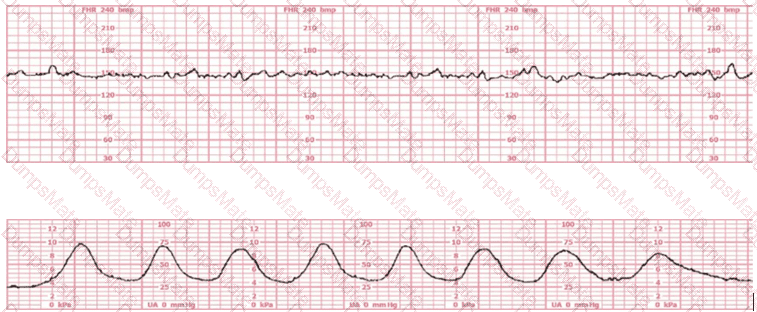
This is a fetal heart rate tracing of a multiparous woman whose cervix is 7 cm dilated on admission. The most likely cause for this pattern is:

EFM Question 20

Options:

A.

Placental abruption

B.

Rapid fetal descent

C.

Tachysystole

Buy Now
Questions 21

The most highly oxygenated blood in the fetal circulation is found in the

Options:

A.

descending aorta

B.

ductus venosus

C.

pulmonary arteries

Buy Now
Questions 22

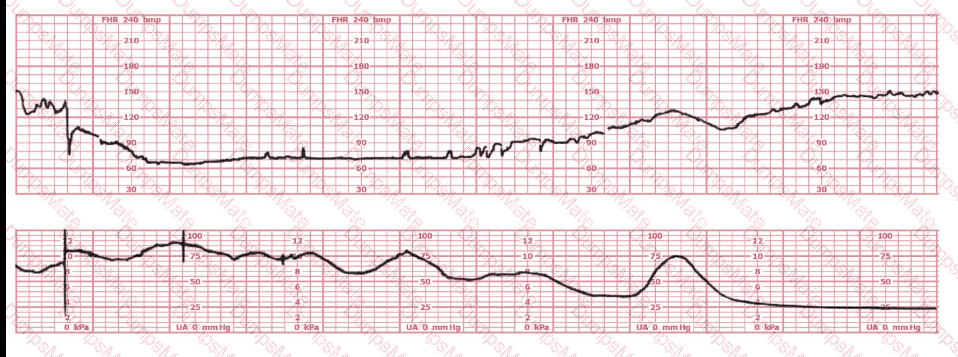
This tracing has lasted for 20 minutes in a woman who is 6 cm dilated. The most appropriate intervention is:

EFM Question 22

Options:

A.

Delivery

B.

Fetal scalp stimulation

C.

Intravenous bolus of D5% Lactated Ringers

Buy Now
Questions 23

A woman with hypertension at 38-weeks gestation has a biophysical profile. The result is 4/10 with decreased amniotic fluid volume. The next step should be to:

Options:

A.

Admit for delivery

B.

Discharge home on bedrest

C.

Repeat the biophysical profile in 24 hours

Buy Now
Questions 24

A woman who is one week past a confirmed due date has serial ultrasounds to determine:

Options:

A.

Amniotic fluid volume

B.

Fetal weight

C.

Placental calcification

Buy Now
Questions 25

The presence of fetal breathing movements on a biophysical profile reflects adequate:

Options:

A.

Neurologic function

B.

Pulmonary vasoconstriction

C.

Surfactant levels

Buy Now
Questions 26

A woman at 39-weeks gestation is in early labor, 2–3 cm dilated, 85% effaced, and –2 station. Based on the fetal heart rate tracing shown, what is the most appropriate first intervention?

EFM Question 26

Options:

A.

Adjust the fetal monitor

B.

Administer an IV fluid bolus

C.

Administer terbutaline

Buy Now
Questions 27

A woman at 38-weeks gestation is admitted to labor and delivery following a fall down the stairs three hours ago. She started feeling contractions in the ambulance. The fetal heart rate tracing shown is on initial evaluation and represents 25 minutes. This tracing is most consistent with a

EFM Question 27

Options:

A.

category I tracing

B.

category II tracing

C.

category III tracing

Buy Now
Questions 28

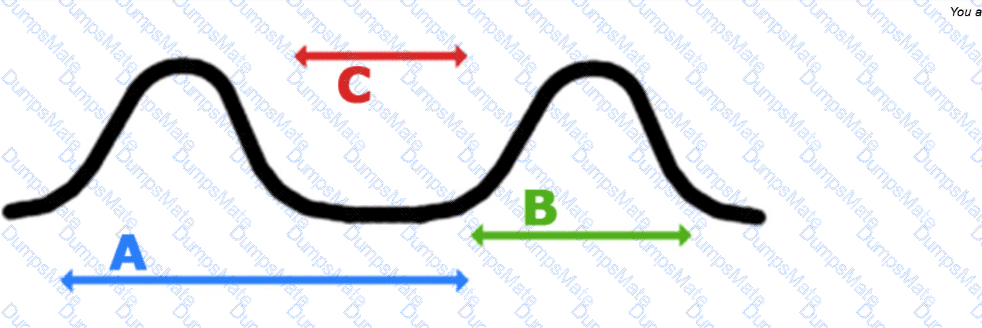
The duration of a contraction is best represented by which colored arrow?

EFM Question 28

Options:

A.

Blue (A)

B.

Green (B)

C.

Red (C)

Buy Now
Questions 29

A patient presents at 38-weeks gestation with complaints of decreased fetal movement and ruptured membranes. The fetal heart rate is not able to be determined with an external ultrasound monitor. A spiral electrode is placed, and the tracing shows a rate of 90 bpm. What is the next most appropriate action?

Options:

A.

Intrauterine resuscitation measures

B.

Palpation of the maternal radial pulse

C.

Request for an urgent bedside ultrasound

Buy Now
Questions 30

Patient safety is enhanced when alarms:

Options:

A.

Are determined by the unit leaders

B.

Can be called by anyone

C.

Occur infrequently

Buy Now
Questions 31

A 20-year-old woman (G1P0) at 40-weeks gestation was admitted for cervical ripening with dinoprostone (Cervidil) four hours ago. She developed the pattern shown one hour ago. She has been changed to a lateral position and given a fluid bolus, and the pattern continues. An appropriate intervention would be to:

EFM Question 31

Options:

A.

Continue to observe

B.

Give 0.25 mg of terbutaline subcutaneously

C.

Remove the dinoprostone (Cervidil) insert

Buy Now
Questions 32

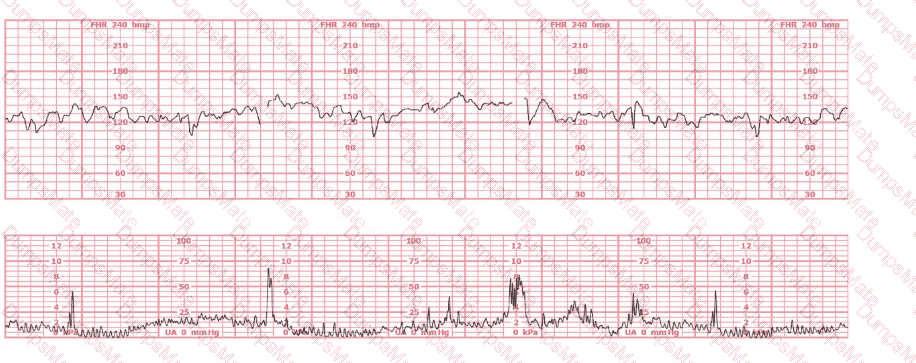
A woman (G1P0) arrives in triage with a pain score of 4/10 at 39-weeks gestation. The fetal heart rate tracing shown is obtained. The best intervention is to:

EFM Question 32

Options:

A.

Adjust tocotransducer and continue to monitor

B.

Admit for induction

C.

Discharge to home

Buy Now
Questions 33

To differentiate a fetal dysrhythmia from artifact, it is important to recognize that artifact appears as deflections that are:

Options:

A.

Similar in pattern

B.

Uniform but occur irregularly

C.

Varied and disorganized

Buy Now
Questions 34

A patient at 41 weeks gestation is being induced. She has progressed slowly and is now at 6 cm, 90% effaced, –1 station. She has the fetal heart tracing shown despite repositioning. The next step in the management of this patient should be to:

EFM Question 34

Options:

A.

Apply a spiral electrode

B.

Decrease the oxytocin

C.

Perform an amnioinfusion

Buy Now
Questions 35

Interventions undertaken to address fetal tachycardia are targeted at maximizing

Options:

A.

maternal circulation

B.

sympathetic autonomic tone

C.

uteroplacental perfusion

Buy Now
Questions 36

This tracing demonstrates:

EFM Question 36

Options:

A.

Bradycardia

B.

Category III tracing

C.

Prolonged deceleration

Buy Now
Questions 37

Fetal cardiac output is essentially dependent on the fetal:

Options:

A.

Activity

B.

Baroreceptors

C.

Heart rate

Buy Now
Exam Code: EFM
Exam Name: Certified - Electronic Fetal Monitoring
Last Update: Dec 4, 2025
Questions: 125

PDF + Testing Engine

$49.5  $164.99

Testing Engine

$37.5  $124.99
buy now EFM testing engine

PDF (Q&A)

$31.5  $104.99
buy now EFM pdf
dumpsmate guaranteed to pass

24/7 Customer Support

DumpsMate's team of experts is always available to respond your queries on exam preparation. Get professional answers on any topic of the certification syllabus. Our experts will thoroughly satisfy you.

Site Secure

mcafee secure

TESTED 04 Dec 2025