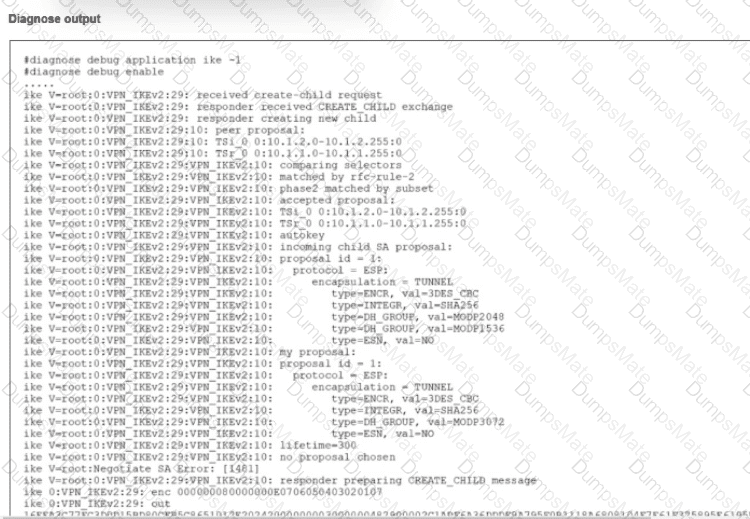
To determine the cause of the failure, we must analyze the IKEv2 debug output provided in the exhibit (image_ad3dc6.jpg):
Identify the Negotiation Phase:
The debug log shows: responder received CREATE_CHILD exchange.
In IKEv2, the CREATE_CHILD_SA exchange is used to create new Child SAs (Phase 2) or to rekey existing ones.
The fact that the tunnel was previously " brought up successfully " implies the initial IKE SA (Phase 1) is stable, and this error is occurring specifically during a rekey event, which often involves Perfect Forward Secrecy (PFS).
Analyze the Proposals (The Mismatch):
Incoming Proposal (Remote Peer):
The remote peer sends a proposal containing two Diffie-Hellman groups: type=DH_GROUP, val=MODP2048 (Group 14) and type=DH_GROUP, val=MODP1536 (Group 5).
My Proposal (Local FortiGate):
The local FortiGate configuration expects: type=DH_GROUP, val=MODP3072 (Group 15).
Result of the Negotiation:
The debug output concludes with: no proposal chosen and Negotiate SA Error.
This error occurs because the local FortiGate cannot find a common Diffie-Hellman group between what it requires (Group 15) and what the peer is offering (Groups 14 or 5).
While this is technically a mismatch occurring during the Phase 2 (Child SA) creation, " A Diffie-Hellman mismatch " (Option A) is the precise root cause identified in the logs.
Why other options are incorrect:
B: The log shows received create-child request, confirming that UDP traffic is reaching the device and is not blocked.
C: The failure is in the CREATE_CHILD exchange (Phase 2/Rekey), not the IKE_SA_INIT or IKE_AUTH (Phase 1) exchanges.
D: While the mismatch is occurring within the Phase 2 definitions, Option A is the specific technical reason for the no proposal chosen error shown in the DH_GROUP lines.
[Reference:, , FortiGate Security 7.6 Study Guide (IPsec VPN): "Phase 2 parameters... if Perfect Forward Secrecy (PFS) is enabled, a Diffie-Hellman exchange is performed again. Both peers must match the DH Group.", ]