Grab 75% Off This Black Friday: Use coupon code below to save on all exam bundles! - Ends in 0d 00h 00m 00s - Coupon code: 75only

HPE7-A10 HPE Network Security Expert Written Exam Questions and Answers

Questions 4

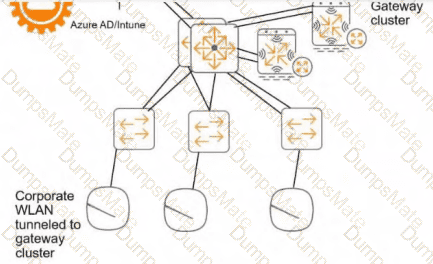
Refer to the scenario.

HPE7-A10 Question 4

HPE7-A10 Question 4

You must configure HPE Aruba Networking ClearPass Onboard to issue client certificates for Azure AD-joined devices. Which step is required to accomplish this objective?

Options:

A.

Create an HTTP authentication source that references an Intune extension.

B.

Recreate the CA as a registration authority under Azure AD.

C.

Create a CPPM policy that authenticates guest users to Azure AD.

D.

Install the Intune SCEP extension on the ClearPass subscribers.

Buy Now
Questions 5

You are assisting a company with designing role-based access control policies on HPE Aruba Networking AOS-10 gateways. The security policy dictates that traffic originating from authenticated corporate user roles must be inspected statefully, allowing client-initiated outbound flows to the data center while strictly dropping any unsolicited inbound connection attempts initiated from data center servers back toward the clients.

What design principle ensures this traffic flow behavior?

Options:

A.

Session ACLs on AOS-10 gateways are stateful and inherently permit return traffic while blocking unsolicited reverse sessions.

B.

Gateways must have explicit inverse session rules configured matching the reverse TCP flags (ACK=1, SYN=0).

C.

Administrators must deploy an external firewall because gateway PEF roles only enforce stateless Layer 2 filtering.

D.

The gateway must be switched from Default Gateway mode to Mobility Access mode to enable bidirectional state tracking.

Buy Now
Questions 6

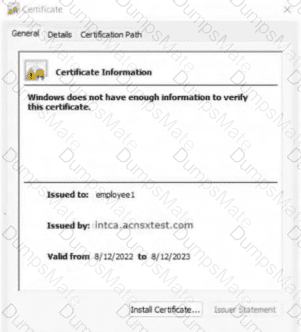
A company wants its AOS-CX switches to obtain certificates from ClearPass Onboard and use those certificates to implement RadSec with ClearPass Policy Manager (CPPM).

ClearPass Onboard has a CA with EST enabled and this EST URL: `[https://cp1.acnsxtest.com/.well-known/est/ca:2](https://cp1.acnsxtest.com/.well-known/est/ca:2)`

ClearPass Guest has an account whose username is `switchcorp123`. (Assume CPPM also has a valid service to authenticate users who access the EST application.)

CPPM has a network-device account for the switches with RadSec enabled. The RadSec settings validate by CN or SAN using this regex: `switchcorp123`

ClearPass has these certificates:

* HTTPS certificate signed by DigiCert

* RadSec certificate signed by DigiCert

* RADIUS/EAP certificate signed by MyDomainCA

This configuration is on the AOS-CX switches:

```text

crypto pki est-profile est1

url https://clearpass1.acnsxtest.com/.well-known/est/ca:2

username switchcorp123

password plaintext %FY212h & zaTk

vrf default

exit

crypto pki certificate cert1

subject switchcorp123

enroll est-profile onboard

crypto pki application radsec-client certificate cert1

```

The switches’ TA-profile list includes DigiCert.

Assume you have obtained the correct password associated with the indicated username. What error or errors are present?

Options:

A.

The URL in the EST profile is incorrect, and the switch does not trust a necessary CA.

B.

Only the username in the EST profile is incorrect.

C.

Only the URL in the EST profile is incorrect.

D.

The URL in the EST profile is incorrect, and the common name in the EST profile is incorrect.

Buy Now
Questions 7

A customer has an AOS-10 architecture managed by HPE Aruba Networking Central. HPE Aruba Networking infrastructure devices authenticate clients against an HPE Aruba Networking ClearPass cluster.

In HPE Aruba Networking Central, you are reviewing network traffic flows for a wireless IoT device categorized as a “Raspberry Pi” client. You observe SSH traffic. You then review several additional wireless IoT clients and find that they are also sending SSH.

Refer to the scenario.

You are assisting the customer in assessing ways to mitigate the potential threat detected. For the foreseeable future, until the security team has addressed the threat, the company wants to block most traffic from any IoT client detected sending SSH traffic. The company does want to allow limited access for these clients so that administrators can remediate them remotely.

What action should you take?

Options:

A.

Create a rule in the IoT clients' typical AOS user role. This rule should match all SSH traffic from the client and apply denylisting.

B.

Configure global firewall settings on HPE Aruba Networking Central-managed APs and gateways to denylist clients that violate control plane (CP) policies.

C.

Create a post-authentication profile on CPPM that updates endpoint attributes based on information from Central. Then add a rule to the relevant CPPM enforcement policy that selects those attributes and applies a quarantine profile.

D.

Create a tag on HPE Aruba Networking Central to select IoT clients using SSH. Add a rule to the relevant CPPM enforcement policy that selects this tag and applies a quarantine profile.

Buy Now
Questions 8

This customer enforces 802.1X on AOS-CX switches using HPE Aruba Networking ClearPass Policy Manager (CPPM). The customer wants the switches to download role settings from CPPM. The reception-domain role must have these settings:

* Assign clients to VLAN 14 on switch 1, VLAN 24 on switch 2, and so on.

* Filter client traffic as follows:

* Clients are allowed full access to 10.1.5.0/24 and the Internet.

* Clients are denied access to 10.1.0.0/16.

Refer to the scenario.

Where should you configure rules that allow clients to access the appropriate IP addresses?

Options:

A.

In a port-access policy on individual switches that are associated with VLAN 14, 24, or 34 on that switch

B.

In a policy configured as part of the role settings in the CPPM enforcement profile

C.

In an access control list applied to VLAN 14 on switch 1, VLAN 24 on switch 2, and so on for the other switches

D.

In access control lists applied to VLAN interfaces 14, 24, and 34 on the core VSX pair

Buy Now
Questions 9

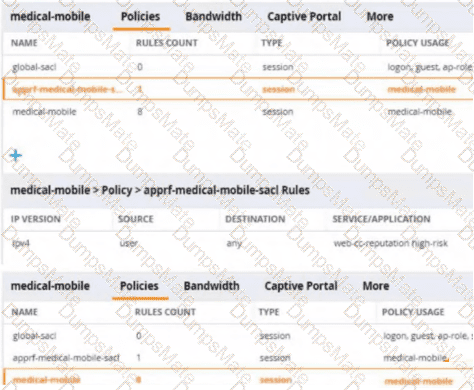
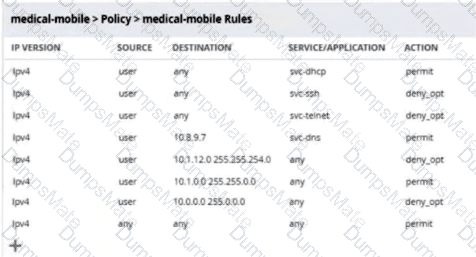
A customer needs the following rights for clients in the medical-mobile AOS firewall role on HPE Aruba Networking Mobility Controllers (MCs):

* They may receive IP addresses through DHCP.

* They may access DNS services at 10.8.9.7, and no other server.

* They may access all subnets in the 10.1.0.0/16 range, except 10.1.12.0/22, which must be denied.

* They must be denied access to other 10.0.0.0/8 subnets.

* They may access the Internet.

* They must be denied WLAN access for a period of time if they send any SSH traffic.

* They must be denied WLAN access for a period of time if they send any Telnet traffic.

* They must be denied access to all high-risk websites.

* External devices must not be allowed to initiate sessions with medical-mobile clients; they may send only return traffic.

HPE7-A10 Question 9

HPE7-A10 Question 9

Refer to the scenario. The exhibits below show the role configuration.

* Role policies: `apprf-medical-mobile-sacl` (Rule: `user any web-cc-reputation high-risk deny`) and `medical-mobile` (8 rules configured).

Which setting not shown in the exhibits must you check to ensure the scenario requirements are met?

Options:

A.

That AppRF and WebCC are enabled globally and on the medical-mobile role

B.

That stateful handling of traffic is enabled globally on the MCs’ firewalls and on the medical-mobile role

C.

That the MCs are assigned RF Protect licenses

D.

That denylisting is enabled globally on the MCs’ firewalls

Buy Now
Questions 10

A company uses an HPE Aruba Networking EdgeConnect SD-Branch solution. The customer wants to integrate the solution with HPE Aruba Networking SSE.

What is one step that must be completed in HPE Aruba Networking SSE and is not automated as part of the typical setup?

Options:

A.

Defining rules for applying SSL inspection to branch user traffic

B.

Creating locations for branches

C.

Choosing whether to enforce IPsec SLAs

D.

Selecting which EdgeConnect SD-Branch gateways establish tunnels with HPE Aruba Networking SSE

Buy Now
Questions 11

A customer has an AOS-10 architecture managed by HPE Aruba Networking Central. HPE Aruba Networking infrastructure devices authenticate clients against an HPE Aruba Networking ClearPass cluster.

In HPE Aruba Networking Central, you are reviewing network traffic flows for a wireless IoT device categorized as "Raspberry Pi" clients. You observe SSH traffic. You then review several additional wireless IoT clients and find that they are also sending SSH.

Refer to the scenario.

You are assisting the customer in evaluating ways to mitigate the potential threat detected. The customer wants to temporarily block misbehaving clients for a penalty period. If a client reconnects and no longer sends SSH traffic, it should be permitted to stay connected.

What approach should you take?

Options:

A.

Create a tag on HPE Aruba Networking Central to select IoT clients using SSH. Add a rule to the relevant CPPM enforcement policy that selects this tag and applies a quarantine profile.

B.

Configure global firewall settings on HPE Aruba Networking Central-managed APs and gateways to denylist clients that violate control plane (CP) policies.

C.

Create a post-authentication profile on CPPM that updates endpoints attributes based on information from Central. Then, add a rule to the relevant CPPM enforcement policy that selects those attributes and applies a quarantine profile.

D.

Create a rule in the clients’ AOS user role that matches all SSH traffic from the client and applies denylisting.

Buy Now
Questions 12

An HPE Aruba Networking Mobility Controller is configured with the following commands:

`aaa rfc-3576-server 10.1.2.3 key mysecretkey & ^%!7531 replay-protection window-duration 300`

Later, this output is displayed:

`(host)#show aaa rfc-3576-server statistics`

`RADIUS RFC 3576 Statistics - 10.1.2.3`

`Disconnect Requests: 2534 | Disconnect Accepts: 2534 | Disconnect Rejects: 0`

`No Secret: 0 | No Session ID: 0 | Bad Authenticator: 0 | Invalid Request: 0`

`Packets Dropped: 1431 | Unknown service: 0`

`CoA Requests: 2453 | CoA Accepts: 1022 | CoA Rejects: 0 | No permission: 0`

What should be investigated?

Options:

A.

Why so many packets are being dropped, which could be a sign that hackers are capturing and resending CoAs for their own purposes

B.

Whether an unstable network is disrupting communications between the MC and 10.1.2.3

C.

Whether the server sending the CoAs has been configured with the wrong RADIUS secret or whether this is a sign that someone is spoofing messages

D.

Why the 10.1.2.3 server is sending legacy packets that are no longer supported

Buy Now
Questions 13

A company has HPE Aruba Networking gateways and plans to begin implementing gateway IDS/IPS. The customer has chosen Block as the Fail Strategy.

What could you recommend to help reduce unexpected outages caused by this particular fail strategy?

Options:

A.

Enabling alerts and email notifications for events related to gateway IPS engine utilization and errors

B.

Setting the IDS or IPS policy to the least restrictive option, Lenient

C.

Making sure that the gateways have formed a cluster and operate in default gateway mode

D.

Configuring a relatively high threshold for the gateway threat count alerts

Buy Now
Questions 14

You must install a certificate on a standalone HPE Aruba Networking Mobility Controller (MC). The MC must use the certificate for the Web UI and to implement RadSec with HPE Aruba Networking ClearPass Policy Manager. You have received a certificate with these settings:

Subject: CN=mc49.site30.example.com

No SANs

Issuer: CN=ca89.example.com

EKUs: Server Authentication, Client Authentication

What problem does this certificate have for its intended uses?

Options:

A.

It specifies domain info in the CN field instead of the DC field.

B.

It lacks a DNS SAN.

C.

It has conflicting EKUs.

D.

It is issued by a private CA.

Buy Now
Questions 15

Your company uses HPE Aruba Networking AOS-10 APs and gateways, along with AOS-CX switches, all managed through HPE Aruba Networking Central. In HPE Aruba Networking Central, you need to collect a packet capture for a client connected to an AP.

What is a prerequisite?

Options:

A.

The AP tunnels the client's SSID to a gateway with application visibility enabled.

B.

The AP tunnels the client's SSID to a gateway with DPI enabled.

C.

The AP has one radio configured in monitor mode.

D.

The AP is assigned to an HPE Aruba Networking Central site.

Buy Now
Questions 16

Introduction to the customer

You are assisting a company with adding HPE Aruba Networking ClearPass to its network, which uses HPE Aruba Networking network-infrastructure devices.

The company already has a Windows domain and Windows CA. The Windows CA issues certificates to domain computers, domain users, and servers such as domain controllers.

ClearPass cluster IP addressing and hostnames

Publisher = 10.47.47.5

Subscriber 1 = 10.47.47.6

Subscriber 2 = 10.47.47.7

Virtual IP with Subscriber 1 and Subscriber 2 = 10.47.47.8

Refer to the scenario.

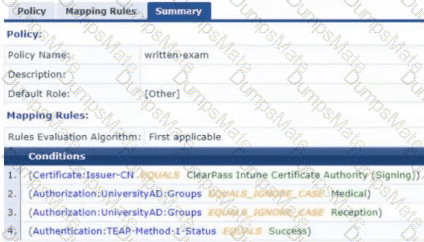
You created a role-mapping policy as displayed in the exhibits below.

HPE7-A10 Question 16

Policy Name: written-exam

Rules Evaluation Algorithm: First applicable

Conditions:

1. (Certificate:Issuer-CN EQUALS ClearPass Intune Certificate Authority (Signing))

2. (Authorization:UniversityAD:Groups EQUALS_IGNORE_CASE Medical)

3. (Authorization:UniversityAD:Groups EQUALS_IGNORE_CASE Reception)

4. (Authentication:TEAP-Method-1-Status EQUALS Success)

What one change must you make to this policy?

Options:

A.

Move rule 1 to the bottom of the list.

B.

Change the default role to "mobile-onboarded".

C.

In rule 1 change Issuer-CN to Subject-CN.

D.

Change the rules evaluation algorithm to select all matches.

Buy Now
Questions 17

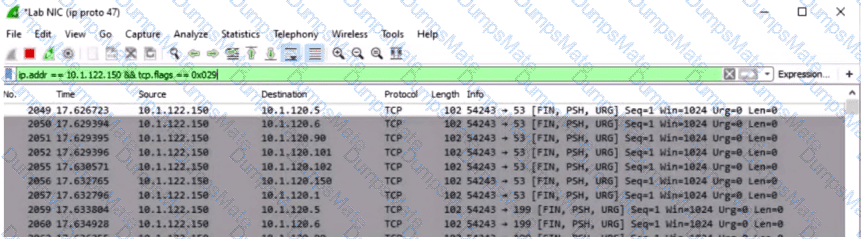
Refer to the exhibit.

HPE7-A10 Question 17

Packet trace display:

    Source: 10.1.122.150 - > Destination: 10.1.120.5 TCP 54243 - > 53 [FIN, PSH, URG] Seq=1 Win=1024 Urg=0 Len=0

    Source: 10.1.122.150 - > Destination: 10.1.120.6 TCP 54243 - > 53 [FIN, PSH, URG] Seq=1 Win=1024 Urg=0 Len=0

    Source: 10.1.122.150 - > Destination: 10.1.120.90 TCP 54243 - > 53 [FIN, PSH, URG] Seq=1 Win=1024 Urg=0 Len=0

    Source: 10.1.122.150 - > Destination: 10.1.120.101 TCP 54243 - > 53 [FIN, PSH, URG] Seq=1 Win= 1024 Urg=0 Len=0

    Source: 10.1.122.150 - > Destination: 10.1.120.5 TCP 54243 - > 199 [FIN, PSH, URG] Seq=1 Win=1024 Urg=0 Len=0

What does this indicate?

Options:

A.

Someone is attempting to determine which ports are open on devices in subnet 10.1.120.0/24.

B.

Someone is attempting to launch a DoS attack against clients in the 10.1.120.0/24 subnet.

C.

Port forwarding policies are misconfigured on core routers or routing switches.

D.

A hacker is hijacking the connections between clients in 10.1.120.0/24 and the true owner of the 10.1.122.150 IP address.

Buy Now
Questions 18

A customer has an AOS-10 architecture consisting of HPE Aruba Networking APs and AOS-CX switches, managed through HPE Aruba Networking Central. The customer wants information about clients, including their general category and OS.

What should you explain?

Options:

A.

The customer should set up a dedicated switch VSX group to sniff packets and direct them to HPE Aruba Networking Central.

B.

You will need to set up HPE Aruba Networking Central as a secondary IP helper for client VLANs, but this will not interfere with existing operations.

C.

HPE Aruba Networking Central will automatically derive this information using telemetry from the HPE Aruba Networking devices.

D.

The customer must deploy HPE Aruba Networking gateways in order to receive any client profiling information.

Buy Now
Questions 19

A customer has an AOS-10 architecture managed by HPE Aruba Networking Central. HPE Aruba Networking infrastructure devices authenticate clients to an HPE Aruba Networking ClearPass cluster.

In HPE Aruba Networking Central, you are reviewing network traffic flows for a wireless IoT device categorized as a “Raspberry Pi” client. You observe SSH traffic. You then review several additional wireless IoT clients and find that they are also sending SSH.

Which element helps establish a foundation for robust network-security forensics?

Options:

A.

Enabling debug-level information for network infrastructure device logs

B.

Enable BPDU protection and loop protection on edge switch ports

C.

Implementing 802.1X authentication on switch ports that connect to APs

D.

Ensuring that all network devices use a correct, consistent clock

Buy Now
Questions 20

A customer uses an AOS-10 architecture managed by HPE Aruba Networking Central. HPE Aruba Networking infrastructure devices authenticate clients against an HPE Aruba Networking ClearPass cluster.

In HPE Aruba Networking Central, you are reviewing network traffic flows for a wireless IoT device categorized as a “Raspberry Pi” client. You observe SSH traffic. You then inspect several additional wireless IoT clients and find that they are also sending SSH.

Refer to the scenario.

What potential issue does this indicate?

Options:

A.

A hacker might have inserted a rogue network device between these clients and the authorized router, creating a man-in-the-middle attack.

B.

The clients are likely responding to port scanning requests by a hacker attempting to conduct network reconnaissance.

C.

Network admins are not using proper management protocols when accessing user devices.

D.

These clients might be controlled by hackers through reverse SSH tunnels.

Buy Now
Questions 21

A customer wants to avoid using RadSec between AOS-CX switches and ClearPass Policy Manager (CPPM) in order to reduce the need to manage switch certificates. Given this condition, what can you recommend to enhance security?

Options:

A.

Make sure that the switches trust CPPM’s HTTPS certificate to make it harder for hackers to eavesdrop on RADIUS communications.

B.

Set a very long and random RADIUS secret to make it harder for hackers to eavesdrop on RADIUS communications.

C.

Make sure that the switches trust CPPM’s RADIUS/EAP certificate to reduce the chances of switches accepting unauthorized messages.

D.

Ensuring that you run the RADIUS communications over a trusted network to reduce the chances of switches accepting unauthorized messages.

Buy Now
Questions 22

A company uses an HPE Aruba Networking AOS-10 mobility infrastructure. Network administrators recently enabled wireless detection on the APs, which checks for all infrastructure and client threats. However, the administrators quickly became overwhelmed and now want to disable most checks.

They want a recommendation for the checks most likely to indicate genuine threats.

Which one should be mentioned?

Options:

A.

detect overflow ie

B.

detect AP spoofing

C.

detect AP flood

D.

detect rate anomalies

Buy Now
Exam Code: HPE7-A10
Exam Name: HPE Network Security Expert Written Exam
Last Update: Nov 19, 2026
Questions: 75

PDF + Testing Engine

$42.5  $169.99

Testing Engine

$32.5  $129.99
buy now HPE7-A10 testing engine

PDF (Q&A)

$27.5  $109.99
buy now HPE7-A10 pdf
dumpsmate guaranteed to pass

24/7 Customer Support

DumpsMate's team of experts is always available to respond your queries on exam preparation. Get professional answers on any topic of the certification syllabus. Our experts will thoroughly satisfy you.

Site Secure

mcafee secure

TESTED 19 Nov 2026