New Year Sale - 70% Discount Offer - Ends in 0d 00h 00m 00s - Coupon code: dm70dm

MuleSoft-Platform-Architect-I Salesforce Certified MuleSoft Platform Architect (Mule-Arch-201) Questions and Answers

Questions 4

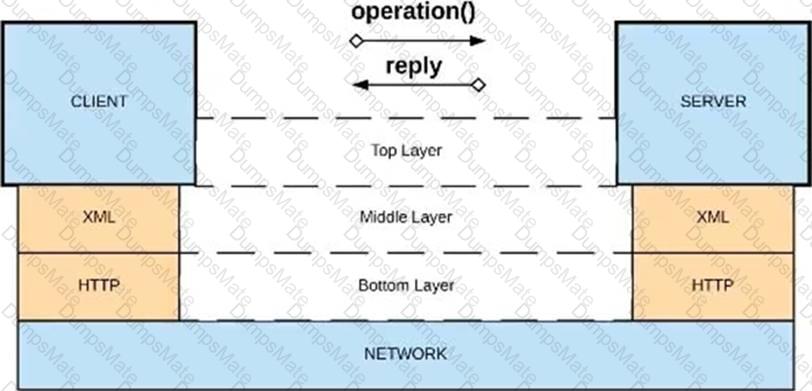
How are an API implementation, API client, and API consumer combined to invoke and process an API?

Options:

A.

The API consumer creates an API implementation, which receives API invocations from an API such that they are processed for an API client

B.

The API client creates an API consumer, which receives API invocations from an API such that they are processed for an API implementation

C.

The ApI consumer creates an API client, which sends API invocations to an API such that they are processed by an API implementation

D.

The ApI client creates an API consumer, which sends API invocations to an API such that they are processed by an API implementation

Buy Now
Questions 5

An Anypoint Platform organization has been configured with an external identity provider (IdP) for identity management and client management. What credentials or token must be provided to Anypoint CLI to execute commands against the Anypoint Platform APIs?

Options:

A.

The credentials provided by the IdP for identity management

B.

The credentials provided by the IdP for client management

C.

An OAuth 2.0 token generated using the credentials provided by the IdP for client management

D.

An OAuth 2.0 token generated using the credentials provided by the IdP for identity management

Buy Now
Questions 6

An API client calls one method from an existing API implementation. The API implementation is later updated. What change to the API implementation would require the API client's invocation logic to also be updated?

Options:

A.

When the data type of the response is changed for the method called by the API client

B.

When a new method is added to the resource used by the API client

C.

When a new required field is added to the method called by the API client

D.

When a child method is added to the method called by the API client

Buy Now
Questions 7

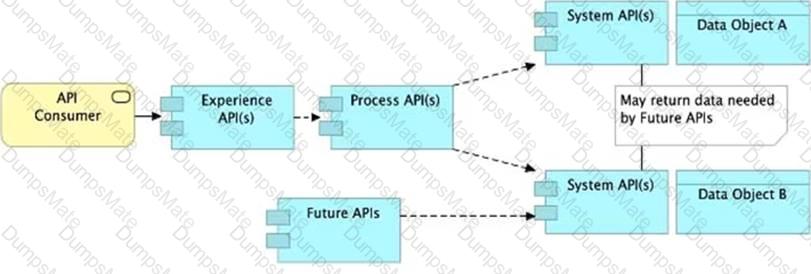
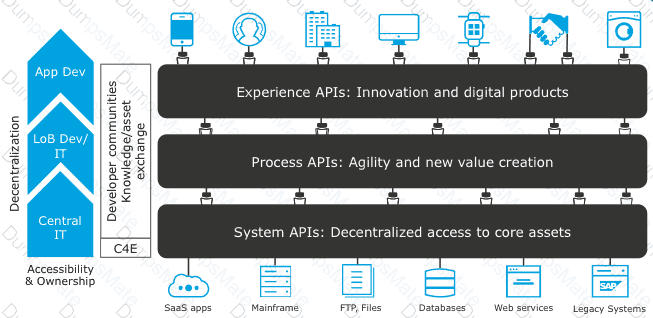
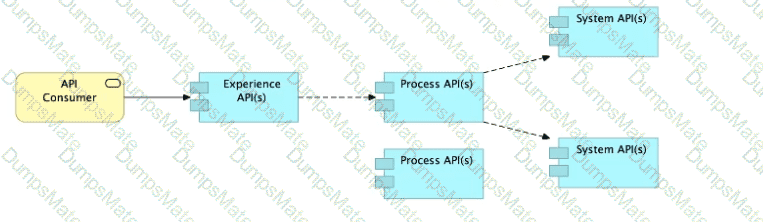
Refer to the exhibit.

What is the best way to decompose one end-to-end business process into a collaboration of Experience, Process, and System APIs?

A) Handle customizations for the end-user application at the Process API level rather than the Experience API level

B) Allow System APIs to return data that is NOT currently required by the identified Process or Experience APIs

C) Always use a tiered approach by creating exactly one API for each of the 3 layers (Experience, Process and System APIs)

D) Use a Process API to orchestrate calls to multiple System APIs, but NOT to other Process APIs

MuleSoft-Platform-Architect-I Question 7

Options:

A.

Option A

B.

Option B

C.

Option C

D.

Option D

Buy Now
Questions 8

What is a key requirement when using an external Identity Provider for Client Management in Anypoint Platform?

Options:

A.

Single sign-on is required to sign in to Anypoint Platform

B.

The application network must include System APIs that interact with the Identity Provider

C.

To invoke OAuth 2.0-protected APIs managed by Anypoint Platform, API clients must submit access tokens issued by that same Identity Provider

D.

APIs managed by Anypoint Platform must be protected by SAML 2.0 policies

Buy Now
Questions 9

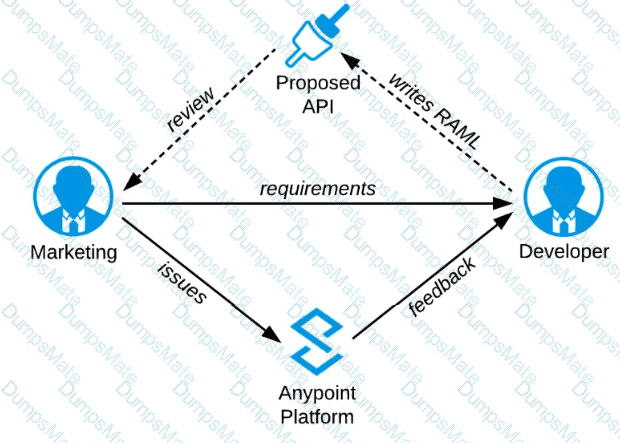
Refer to the exhibit.

MuleSoft-Platform-Architect-I Question 9

A RAML definition has been proposed for a new Promotions Process API, and has been published to Anypoint Exchange.

The Marketing Department, who will be an important consumer of the Promotions API, has important requirements and expectations that must be met.

What is the most effective way to use Anypoint Platform features to involve the Marketing Department in this early API design phase?

A) Ask the Marketing Department to interact with a mocking implementation of the API using the automatically generated API Console

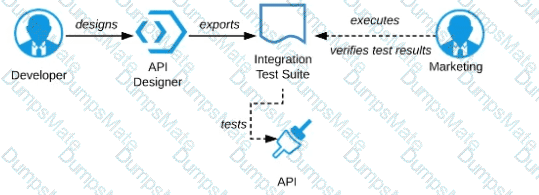
MuleSoft-Platform-Architect-I Question 9

B) Organize a design workshop with the DBAs of the Marketing Department in which the database schema of the Marketing IT systems is translated into RAML

C) Use Anypoint Studio to Implement the API as a Mule application, then deploy that API implementation to CloudHub and ask the Marketing Department to interact with it

D) Export an integration test suite from API designer and have the Marketing Department execute the tests In that suite to ensure they pass

MuleSoft-Platform-Architect-I Question 9

Options:

A.

Option A

B.

Option B

C.

Option C

D.

Option D

Buy Now
Questions 10

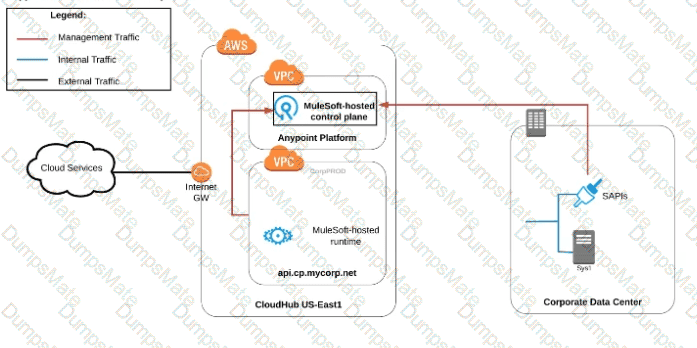
An organization uses various cloud-based SaaS systems and multiple on-premises systems. The on-premises systems are an important part of the organization's application network and can only be accessed from within the organization's intranet.

What is the best way to configure and use Anypoint Platform to support integrations with both the cloud-based SaaS systems and on-premises systems?

A) Use CloudHub-deployed Mule runtimes in an Anypoint VPC managed by Anypoint Platform Private Cloud Edition control plane

B) Use CloudHub-deployed Mule runtimes in the shared worker cloud managed by the MuleSoft-hosted Anypoint Platform control plane

C) Use an on-premises installation of Mule runtimes that are completely isolated with NO external network access, managed by the Anypoint Platform Private Cloud Edition control plane

D) Use a combination of Cloud Hub-deployed and manually provisioned on-premises Mule runtimes managed by the MuleSoft-hosted Anypoint Platform control plane

MuleSoft-Platform-Architect-I Question 10

Options:

A.

Option A

B.

Option B

C.

Option C

D.

Option D

Buy Now
Questions 11

A REST API is being designed to implement a Mule application.

What standard interface definition language can be used to define REST APIs?

Options:

A.

Web Service Definition Language(WSDL)

B.

OpenAPI Specification (OAS)

C.

YAML

D.

AsyncAPI Specification

Buy Now
Questions 12

A team is planning to enhance an Experience API specification, and they are following API-led connectivity design principles.

What is their motivation for enhancing the API?

Options:

A.

The primary API consumer wants certain kinds of endpoints changed from the Center for Enablement standard to the consumer system standard

B.

The underlying System API is updated to provide more detailed data for several heavily used resources

C.

An IP Allowlist policy is being added to the API instances in the Development and Staging environments

D.

A Canonical Data Model is being adopted that impacts several types of data included in the API

Buy Now
Questions 13

What do the API invocation metrics provided by Anypoint Platform provide?

Options:

A.

ROI metrics from APIs that can be directly shared with business users

B.

Measurements of the effectiveness of the application network based on the level of reuse

C.

Data on past API invocations to help identify anomalies and usage patterns across various APIs

D.

Proactive identification of likely future policy violations that exceed a given threat threshold

Buy Now
Questions 14

An organization has built an application network following the API-led connectivity approach recommended by MuleSoft. To protect the application network against

attacks from malicious external API clients, the organization plans to apply JSON Threat Protection policies.

To which API-led connectivity layer should the JSON Threat Protection policies most commonly be applied?

Options:

A.

All layers

B.

System layer

C.

Process layer

D.

Experience layer

Buy Now
Questions 15

A circuit breaker strategy is planned in order to meet the goal of improved response time and demand on a downstream API.

* Circuit Open: More than 10 errors per minute for three minutes

* Circuit Half-Open: One error per minute

* Circuit Closed: Less than one error per minute for five minutes

Out of several proposals from the engineering team, which option will meet this goal?

Options:

A.

Create a custom policy that implements the circuit breaker and includes policy template expressions for the required settings

B.

Create Anypoint Monitoring alerts for Circuit Open/Closed configurations, and then implement a retry strategy for Circuit Half-Open configuration

C.

Add the Circuit Breaker policy to the API instance, and configure the required settings

D.

Implement the strategy in a Mule application, and provide the settings in the YAML configuration

Buy Now
Questions 16

What should be ensured before sharing an API through a public Anypoint Exchange portal?

Options:

A.

The visibility level of the API instances of that API that need to be publicly accessible should be set to public visibility

B.

The users needing access to the API should be added to the appropriate role in Anypoint Platform

C.

The API should be functional with at least an initial implementation deployed and accessible for users to interact with

D.

The API should be secured using one of the supported authentication/authorization mechanisms to ensure that data is not compromised

Buy Now
Questions 17

An organization has created an API-led architecture that uses various API layers to integrate mobile clients with a backend system. The backend system consists of a number of specialized components and can be accessed via a REST API. The process and experience APIs share the same bounded-context model that is different from the backend data model. What additional canonical models, bounded-context models, or anti-corruption layers are best added to this architecture to help process data consumed from the backend system?

Options:

A.

Create a bounded-context model for every layer and overlap them when the boundary contexts overlap, letting API developers know about the differences between upstream and downstream data models

B.

Create a canonical model that combines the backend and API-led models to simplify and unify data models, and minimize data transformations.

C.

Create a bounded-context model for the system layer to closely match the backend data model, and add an anti-corruption layer to let the different bounded contexts cooperate across the system and process layers

D.

Create an anti-corruption layer for every API to perform transformation for every data model to match each other, and let data simply travel between APIs to avoid the complexity and overhead of building canonical models

Buy Now
Questions 18

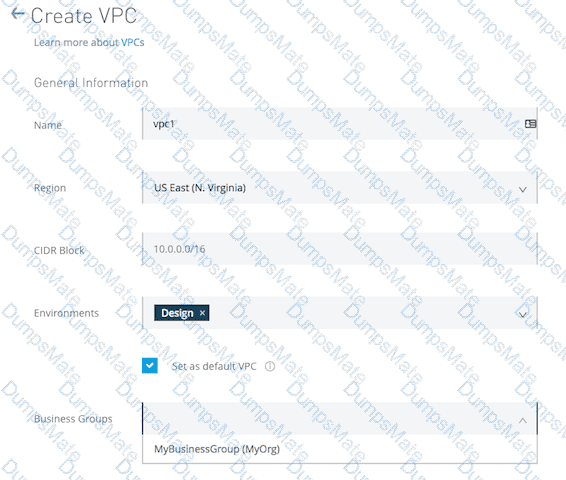
What is true about the technology architecture of Anypoint VPCs?

Options:

A.

The private IP address range of an Anypoint VPC is automatically chosen by CloudHub

B.

Traffic between Mule applications deployed to an Anypoint VPC and on-premises systems can stay within a private network

C.

Each CloudHub environment requires a separate Anypoint VPC

D.

VPC peering can be used to link the underlying AWS VPC to an on-premises (non AWS) private network

Buy Now
Questions 19

An API implementation is deployed to CloudHub.

What conditions can be alerted on using the default Anypoint Platform functionality, where the alert conditions depend on the end-to-end request processing of the API implementation?

Options:

A.

When the API is invoked by an unrecognized API client

B.

When a particular API client invokes the API too often within a given time period

C.

When the response time of API invocations exceeds a threshold

D.

When the API receives a very high number of API invocations

Buy Now
Questions 20

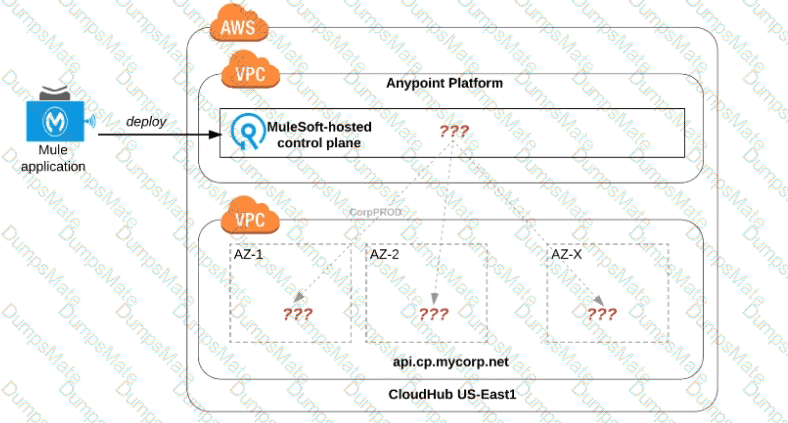
Refer to the exhibit.

MuleSoft-Platform-Architect-I Question 20

An organization uses one specific CloudHub (AWS) region for all CloudHub deployments.

How are CloudHub workers assigned to availability zones (AZs) when the organization's Mule applications are deployed to CloudHub in that region?

Options:

A.

Workers belonging to a given environment are assigned to the same AZ within that region

B.

AZs are selected as part of the Mule application's deployment configuration

C.

Workers are randomly distributed across available AZs within that region

D.

An AZ is randomly selected for a Mule application, and all the Mule application's CloudHub workers are assigned to that one AZ

Buy Now
Questions 21

A TemperatureSensors API instance is defined in API Manager in the PROD environment of the CAR_FACTORY business group. An AcmelemperatureSensors Mule

application implements this API instance and is deployed from Runtime Manager to the PROD environment of the CAR_FACTORY business group. A policy that requires a valid

client ID and client secret is applied in API Manager to the API instance.

Where can an API consumer obtain a valid client ID and client secret to call the AcmeTemperatureSensors Mule application?

Options:

A.

In secrets manager, request access to the Shared Secret static username/password

B.

In API Manager, from the PROD environment of the CAR_FACTORY business group

C.

In access management, from the PROD environment of the CAR_FACTORY business group

D.

In Anypoint Exchange, from an API client application that has been approved for the TemperatureSensors API instance

Buy Now
Questions 22

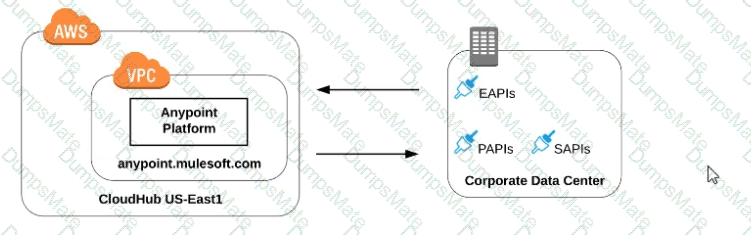
Refer to the exhibit.

MuleSoft-Platform-Architect-I Question 22

what is true when using customer-hosted Mule runtimes with the MuleSoft-hosted Anypoint Platform control plane (hybrid deployment)?

Options:

A.

Anypoint Runtime Manager initiates a network connection to a Mule runtime in order to deploy Mule applications

B.

The MuleSoft-hosted Shared Load Balancer can be used to load balance API invocations to the Mule runtimes

C.

API implementations can run successfully in customer-hosted Mule runtimes, even when they are unable to communicate with the control plane

D.

Anypoint Runtime Manager automatically ensures HA in the control plane by creating a new Mule runtime instance in case of a node failure

Buy Now
Questions 23

An API implementation is being designed that must invoke an Order API, which is known to repeatedly experience downtime.

For this reason, a fallback API is to be called when the Order API is unavailable.

What approach to designing the invocation of the fallback API provides the best resilience?

Options:

A.

Search Anypoint Exchange for a suitable existing fallback API, and then implement invocations to this fallback API in addition to the Order API

B.

Create a separate entry for the Order API in API Manager, and then invoke this API as a fallback API if the primary Order API is unavailable

C.

Redirect client requests through an HTTP 307 Temporary Redirect status code to the fallback API whenever the Order API is unavailable

D.

Set an option in the HTTP Requester component that invokes the Order API to instead invoke a fallback API whenever an HTTP 4xx or 5xx response status code is returned from the Order API

Buy Now
Questions 24

When designing an upstream API and its implementation, the development team has been advised to NOT set timeouts when invoking a downstream API, because that downstream API has no SLA that can be relied upon. This is the only downstream API dependency of that upstream API.

Assume the downstream API runs uninterrupted without crashing. What is the impact of this advice?

Options:

A.

An SLA for the upstream API CANNOT be provided

B.

The invocation of the downstream API will run to completion without timing out

C.

A default timeout of 500 ms will automatically be applied by the Mule runtime in which the upstream API implementation executes

D.

A toad-dependent timeout of less than 1000 ms will be applied by the Mule runtime in which the downstream API implementation executes

Buy Now
Questions 25

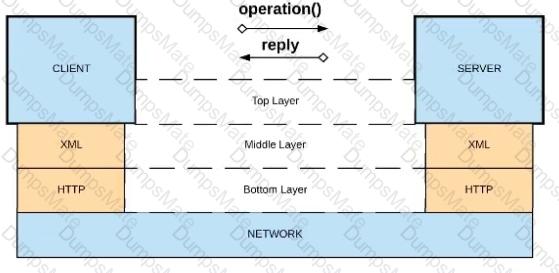
Refer to the exhibit.

What is a valid API in the sense of API-led connectivity and application networks?

A) Java RMI over TCP

B) Java RMI over TCP

MuleSoft-Platform-Architect-I Question 25

C) CORBA over HOP

D) XML over UDP

Options:

A.

Option A

B.

Option B

C.

Option C

D.

Option D

Buy Now
Questions 26

A large organization with an experienced central IT department is getting started using MuleSoft. There is a project to connect a siloed back-end system to a new

Customer Relationship Management (CRM) system. The Center for Enablement is coaching them to use API-led connectivity.

What action would support the creation of an application network using API-led connectivity?

Options:

A.

Invite the business analyst to create a business process model to specify the canonical data model between the two systems

B.

Determine if the new CRM system supports the creation of custom: REST APIs, establishes 4 private network with CloudHub, and supports GAuth 2.0 authentication

C.

To expedite this project, central IT should extend the CRM system and back-end systems to connect to one another using built in integration interfaces

D.

Create a System API to unlock the data on the back-end system using a REST API

Buy Now
Questions 27

A company uses a hybrid Anypoint Platform deployment model that combines the EU control plane with customer-hosted Mule runtimes. After successfully testing a Mule API implementation in the Staging environment, the Mule API implementation is set with environment-specific properties and must be promoted to the Production environment. What is a way that MuleSoft recommends to configure the Mule API implementation and automate its promotion to the Production environment?

Options:

A.

Bundle properties files for each environment into the Mule API implementation's deployable archive, then promote the Mule API implementation to the Production environment using Anypoint CLI or the Anypoint Platform REST APIsB.

B.

Modify the Mule API implementation's properties in the API Manager Properties tab, then promote the Mule API implementation to the Production environment using API Manager

C.

Modify the Mule API implementation's properties in Anypoint Exchange, then promote the Mule API implementation to the Production environment using Runtime Manager

D.

Use an API policy to change properties in the Mule API implementation deployed to the Staging environment and another API policy to deploy the Mule API implementation to the Production environment

Buy Now
Questions 28

What CANNOT be effectively enforced using an API policy in Anypoint Platform?

Options:

A.

Guarding against Denial of Service attacks

B.

Maintaining tamper-proof credentials between APIs

C.

Logging HTTP requests and responses

D.

Backend system overloading

Buy Now
Questions 29

A Mule application implements an API. The Mule application has an HTTP Listener whose connector configuration sets the HTTPS protocol and hard-codes the port

value. The Mule application is deployed to an Anypoint VPC and uses the CloudHub 1.0 Shared Load Balancer (SLB) for all incoming traffic.

Which port number must be assigned to the HTTP Listener's connector configuration so that the Mule application properly receives HTTPS API invocations routed through the

SLB?

Options:

A.

8082

B.

8092

C.

80

D.

443

Buy Now
Questions 30

An existing Quoting API is defined in RAML and used by REST clients for interacting with the quoting engine. Currently there is a resource defined in the RAML that allows the creation of quotes; however, a new requirement was just received to allow for the updating of existing quotes.

Which two actions need to be taken to facilitate this change so it can be processed?

Choose 2 answers

Options:

A.

Update the API implementation to accommodate the new update request

B.

Remove the old client applications and create new client applications to account for the changes

C.

Update the RAML with new method details for the update request

D.

Deprecate existing versions of the API in Exchange

E.

Add a new API policy to API Manager to allow access to the updated endpoint

Buy Now
Questions 31

Mule applications that implement a number of REST APIs are deployed to their own subnet that is inaccessible from outside the organization.

External business-partners need to access these APIs, which are only allowed to be invoked from a separate subnet dedicated to partners - called Partner-subnet. This subnet is accessible from the public internet, which allows these external partners to reach it.

Anypoint Platform and Mule runtimes are already deployed in Partner-subnet. These Mule runtimes can already access the APIs.

What is the most resource-efficient solution to comply with these requirements, while having the least impact on other applications that are currently using the APIs?

Options:

A.

Implement (or generate) an API proxy Mule application for each of the APIs, then deploy the API proxies to the Mule runtimes

B.

Redeploy the API implementations to the same servers running the Mule runtimes

C.

Add an additional endpoint to each API for partner-enablement consumption

D.

Duplicate the APIs as Mule applications, then deploy them to the Mule runtimes

Buy Now
Questions 32

A large company wants to implement IT infrastructure in its own data center, based on the corporate IT policy requirements that data and metadata reside locally.

Which combination of Mule control plane and Mule runtime plane(s) meets the requirements?

Options:

A.

Anypoint Platform Private Cloud Edition for the control plane and the MuleSoft-hosted runtime plane

B.

The MuleSoft-hosted control plane and Anypoint Runtime Fabric for the runtime plane

C.

The MuleSoft-hosted control plane and customer-hosted Mule runtimes for the runtime plane

D.

Anypoint Platform Private Cloud Edition for the control plane and customer-hosted Mule runtimes for the runtime plane

Buy Now
Questions 33

When can CloudHub Object Store v2 be used?

Options:

A.

To store an unlimited number of key-value pairs

B.

To store payloads with an average size greater than 15MB

C.

To store information in Mule 4 Object Store v1

D.

To store key-value pairs with keys up to 300 characters

Buy Now
Questions 34

Question 10: Skipped

An API implementation returns three X-RateLimit-* HTTP response headers to a requesting API client. What type of information do these response headers indicate to the API client?

Options:

A.

The error codes that result from throttling

B.

A correlation ID that should be sent in the next request

C.

The HTTP response size

D.

The remaining capacity allowed by the API implementation

Buy Now
Questions 35

When should idempotency be taken into account?

Options:

A.

When making requests to update currently locked entities

B.

When storing the results of s previous request for use in response to subsequent requests

C.

When sending concurrent update requests for the same entity

D.

When preventing duplicate processing from multiple sent requests

Buy Now
Questions 36

Which two statements are true about the technology architecture of an Anypoint Virtual Private Cloud (VPC)?

Choose 2 answers

Options:

A.

Ports 8081 and 8082 are used

B.

CIDR blacks are used

C.

Anypoint VPC is responsible for load balancing the applications

D.

Round-robin load balancing is used to distribute client requests across different applications

E.

By default, HTTP requests can be made from the public internet to workers at port 6091

Buy Now
Questions 37

A system API has a guaranteed SLA of 100 ms per request. The system API is deployed to a primary environment as well as to a disaster recovery (DR) environment, with different DNS names in each environment. An upstream process API invokes the system API and the main goal of this process API is to respond to client requests in the least possible time. In what order should the system APIs be invoked, and what changes should be made in order to speed up the response time for requests from the process API?

Options:

A.

In parallel, invoke the system API deployed to the primary environment and the system API deployed to the DR environment, and ONLY use the first response

B.

In parallel, invoke the system API deployed to the primary environment and the system API deployed to the DR environment using a scatter-gather configured with a timeout, and then merge the responses

C.

Invoke the system API deployed to the primary environment, and if it fails, invoke the system API deployed to the DR environment

D.

Invoke ONLY the system API deployed to the primary environment, and add timeout and retry logic to avoid intermittent failures

Buy Now
Questions 38

Refer to the exhibit.

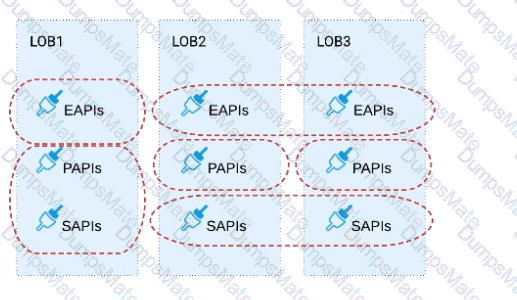
Three business processes need to be implemented, and the implementations need to communicate with several different SaaS applications.

These processes are owned by separate (siloed) LOBs and are mainly independent of each other, but do share a few business entities. Each LOB has one development team and their own budget

In this organizational context, what is the most effective approach to choose the API data models for the APIs that will implement these business processes with minimal redundancy of the data models?

A) Build several Bounded Context Data Models that align with coherent parts of the business processes and the definitions of associated business entities

MuleSoft-Platform-Architect-I Question 38

B) Build distinct data models for each API to follow established micro-services and Agile API-centric practices

C) Build all API data models using XML schema to drive consistency and reuse across the organization

D) Build one centralized Canonical Data Model (Enterprise Data Model) that unifies all the data types from all three business processes, ensuring the data model is consistent and non-redundant

Options:

A.

Option A

B.

Option B

C.

Option C

D.

Option D

Buy Now
Questions 39

Which layer in the API-led connectivity focuses on unlocking key systems, legacy systems, data sources etc and exposes the functionality?

Options:

A.

Experience Layer

B.

Process Layer

C.

System Layer

Buy Now
Questions 40

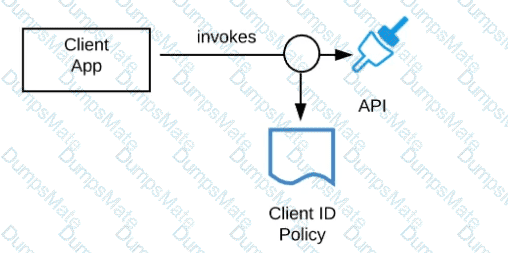
Refer to the exhibit.

MuleSoft-Platform-Architect-I Question 40

A developer is building a client application to invoke an API deployed to the STAGING environment that is governed by a client ID enforcement policy.

What is required to successfully invoke the API?

Options:

A.

The client ID and secret for the Anypoint Platform account owning the API in the STAGING environment

B.

The client ID and secret for the Anypoint Platform account's STAGING environment

C.

The client ID and secret obtained from Anypoint Exchange for the API instance in the STAGING environment

D.

A valid OAuth token obtained from Anypoint Platform and its associated client ID and secret

Buy Now
Questions 41

Refer to the exhibit. An organization is running a Mule standalone runtime and has configured Active Directory as the Anypoint Platform external Identity Provider. The organization does not have budget for other system components.

What policy should be applied to all instances of APIs in the organization to most effecuvelyKestrict access to a specific group of internal users?

Options:

A.

Apply a basic authentication - LDAP policy; the internal Active Directory will be configured as the LDAP source for authenticating users

B.

Apply a client ID enforcement policy; the specific group of users will configure their client applications to use their specific client credentials

C.

Apply an IP whitelist policy; only the specific users' workstations will be in the whitelist

D.

Apply an OAuth 2.0 access token enforcement policy; the internal Active Directory will be configured as the OAuth server

Buy Now
Questions 42

Several times a week, an API implementation shows several thousand requests per minute in an Anypoint Monitoring dashboard, Between these bursts, the

dashboard shows between two and five requests per minute. The API implementation is running on Anypoint Runtime Fabric with two non-clustered replicas, reserved vCPU 1.0

and vCPU Limit 2.0.

An API consumer has complained about slow response time, and the dashboard shows the 99 percentile is greater than 120 seconds at the time of the complaint. It also shows

greater than 90% CPU usage during these time periods.

In manual tests in the QA environment, the API consumer has consistently reproduced the slow response time and high CPU usage, and there were no other API requests at

this time. In a brainstorming session, the engineering team has created several proposals to reduce the response time for requests.

Which proposal should be pursued first?

Options:

A.

Increase the vCPU resources of the API implementation

B.

Modify the API client to split the problematic request into smaller, less-demanding requests

C.

Increase the number of replicas of the API implementation

D.

Throttle the APT client to reduce the number of requests per minute

Buy Now
Questions 43

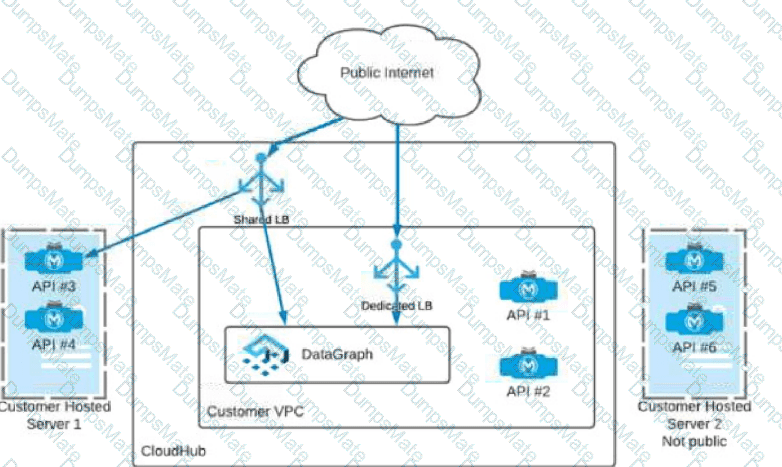
Which APIs can be used with DataGraph to create a unified schema?

MuleSoft-Platform-Architect-I Question 43

Options:

A.

APIs 1, 3, 5

B.

APIs 2, 4 ,6

C.

APIs 1, 2, s5, 6

D.

APIs 1, 2, 3, 4

Buy Now
Questions 44

Refer to the exhibit. An organization needs to enable access to their customer data from both a mobile app and a web application, which each need access to common fields as well as certain unique fields.

The data is available partially in a database and partially in a 3rd-party CRM system.

What APIs should be created to best fit these design requirements?
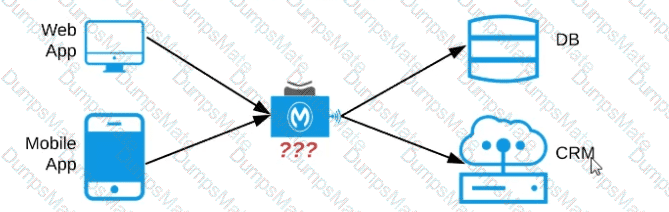
MuleSoft-Platform-Architect-I Question 44

A) A Process API that contains the data required by both the web and mobile apps, allowing these applications to invoke it directly and access the data they need thereby providing the flexibility to add more fields in the future without needing API changes

B) One set of APIs (Experience API, Process API, and System API) for the web app, and another set for the mobile app

C) Separate Experience APIs for the mobile and web app, but a common Process API that invokes separate System APIs created for the database and CRM system
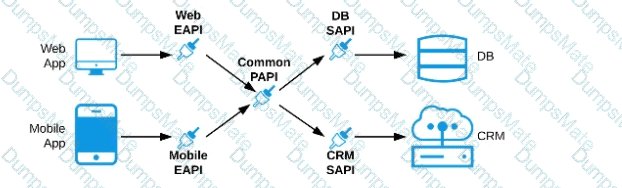
MuleSoft-Platform-Architect-I Question 44

D) A common Experience API used by both the web and mobile apps, but separate Process APIs for the web and mobile apps that interact with the database and the CRM System

Options:

A.

Option A

B.

Option B

C.

Option C

D.

Option D

Buy Now
Questions 45

To minimize operation costs, a customer wants to use a CloudHub 1.0 solution. The customer's requirements are:

* Separate resources with two Business groups

* High-availability (HA) for all APIs

* Route traffic via Dedicated load balancer (DLBs)

* Separate environments into production and non-production

Which solution meets the customer's needs?

Options:

A.

One production and one non-production Virtual Private Cloud (VPC). Use availability zones to differentiate between Business groups. Allocate maximum CIDR per VPCs to ensure HA across availability zones

B.

One production and one non-production Virtual Private Cloud (VPC) per Business group. Minimize CIDR aligning with projected application total. Choose a MuleSoft CloudHub 1.0 region with multiple availability zones. Deploy multiple workers for HA,

C.

One production and one non-production Virtual Private Cloud (VPC) per Business group. Minimize CIDR aligning with projected application total. Divide availability zones during deployment of APIs for HA.

D.

One production and one non-production Virtual Private Claud (VPC). Configure subnet to differentiate between business groups. Allocate maximum CIDR per VPCs to make it easier to add Child groups. Span VPC to cover three availability zones.

Buy Now
Exam Name: Salesforce Certified MuleSoft Platform Architect (Mule-Arch-201)
Last Update: Jan 5, 2026
Questions: 152

PDF + Testing Engine

$49.5  $164.99

Testing Engine

$37.5  $124.99
buy now MuleSoft-Platform-Architect-I testing engine

PDF (Q&A)

$31.5  $104.99
buy now MuleSoft-Platform-Architect-I pdf
dumpsmate guaranteed to pass

24/7 Customer Support

DumpsMate's team of experts is always available to respond your queries on exam preparation. Get professional answers on any topic of the certification syllabus. Our experts will thoroughly satisfy you.

Site Secure

mcafee secure

TESTED 05 Jan 2026