Grab 75% Off This Black Friday: Use coupon code below to save on all exam bundles! - Ends in 0d 00h 00m 00s - Coupon code: 75only

NetSec-Architect Palo Alto Networks Network Security Architect Questions and Answers

Questions 4

An organization uses Microsoft Entra ID and wants to strictly enforce that remote users access highly sensitive SaaS applications only when their requests originate from Prisma Browser.

Which unique identifier must be configured in the Entra ID Conditional Access policy to verify and enforce that an access request specifically comes from Prisma Browser, while preventing standard web browsers from bypassing the Zero Trust Network Access (ZTNA) control?

Options:

A.

List of known egress IP addresses associated with Prisma Browser’s cloud proxy infrastructure

B.

Unique device token or Device-ID issued by Prisma Browser and validated by Entra ID

C.

Certificate thumbprint of Prisma Browser’s secure workspace key used for session encryption

D.

GlobalProtect mobile application installed on the user's endpoint

Buy Now
Questions 5

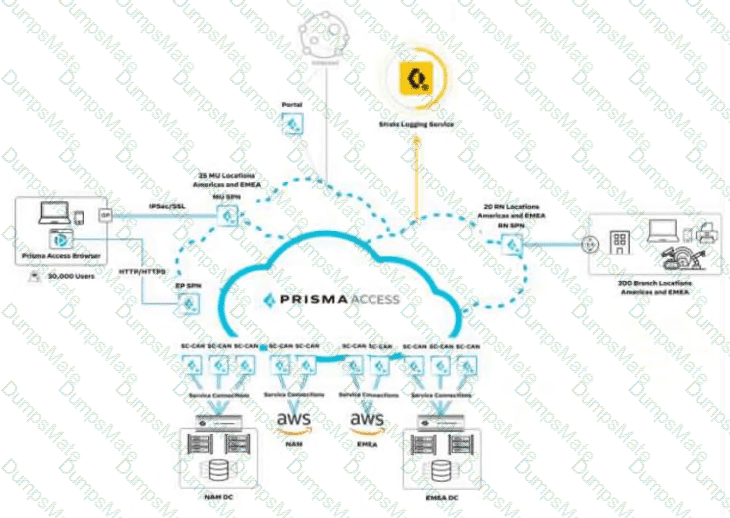
A global manufacturing organization with 50,000 employees across 35 countries designs advanced industrial equipment and owns substantial intellectual property. It operates in a highly competitive market where safeguarding trade secrets is essential to preserving market advantage.

Over the last 18 months, the CISO has found that employees throughout the organization have adopted hundreds of GenAI applications to improve productivity. Engineers use AI coding assistants to speed product development, sales teams use AI tools to create proposals, and customer service representatives use chatbots to draft responses. Although this adoption has fueled innovation, it has also introduced substantial security risks.

A security audit finds sensitive CAD files uploaded to image-generation services, proprietary source code shared with public coding assistants, and confidential customer information included in prompts. The audit identifies more than 300 different GenAI applications in use, most of which were not formally reviewed or approved.

The customer service department is also developing internal AI applications, including a customer service copilot built on a cloud large language model (LLM) platform, an internal knowledge management assistant, and a code review tool. These internal applications access sensitive databases, customer records, and internal APIs—creating further security concerns about exploitation or misuse.

The organization has a distributed workforce, with 60% of employees working remotely or in hybrid arrangements and accessing corporate resources and AI applications from different locations using managed and unmanaged devices. Its existing network security infrastructure has no AI-specific security capabilities.

Organization leadership wants to enable AI-driven innovation while deploying comprehensive security controls. The CISO has been assigned to develop an organization-wide GenAI governance program that safeguards sensitive assets without impeding productivity. The program must address both external AI applications employees use and internal AI applications IT develops.

Which architectural approach most closely aligns with the organization’s strategic objectives of enabling AI innovation and protecting sensitive assets?

Options:

A.

Rely on existing perimeter firewalls and VPN concentrators applying standard URL filtering and data loss prevention (DLP) policies for AI traffic

B.

Segment network zones within each data center to isolate AI workloads from critical IP address repositories and monitor east-west traffic

C.

Deploy a cloud-delivered security platform with AI-aware controls integrated with identity and device posture

D.

Block external GenAI applications at the firewall and empower employees to use internally developed AI applications.

Buy Now
Questions 6

A large organization runs Palo Alto Networks VM-Series firewalls across multiple availability zones in Microsoft Azure. The firewalls are managed by an Azure Virtual Machine Scale Set (VMSS) and integrated with an Azure Load Balancer for highly available (HA) traffic inspection in a Transit VNet.

The security team must carry out a critical PAN-OS software upgrade for the entire firewall fleet while minimizing application downtime.

Following Palo Alto Networks best practices for highly available cloud deployments, which approach is recommended to perform this software upgrade safely with the least downtime?

Options:

A.

Update the image in an Azure VMSS and then initiate an upgrade of the instances

B.

Configure Azure Load Balancer probes to handle the health check failover during upgrades

C.

Provision a new, parallel VMSS with the new PAN-OS version, validate it, and redirect traffic from the old VMSS to the new one

D.

Use Azure Update Manager to push the PAN-OS upgrade package directly to all firewall instances simultaneously during a scheduled maintenance window

Buy Now
Questions 7

An organization intends to deploy a complete SASE architecture comprising Prisma SD-WAN IONs at branches and data centers, together with Prisma Access remote networks, service connections, and mobile users.

NetSec-Architect Question 7

The business office team requires traffic from global remote offices to the public cloud to be of the highest criticality. This traffic must receive the highest SLA and QoS priority while retaining a balanced level of threat inspection.

Which recommendation should the architect make to deliver the lowest latency, highest throughput, and greatest resilience for the applications?

Options:

A.

Prisma Access Agent or a PAC file explicit proxy configuration connecting the end user devices directly to Prisma Access with a service connection to the public cloud provider

B.

Prisma Access remote networks with service connections directly to the cloud environment using IPSec and either static or dynamic routing

C.

Prisma SD-WAN IONs deployed within the cloud environment using BGP-to-peer to the internal route tables of the application

D.

Prisma SD-WAN ION deployed at both branch and private data center with a direct private link between the private data center and the public cloud provider

Buy Now
Questions 8

A multinational organization has a large global population of remote users. This population includes several persona types with distinct requirements and concerns about adopting a Zero Trust Network Access (ZTNA) solution.

Developers need to temporarily bypass security controls for business reasons, but the security team views this as a potential risk. Developers commonly access development servers on site in private data centers and the public cloud. These development applications use web (HTTP/HTTPS), API, RPC, and SMB-based applications.

Sales staff travel regularly and connect to the network through many different connection types, but they are generally limited to SaaS-based web applications. They often report performance concerns when any agent is installed and want the option to temporarily disable those agents. Data exfiltration and insider risk have been identified as the primary threats for this user class.

Executives are concerned about being high-value targets. Security must remain consistent across multiple endpoint types, including mobile and desktop devices. Executive team members have indicated that their primary objective is for the solution to be responsive and easy to troubleshoot.

Which statement applies when securing the developers’ applications?

Options:

A.

Mobile users, remote networks, and explicit proxy all provide the same Cloud-Delivered Security Services (CDSS) capabilities.

B.

GlobalProtect mobile users and explicit proxy users share the same configuration scope for policy configuration

C.

ZTNA Connector requires DNS for all applications it publishes and does not permit direct IP address-based access

D.

Explicit proxy on ramps can only provide security for HTTP, HTTPS, and proxy-aware applications

Buy Now
Questions 9

A global manufacturing organization has a strategic plan for rapid growth through mergers and acquisitions. Several components that the organization purchased are considered large deployments with existing IP address schemas and allocations that conflict with the parent organization. The manufacturing organization requires access to the resources before a re-IP initiative can be completed.

All deployments contain a variety of IoT devices. Leadership requires protection of vulnerable assets and identification of any known CVEs associated with the IoT devices. The governance, risk, and compliance (GRC) team requires comprehensive, non-repudiable logs to identify all IoT devices reporting “Critical (9.0+) CVE scores” for mandatory remediation.

Throughput must exceed the current 1 Gbps trending rate and, with anticipated growth, will soon scale to 5 Gbps.

Segmentation is mandatory, with enclaves based on region, device type, and function.

Which architectural component ensures IoT storage, integrity, and non-repudiation of this granular risk data for auditing purposes?

Options:

A.

NGFW’s session table, which is encrypted with the master key

B.

Strata Logging Service for cloud storage of the security logs and device telemetry

C.

GlobalProtect agent to collect device posture and to locally log all critical CVE scores

D.

Panorama log collector using its local database with a 90-day retention policy

Buy Now
Questions 10

A retail organization wants to approve the use of a specific third-party SaaS-based AI application for inventory management. The application requires network-layer data access to the organization’s internal supply-chain database, which contains confidential information and is highly secured in its own DMZ. Implementation has been delayed because the CISO is concerned that the approved third-party AI application could be compromised and then used to exfiltrate customer PII from the internal database.

Which solution will address the CISO’s concern?

Options:

A.

Prisma AIRS with the AI agent deployed on the database server to monitor for unauthorized access attempts

B.

Prisma AIRS with AI Security content updates to inspect the model's behavior and block anomalous database queries

C.

AI Access Security with an App-ID Cloud Engine subscription to precisely identify and then block the inventory management application entirely

D.

AI Access Security with an Enterprise DLP subscription to identify and block the PII within the traffic to and from the SaaS application

Buy Now
Questions 11

Which custom component can reduce the risk of an organization’s sales staff completing a customer-intake PDF form that includes corporate confidential information?

Options:

A.

App-ID matching distinct components of the PDF applied using a security rule

B.

Document type using trainable classifiers applied using a profile

C.

Threat signature blocking the file based on a hash of the PDF

D.

File blocking rule unique matching header or byte-code of the PDF

Buy Now
Questions 12

Which factor should be considered when deciding whether to recommend an NGFW edge architecture or a SASE architecture for a customer planning to implement a Zero Trust Network Access (ZTNA) solution?

Options:

A.

ZTNA requires User-ID and Group-ID information that is not available in Prisma SD-WAN

B.

ZTNA can be implemented regardless of the whether an NGFW or SASE solution is selected

C.

ZTNA revolves around an agent on the endpoint and does not influence the overall NGFW or SASE architecture

D.

ZTNA is a component of SASE and can only be implemented with Prisma Access

Buy Now
Questions 13

A multinational organization has a large, worldwide remote-user base. The user base includes several persona types with distinct requirements and concerns for adopting a Zero Trust Network Access (ZTNA) solution.

Developers need to temporarily bypass security controls for business purposes, but the security team views this as a potential risk. Developers commonly access development servers onsite in private data centers and in the public cloud. These development applications use web (HTTP/HTTPS), API, RPC, and SMB-based applications.

Sales staff travel regularly and connect to the network through many different connection types, but they are generally limited to SaaS-based web applications. They often complain about performance whenever an agent is installed and want the ability to temporarily disable those agents. Data exfiltration and insider risk have been identified as the primary threats for this user class.

Executives are concerned about being high-value targets. Security must remain consistent across the multiple endpoint types, including mobile and desktop devices. Executive team members have indicated that their primary objective is for the solution to be responsive and easy to troubleshoot.

Which two parameters should the architect consider for GlobalProtect gateway selection? (Choose two.)

Options:

A.

Gateway geo IP mapping

B.

Gateway priority

C.

Proximity to users

D.

Proximity to destination resources

Buy Now
Exam Code: NetSec-Architect
Exam Name: Palo Alto Networks Network Security Architect
Last Update: Nov 22, 2026
Questions: 45

PDF + Testing Engine

$42.5  $169.99

Testing Engine

$32.5  $129.99
buy now NetSec-Architect testing engine

PDF (Q&A)

$27.5  $109.99
buy now NetSec-Architect pdf
dumpsmate guaranteed to pass

24/7 Customer Support

DumpsMate's team of experts is always available to respond your queries on exam preparation. Get professional answers on any topic of the certification syllabus. Our experts will thoroughly satisfy you.

Site Secure

mcafee secure

TESTED 22 Nov 2026