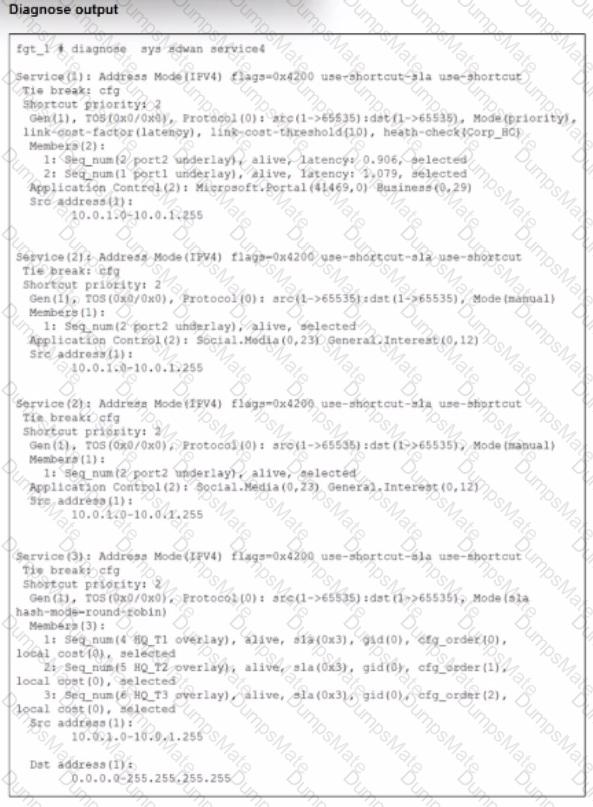
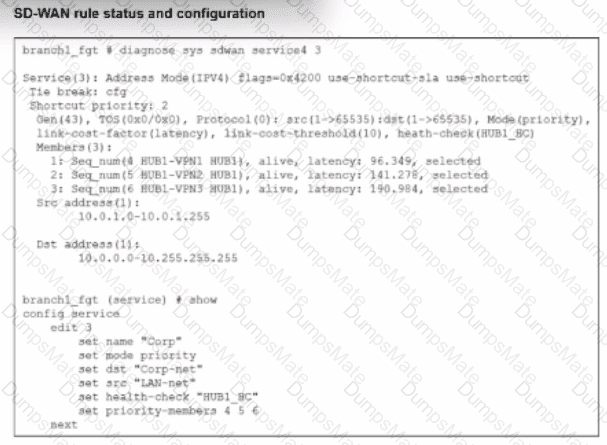
According to the SD-WAN 7.6 Core Administrator study guide and FortiOS 7.6 Administration Guide, the " implicit rule " is the default rule at the bottom of the SD-WAN rule list (ID 0). It is only evaluated if traffic does not match any manually configured SD-WAN rules.
Policy Route Table Context (Option B): SD-WAN rules are technically a specialized form of policy-based routing. For a packet to match the implicit rule, it must first pass through the routing hierarchy. If traffic matches the implicit rule, it indicates that it did not match any higher-priority user-defined SD-WAN rules or any specific entries in the manual policy route table that would have intercepted the traffic earlier.
Session Information (Option E): When you use the CLI to inspect an active session (e.g., diagnose sys session list), the output contains a field for the SD-WAN Service ID. If traffic is steered by a user-defined rule, it displays the ID of that rule (e.g., service_id=1). However, when traffic falls through to the implicit rule, the session information displays no SD-WAN service ID (it often shows as 0 or is omitted), because the implicit rule does not function as a " service " in the same way user-defined rules do.
Routing Behavior: The implicit rule follows the standard routing table (RIB/FIB) logic. It uses the priority and distance of the static routes to determine the path. If multiple paths have the same distance and priority, it uses the algorithm set by v4-ecmp-mode, but this is a function of the routing engine, not the SD-WAN engine itself.
Why other options are incorrect:
Option A: While v4-ecmp-mode (e.g., source-ip-based) is used for ECMP routing, this is part of the general FortiOS routing behavior for equal-cost paths in the FIB, whereas the implicit rule simply " hands over " the decision to that routing table.
Option C: When traffic matches the implicit rule, the session is actually flagged with vwl_id=0 and potentially dirty if a route change occurs, but vwl_default is not the standard flag name used in this specific context in the curriculum.
Option D: This is incorrect because the implicit rule does respect weight, distance, and priority as defined in the static routes within the routing table; it does not distribute traffic " regardless " of these values.