Halloween Sale Special - 75% Discount Offer - Ends in 0d 00h 00m 00s - Coupon code: 75only

NSE7_SSE_AR-26 Fortinet NSE 7 - FortiSASE 26 Architect Questions and Answers

Questions 4

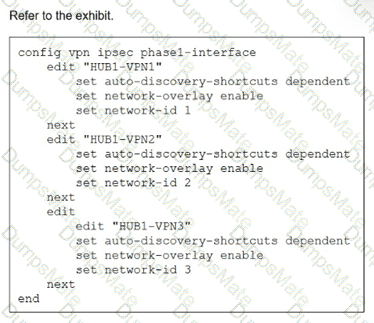
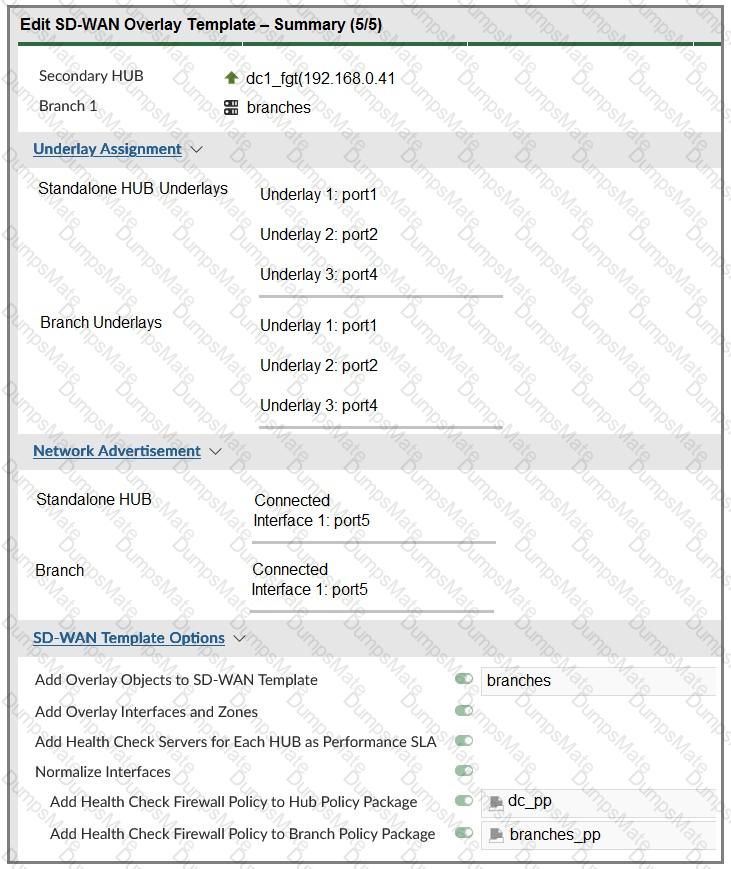
Refer to the exhibit. You update the spokes configuration of an existing auto-discovery VPN (ADVPN) topology by adding the parameters shown in the exhibit. Which is a valid objective of those settings? Choose one answer.

NSE7_SSE_AR-26 Question 4

Exhibit 1

Options:

A.

Enable the tunnels as overlay links.

B.

Convert the configuration from ADVPN to ADVPN 2.0.

C.

Prevent cross-overlay shortcuts.

D.

Prevent multiple shortcuts from being established over the same overlay.

Buy Now
Questions 5

As an MSSP administrator, you are asked to configure ADVPN on an existing SD-WAN topology. FortiManager manages the customer devices in a dedicated ADOM. The previous administrator used the SD-WAN overlay topology. Which two statements apply to this scenario? (Choose two.)

Options:

A.

You can activate auto-discovery VPN in the SD-WAN overlay template only if it is a single hub topology.

B.

When auto-discovery VPN is enabled, FortiManager updates the IPsec and BGP templates in the hub.

C.

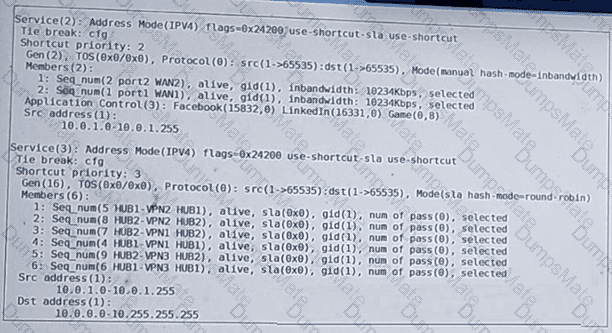
After you enable auto-discovery VPN in the overlay template, you must select between ADVPN 2.0 and ADVPN 1.0.

D.

You can activate auto-discovery VPN in the SD-WAN overlay template for any type of topology, including a primary-primary dual-hub topology.

Buy Now
Questions 6

You are tasked with configuring ADVPN 2.0 on an SD-WAN topology already configured for ADVPN. What should you do to implement ADVPN 2.0 in this scenario?

Options:

A.

Update the IPsec tunnel configurations on the hub.

B.

Update the SD-WAN configuration on the branches.

C.

Update the IPsec tunnel configuration on the branches.

D.

Delete the existing ADVPN configuration and configure ADVPN 2.0.

Buy Now
Questions 7

During the implementation of endpoint-based access controls on FortiSASE, an administrator must determine how security posture tags will improve policy enforcement and performance across managed devices.

In this context, what are two advantages of using security posture tags? (Choose two.)

Options:

A.

Security posture tags can help monitor endpoint system resource use.

B.

Security posture tags can be used to allow or deny access to network resources.

C.

Security posture tags can determine the security posture of an endpoint.

D.

Security posture tags can be assigned to endpoint profiles based on user groups.

Buy Now
Questions 8

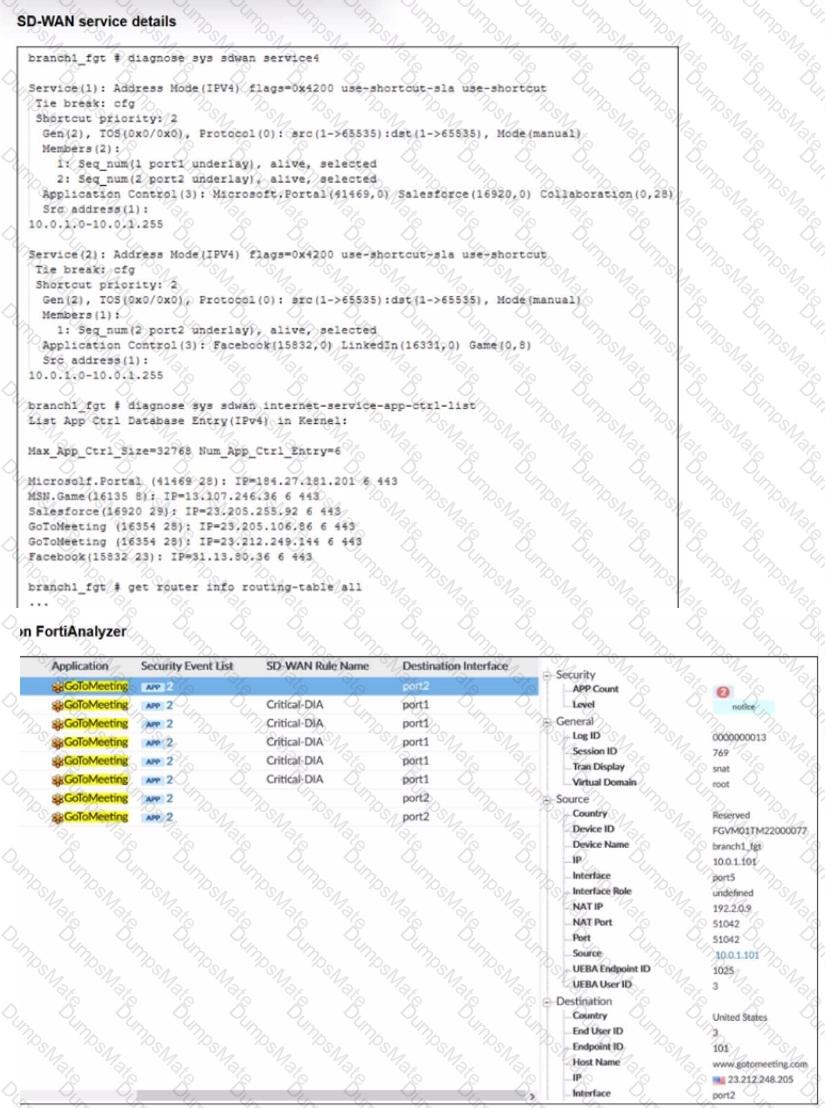
Refer to the exhibits. An administrator is testing application steering in SD-WAN. Before generating test traffic, the administrator collected the information shown in the first exhibit. After generating GoToMeeting test traffic, the administrator examined the corresponding traffic log on FortiAnalyzer, which is shown in the second exhibit. The administrator noticed that the traffic matched the implicit SD-WAN rule, but they expected the traffic to match rule ID 1. Which two reasons explain why some log messages show that the traffic matched the implicit SD-WAN rule? (Choose two.)

NSE7_SSE_AR-26 Question 8

Exhibit 1

Options:

A.

Full SSL inspection is not enabled on the matching firewall policy.

B.

The session 3-tuple did not match any of the existing entries in the ISDB application cache.

C.

FortiGate could not refresh the routing information on the session after the application was detected.

D.

No configured SD-WAN rule matches the traffic related to the collaboration application GoToMeeting

Buy Now
Questions 9

When you use the command diagnose sys session list, how do you identify the sessions that correspond to traffic steered according to SD-WAN rules?

Options:

A.

You identify sessions steered according to SD-WAN rules with the flag vwl.

B.

You cannot identify SD-WAN sessions. You must use the sdwar. session filter.

C.

You identify sessions steered according to SD-WAN rules with the data vwl_mbr_seq.

D.

You identify sessions steered according to SD-WAN rules with the data 3dwan_service_id.

Buy Now
Questions 10

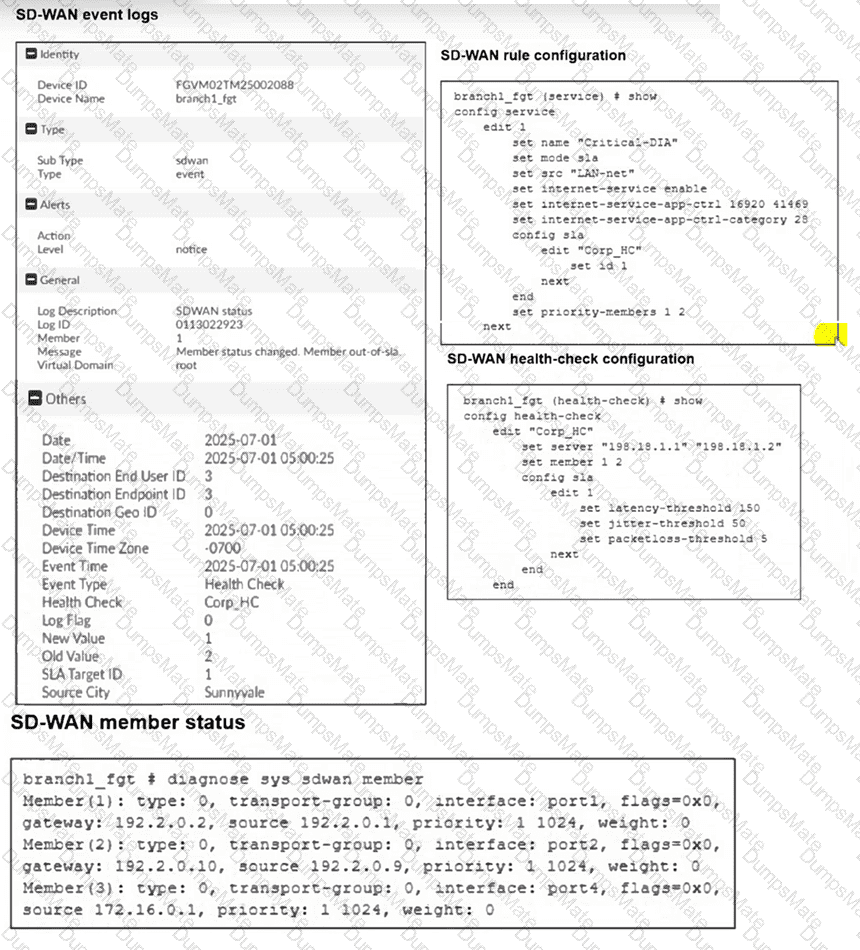
Refer to the exhibits. Two SD-WAN event logs, the member status, the SD-WAN rule configuration, and the health-check configuration for a FortiGate device are shown. Immediately after the log messages are displayed, how will the FortiGate steer the traffic based on the information shown in the exhibits? Choose one answer.

NSE7_SSE_AR-26 Question 10

Exhibit 1

Options:

A.

FortiGate skips SD-WAN rule ID 1.

B.

FortiGate uses port2 to steer the traffic for SD-WAN rule ID 1.

C.

FortiGate uses port1 to steer the traffic for SD-WAN rule ID 1.

D.

FortiGate uses port1 or port2 to steer the traffic for SD-WAN rule ID 1.

Buy Now
Questions 11

An administrator is configuring SD-WAN to load balance their network traffic. Which two things should they consider when setting up SD-WAN? (Choose two.)

Options:

A.

You can select the outbandwidth hash mode with all strategies that allow load balancing.

B.

Only the manual and best-quality strategies allow SD-WAN load balancing.

C.

When applicable. FortiGate load balances the traffic through all members that meet the SLA target.

D.

SD-WAN load balancing is possible only using the best quality and lowest cost (SLA) strategies.

Buy Now
Questions 12

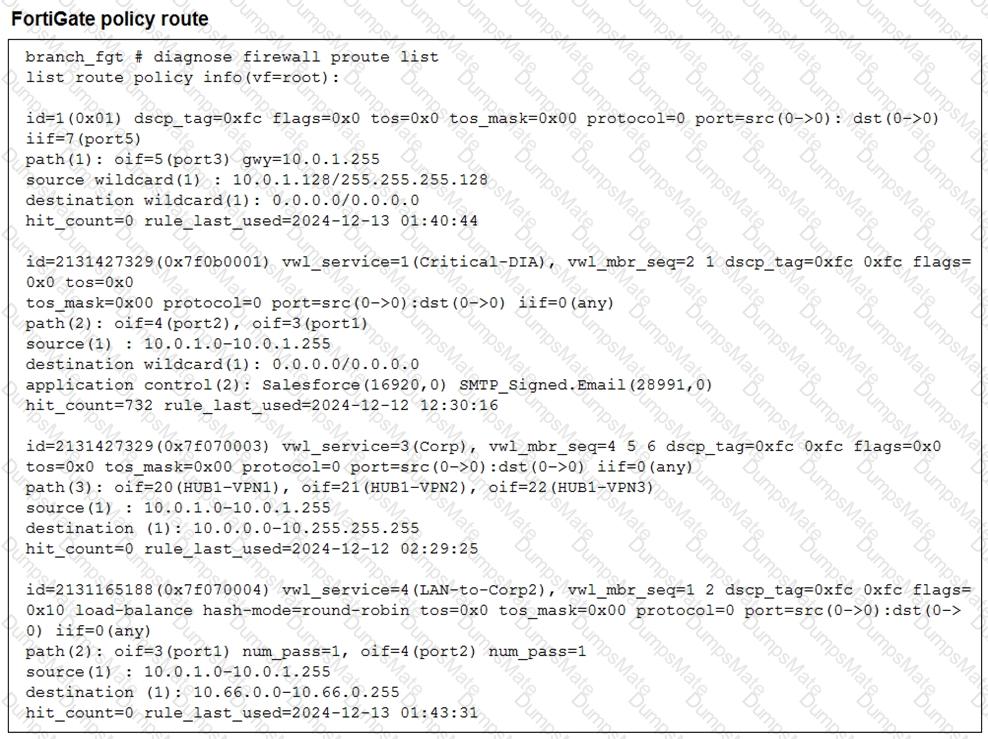
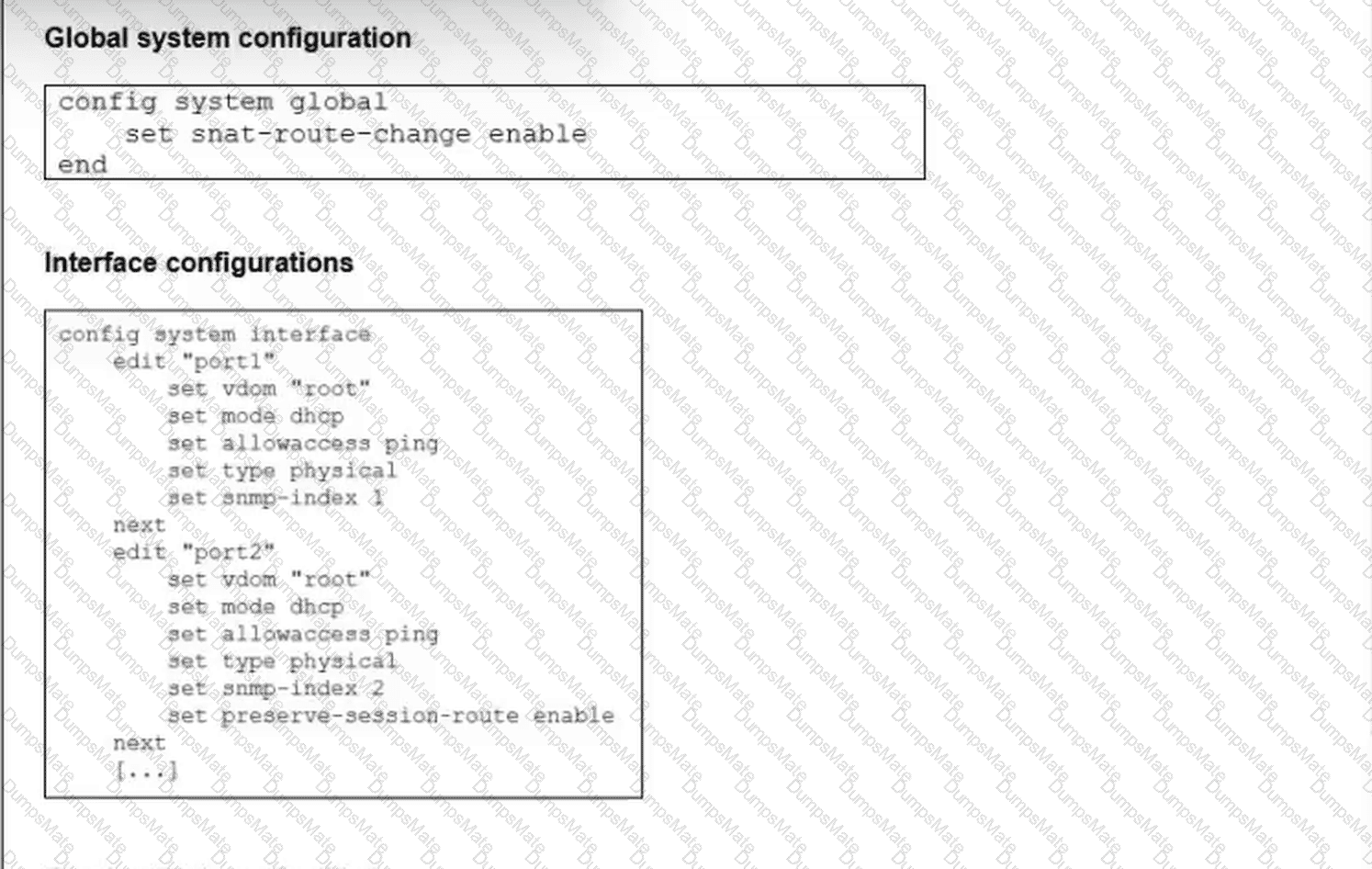
Refer to the exhibit. What conclusions can you draw about the traffic received by FortiGate originating from the source LAN device 10.0.1.133 and destined for the company’s SMTP mail server at 10.66.0.125?

NSE7_SSE_AR-26 Question 12

Exhibit 1

Options:

A.

FortiGate steers the traffic from the LAN device 10.0.1.133 to the company SMTP mail server 10.66 0.125 through port3.

B.

ForliGate steers the traffic from the LAN device 10.0.1.133 to the company SMTP mail server 10.66.0.125 through port2.

C.

FortiGate steers the traffic from the LAN device 10.0.1.133 to the company SMTP mail server 10.66.0.125 through the SD-WAN member ID 4.

D.

FortiGate steers the traffic from the LAN device 10.0.1.133 to the SMTP mail server 10.66.0.125 through the SD-WAN member ID 1 or 2.

Buy Now
Questions 13

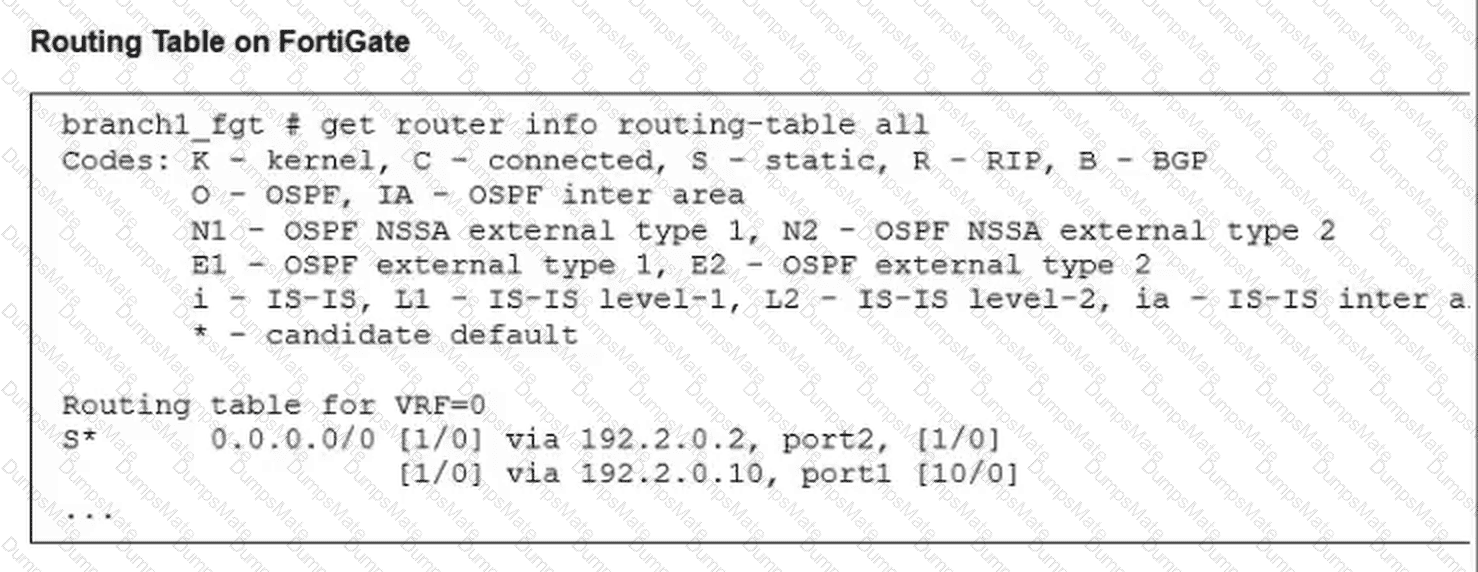
Refer to the exhibits.

The administrator increases the member priority on port2 to 20.

Assuming the route egressing port2 is still valid, upon configuration changes and the receipt of new packets.

Which two actions does FortiGate perform on existing sessions established over port2? (Choose two.)

NSE7_SSE_AR-26 Question 13

Exhibit 1 — Global system and interface configuration

NSE7_SSE_AR-26 Question 13

Exhibit 2 — FortiGate routing table

Options:

A.

FortiGate updates the gateway information of the sessions with SNAT so that they use port1 instead of port2.

B.

FortiGate flags all source network address translation (SNAT) sessions as dirty only if the administrator has assigned an IP pool to the firewall policies with NAT.

C.

FortiGate routes new sessions over port1.

D.

FortiGate flags all sessions as dirty.

E.

FortiGate continues routing all existing sessions over port2.

Buy Now
Questions 14

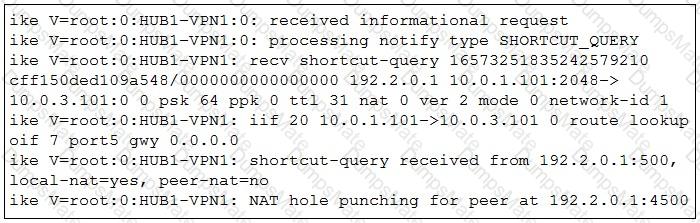
Refer to the exhibit. Which statement best describe the role of the ADVPN device in handling traffic?

NSE7_SSE_AR-26 Question 14

Exhibit 1

Options:

A.

This is a spoke that has received a direct shortcut query from a remote spoke.

B.

This is a hub, and two spokes, 192.2.0.1 and 10.0.3.101, establish a shortcut.

C.

This is a hub that has received a shortcut query from a spoke and has forwarded it to another spoke.

D.

This is a spoke that has received a shortcut query from a remote hub.

Buy Now
Questions 15

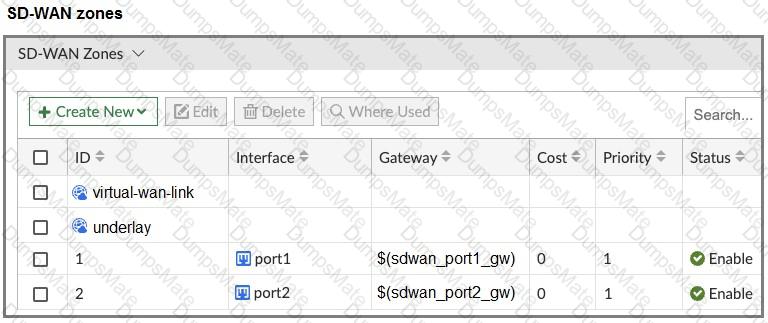
The FortiGate devices are managed by FortiManager, and are configured for direct internet access (DIA). You confirm that DIA is working as expected for each branch, and check the SD-WAN zone configuration and firewall policies shown in the exhibits. Then, you use the SD-WAN overlay template to configure the IPsec overlay tunnels. You create the associated SD-WAN rules to connect existing branches to the company hub device and apply the changes on the branches. After those changes, users complain that they lost internet access. DIA is no longer working. Based on the exhibit, which statement best describes the possible root cause of this issue?

NSE7_SSE_AR-26 Question 15

Exhibit 1

NSE7_SSE_AR-26 Question 15

Exhibit 2

NSE7_SSE_AR-26 Question 15

Exhibit 3

Options:

A.

The SD-WAN overlay template defines a zone for each underlay interface and moves the interfaces into those zones.

B.

The SD-WAN overlay template didn’t configure a firewall policy to allow traffic through the overlay.

C.

The SD-WAN overlay template redefines the interface gateway addresses if they are defined with metadata variables.

D.

The SD-WAN overlay template updates the SD-WAN template and the rules.

Buy Now
Questions 16

In a newly deployed FortiSASE environment using default configuration settings, an administrator provisions endpoint connectivity through FortiClient. As part of the onboarding process, specific configuration elements are automatically synchronized from FortiSASE to connected endpoints without manual intervention.

Which two settings are automatically pushed from FortiSASE to FortiClient, in this default deployment scenario? (Choose two.)

Options:

A.

FortiSASE certificate authority (CA) certificate

B.

Tunnel profile configuration for secure connectivity

C.

FortiSandbox settings

D.

Security posture tag definitions

Buy Now
Questions 17

You used the HUB IPsec_Recommended and the BRANCH IPsec_Recommended templates to define the overlay topology. Then, you used the SD-WAN template to define the SD-WAN members, rules, and performance SLAs. You applied the changes to the devices and want to use the FortiManager monitors menu to get a graphical view that shows the status of each SD-WAN member. Which statement best explains how to obtain this graphical view?

Options:

A.

Use the SD-WAN monitor template view to get a map view of the branches, hub, and tunnel status, including the SLA pass or missed status.

B.

Use the SD-WAN monitor table view to get a donut view and a table view that shows the status of each SD-WAN member, including the SLA pass or missed status.

C.

Use the VPN monitor map view to get a map view of the branches, hub, and tunnel status, including the SLA pass or missed status.

D.

Use the SD-WAN monitor asset view to get a donut view and a table view that shows the status of each device and the SLA status of each SD-WAN member.

Buy Now
Questions 18

Refer to the exhibit.

NSE7_SSE_AR-26 Question 18

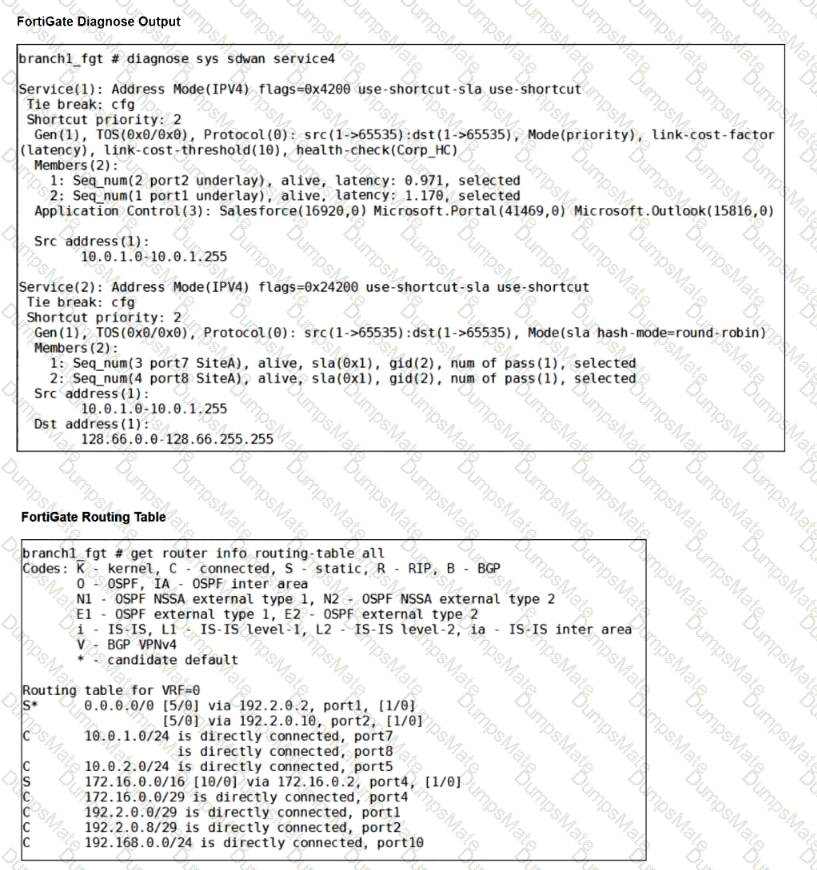
How does FortiGate handle the ICMP traffic with the source IP address 10.0.1.125 and the destination IP address 128.66.0.125?

Options:

A.

FortiGate drops the traffic flow.

B.

FortiGate load balances the traffic flow through port7 and port8.

C.

FortiGate steers the traffic flow through port2.

D.

FortiGate routes the traffic flow according to the forwarding information base (FIB).

Buy Now
Questions 19

You configure the overlay tunnels for an SD-WAN hub-and-spoke topology defined with IPsec tunnels, BGP on loopback, and dynamic BGP.

Which are two recommended IPsec settings for this topology? (Choose two.)

Options:

A.

On the spoke, set the parameter net-device to enable.

B.

On the hub, set the tunnel type to static.

C.

On the spoke, configure the parameter localid .

D.

On the hub, set the parameter mode-cfg to enable.

Buy Now
Questions 20

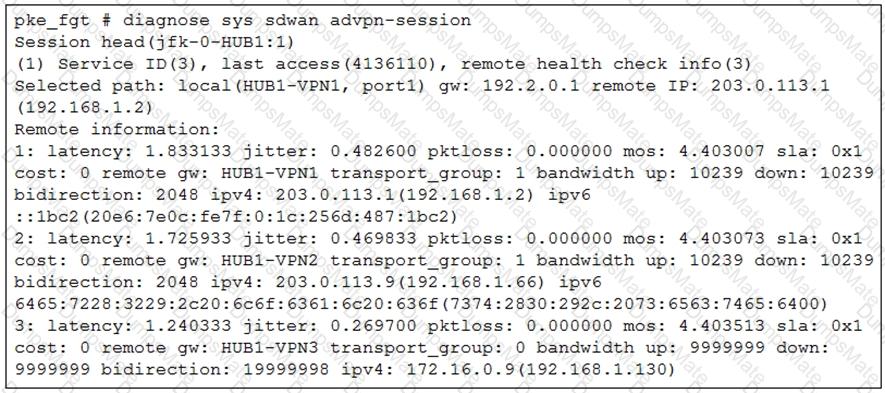
Refer to the exhibit that shows a diagnose output on FortiGate. Based on the output shown in the exhibit, what can you say about the device role and how it handles health checks?

NSE7_SSE_AR-26 Question 20

Exhibit 1

Options:

A.

The device is a spoke. It receives health-check measures for the tunnels of another spoke.

B.

The device is a hub. It receives embedded health-check measures for each tunnel from the spoke.

C.

The device is a spoke. It provides embedded health-check measures for each tunnel to the hub.

D.

The device is a hub. It receives health-check measures for the tunnels of a spoke.

Buy Now
Questions 21

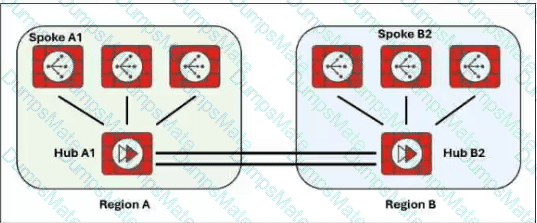
Refer to the exhibit.

Two hub-and-spoke groups are connected through redundant site-to-site IPsec VPNs between Hub 1 and Hub 2.

Which two configuration settings are required for spoke A1 to establish an auto-discovery VPN (ADVPN) shortcut with spoke B2? (Choose two.)

NSE7_SSE_AR-26 Question 21

Exhibit — Hub-and-spoke ADVPN topology

Options:

A.

On the spokes, auto-discovery-receiver must be enabled on the IPsec VPNs to the hub.

B.

On the spokes, auto-discovery-sender must be enabled on the IPsec VPNs to hubs.

C.

On the hubs, auto-discovery-receiver must be enabled on the IPsec VPNs to spokes.

D.

On the hubs, auto-discovery-forwarder must be enabled on the IPsec VPNs to hubs.

Buy Now
Questions 22

You are planning a large SD-WAN deployment with approximately 1000 spokes and want to allow ADVPN between the spokes. Some remote sites use FortiSASE to connect to the company ' s SD-WAN hub. Which overlay routing configuration should you use?

Options:

A.

BGP on loopback with dynamic BGP for ADVPN shortcut routing.

B.

BGP on loopback with IPsec phase 2 selectors for ADVPN shortcut routing.

C.

BGP per overlay with dynamic BGP for ADVPN shortcut routing.

D.

BGP per overlay with BGP next-hop convergence for ADVPN shortcut routing.

Buy Now
Questions 23

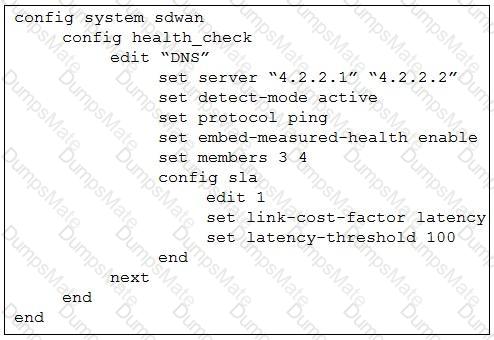
Refer to the exhibit. The exhibit shows the health-check configuration on a FortiGate device used as a spoke. You notice that the hub FortiGate doesn’t prioritize the traffic as expected. Which two configuration elements should you check on the hub? (Choose two.)

NSE7_SSE_AR-26 Question 23

Exhibit 1

Options:

A.

The performance SLA has the parameter priority-out-sla configured.

B.

This performance SLA uses the same members.

C.

The performance SLA uses the same criteria.

D.

The performance SLA is configured with set embedded-measure accept.

Buy Now
Questions 24

Refer to the exhibit.

NSE7_SSE_AR-26 Question 24

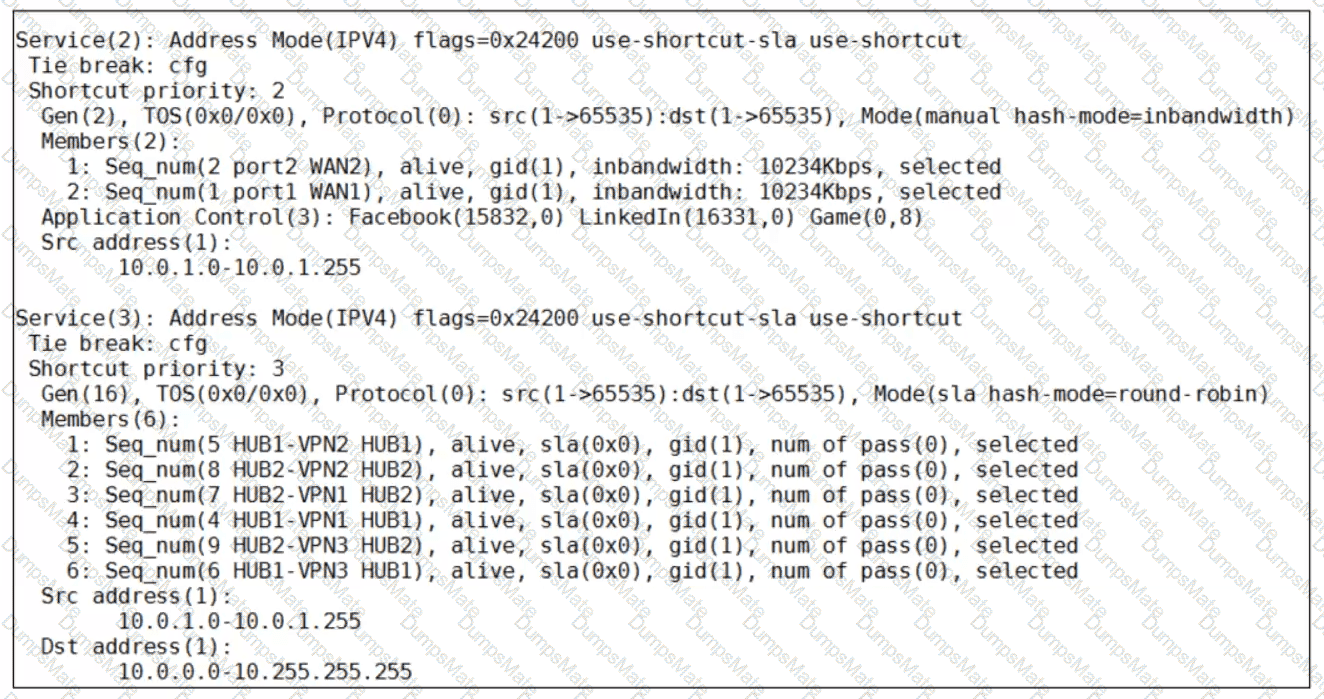
The administrator configured two SD-WAN rules to load balance traffic.

Which interfaces does FortiGate use to steer the SMTP traffic from 10.0.1.124 to 10.0.0.254?

Options:

A.

Any interface in the WAN1 or WAN2 zones.

B.

FortiGate routes the traffic according to the FIB.

C.

HUB1-VPN2

D.

Any interface in the HUB1 or HUB2 zones.

Buy Now
Questions 25

An administrator is enforcing endpoint network lockdown using FortiSASE to ensure that devices access the internet only under defined security conditions. The lockdown state must be released automatically when the endpoint meets specific trust or connectivity criteria.

Which two conditions can trigger the release of the network lockdown on an endpoint? (Choose two answers.)

Options:

A.

The endpoint is detected as being on-net.

B.

The endpoint establishes a connection to the FortiSASE tunnel.

C.

The endpoint is rebooted.

D.

The endpoint is evaluated as compliant using security posture tags.

Buy Now
Questions 26

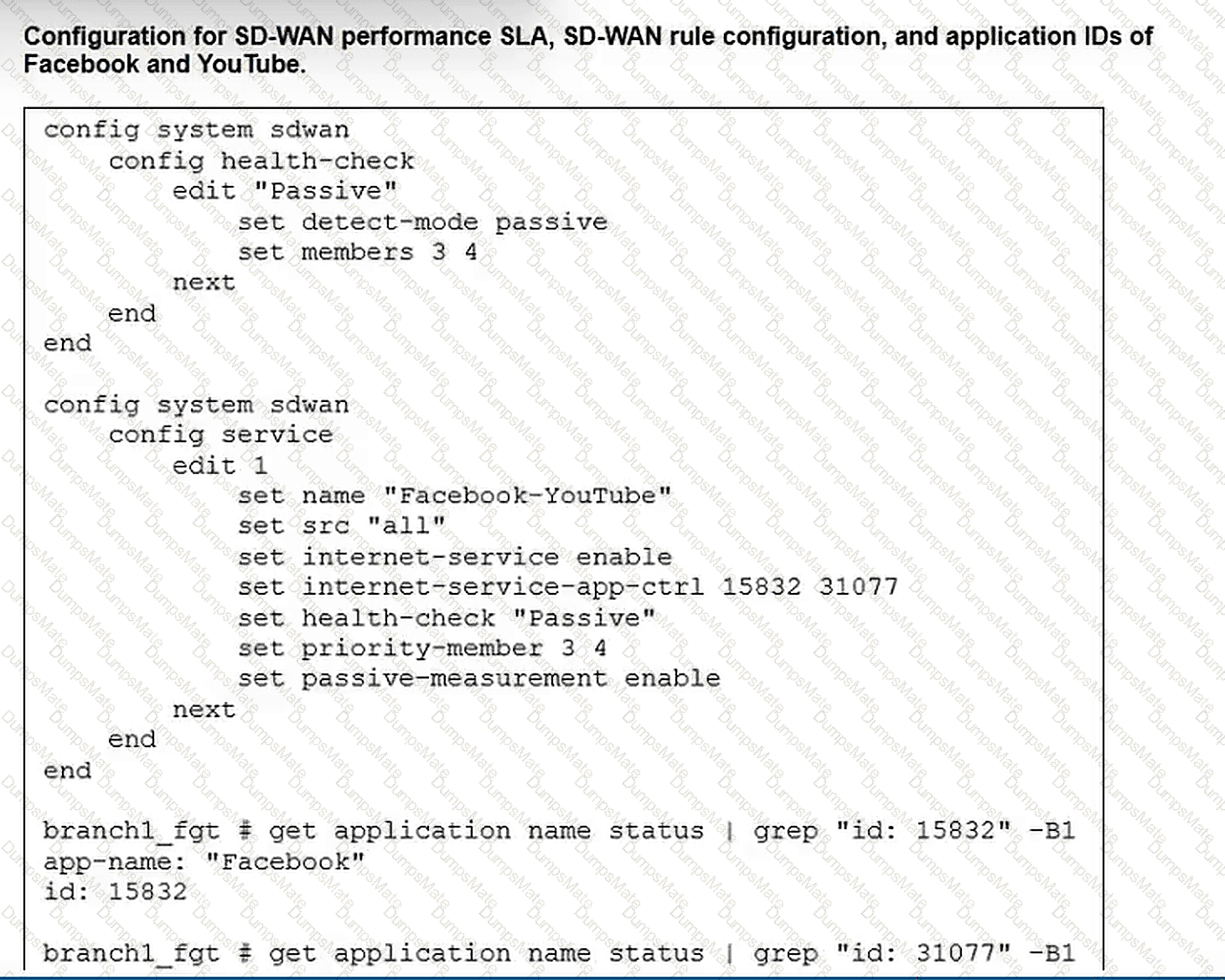
Refer to the exhibits.

Which two statements are true about the health and performance of SD-WAN members 3 and 4? (Choose two.)

NSE7_SSE_AR-26 Question 26

Exhibit — Passive performance SLA and application IDs

Options:

A.

Encrypted traffic is not used for the performance measurement.

B.

The performance is an average of the metrics measured for Facebook and YouTube traffic passing through the member.

C.

Only related TCP traffic is used for performance measurement.

D.

FortiGate identifies the member as dead when there is no Facebook and YouTube traffic passing through the member.

Buy Now
Questions 27

In the context of SD-WAN, the terms underlay and overlay are commonly used to categorize links.

Which two statements about underlay and overlay links are correct? (Choose two.)

Options:

A.

Wireless connections can be used to build overlay links.

B.

Only wired connections can be used as underlay links.

C.

A VLAN is a type of overlay link.

D.

FortiLink interface is considered a underlay link.

E.

Overlay links provide routing flexibility.

Buy Now
Questions 28

An existing FortiSASE customer has a third-party router in a remote office and wants to secure internet access for users at that location.

Which add-on license is required to enable this setup?

Options:

A.

FortiSASE Secure Private Access (SPA) add-on

B.

FortiSASE global add-on

C.

FortiSASE secure web gateway (SWG) add-on

D.

FortiSASE branch on-ramp add-on

Buy Now
Questions 29

Refer to the exhibit.

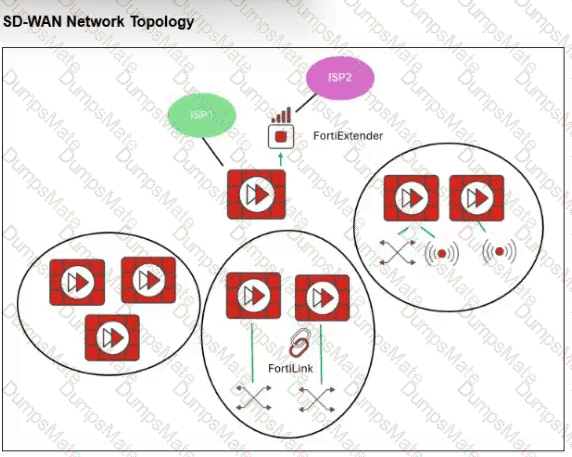
You want to configure SD-WAN on a network, as shown in the exhibit.

The network contains many FortiGate devices. Some are used as next-generation firewalls (NGFW), and some are installed with extensions such as FortiSwitch, FortiAP, or FortiExtender.

Which factors should you consider when planning your deployment?

NSE7_SSE_AR-26 Question 29

Exhibit — SD-WAN network topology

Options:

A.

You should exclude the FortiGate devices with two types of extensions from the SD-WAN topology.

B.

You should build multiple SD-WAN topologies. Each topology should contain only one type of extension.

C.

You can build an SD-WAN topology that includes all devices. The hubs can be FortiGate devices with FortiExtender.

D.

You can build an SD-WAN topology that includes all devices. You must define multiple regions and group devices by extension type.

Buy Now
Questions 30

Which component, typically categorized under network edge connectivity rather than cloud-delivered security controls, is incorporated as a foundational element within a secure access service edge (SASE) architecture but is not considered part of a security service edge (SSE) framework?

Options:

A.

Secure web gateway (SWG)

B.

Software-Defined WAN (SD-WAN)

C.

Zero trust network access (ZTNA)

D.

Cloud access security broker (CASB)

Buy Now
Questions 31

What are two benefits of deploying secure private access with SD-WAN? (Choose two.)

Options:

A.

A direct access proxy tunnel from FortiClient to the on-premises FortiGate

B.

ZTNA posture check performed by the hub FortiGate

C.

Inline security inspection by FortiSASE

D.

Support of both TCP and UDP applications

Buy Now
Questions 32

SD-WAN interacts with many other FortiGate features. Some of them are required to allow SD-WAN to steer the traffic. Which three configuration elements that you must configure before FortiGate can steer traffic according to SD-WAN rules? (Choose three.)

Options:

A.

Firewall policies

B.

Interfaces

C.

Security profiles

D.

Traffic shaping

E.

Routing

Buy Now
Questions 33

Refer to the exhibit. The administrator configured two SD-WAN rules to load balance traffic. Which interfaces does FortiGate use to steer the traffic from 10.0.1.124 to 10.0.0.254? Choose one answer.

NSE7_SSE_AR-26 Question 33

Exhibit 1

Options:

A.

port1 or port2

B.

FortiGate routes the traffic according to the FIB.

C.

HUB1-VPN2

D.

Any interface in the HUB1 or HUB2 zones

Buy Now
Exam Code: NSE7_SSE_AR-26
Exam Name: Fortinet NSE 7 - FortiSASE 26 Architect
Last Update: Oct 24, 2026
Questions: 110

PDF + Testing Engine

$41.25  $164.99

Testing Engine

$31.25  $124.99
buy now NSE7_SSE_AR-26 testing engine

PDF (Q&A)

$26.25  $104.99
buy now NSE7_SSE_AR-26 pdf
dumpsmate guaranteed to pass

24/7 Customer Support

DumpsMate's team of experts is always available to respond your queries on exam preparation. Get professional answers on any topic of the certification syllabus. Our experts will thoroughly satisfy you.

Site Secure

mcafee secure

TESTED 25 Oct 2026