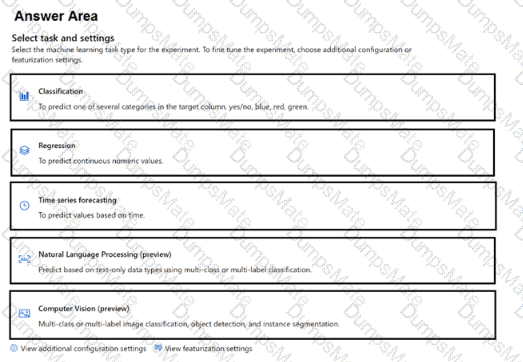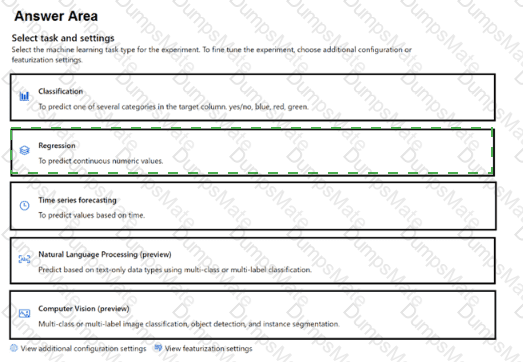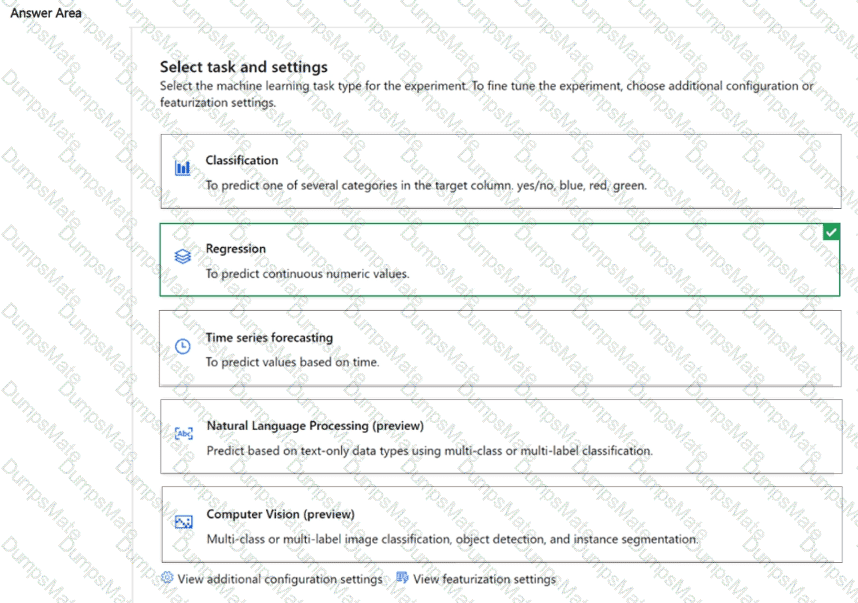
According to the Microsoft Azure AI Fundamentals (AI-900) and Azure Machine Learning documentation, regression is the appropriate machine learning task when the goal is to predict continuous numeric values—such as prices, sales amounts, or other measurable quantities.
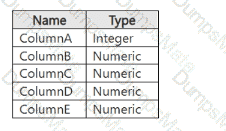
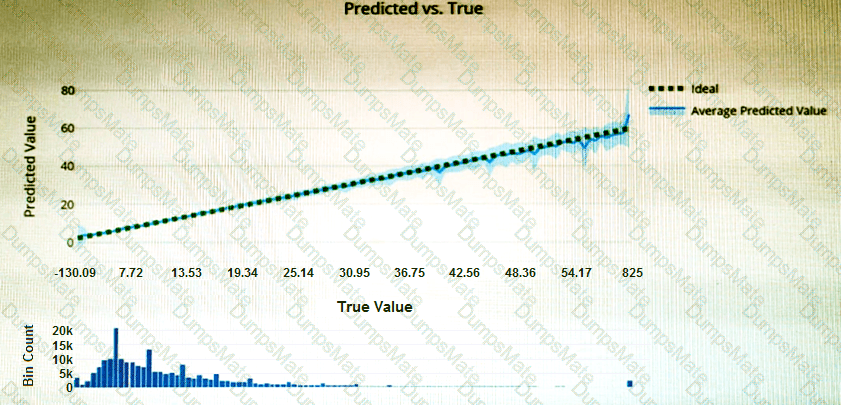
In this scenario, the dataset contains motor vehicle sales data, and the objective is to predict vehicle sale values. A vehicle’s sale value (price) is a continuous numeric variable, meaning it can take on a wide range of possible numbers (for example, $15,000, $28,500, $42,300). Regression models are designed to analyze relationships between input features (like make, model, mileage, age, fuel type) and a continuous output variable (price).
Automated Machine Learning (AutoML) in Azure simplifies this process by automatically testing multiple regression algorithms (e.g., Linear Regression, Random Forest, Gradient Boosted Trees) and hyperparameters to find the best-performing model.
Let’s evaluate why the other options are incorrect:
Classification – Used for predicting discrete categories (e.g., car type: sedan, SUV, or truck). Sale value prediction is not categorical.
Time series forecasting – Used when predicting future values based on time-dependent data (e.g., sales over months or years). The question focuses on predicting price based on vehicle characteristics, not over time.
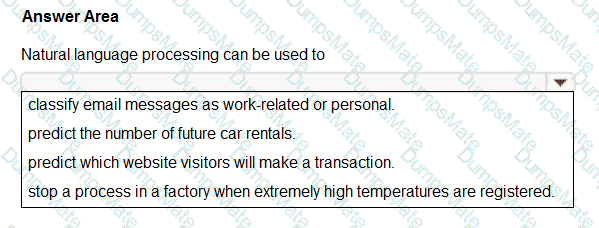
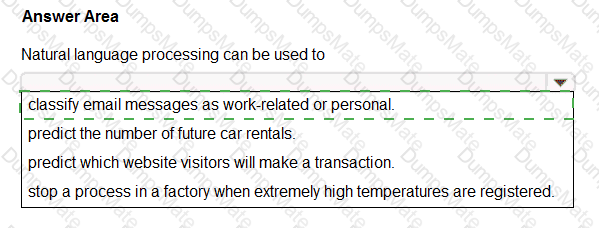
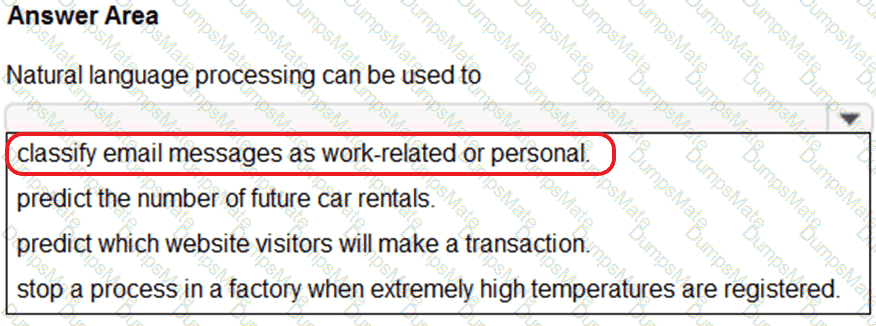
Natural Language Processing (NLP) – Deals with text-based data, not numeric vehicle data.
Computer Vision – Applies to image-based tasks (e.g., detecting car types from photos).
Therefore, per Microsoft Learn’s Automated ML task selection guidance, when predicting a numeric output like vehicle sale value, the correct machine learning task type is Regression.
✅ Final Answer: Regression