Grab 75% Off This Black Friday: Use coupon code below to save on all exam bundles! - Ends in 0d 00h 00m 00s - Coupon code: 75only

HPE7-A11 HPE Network Campus Access Professional Architect Exam Questions and Answers

Questions 4

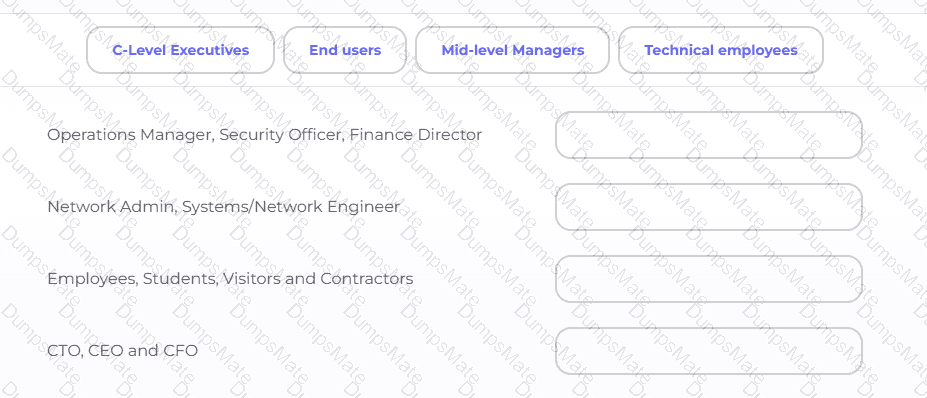
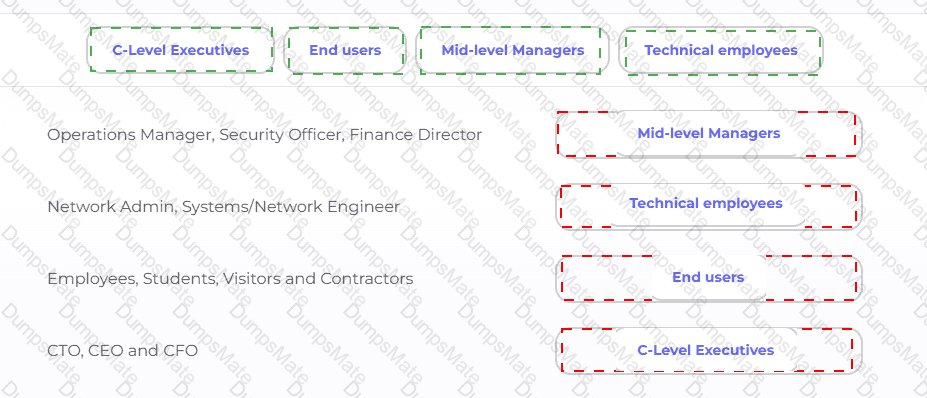
Match the stakeholders to the appropriate roles.

HPE7-A11 Question 4

Options:

Buy Now
Questions 5

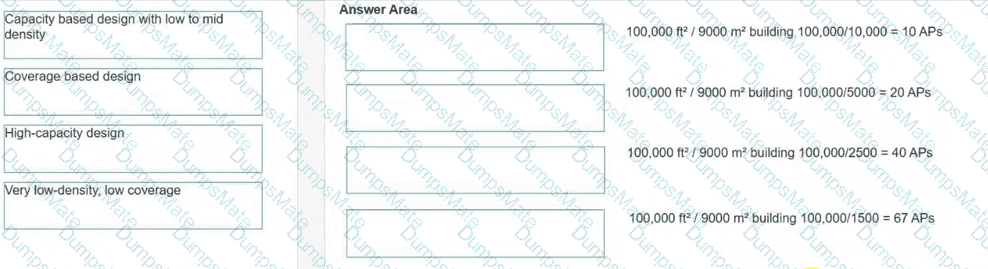
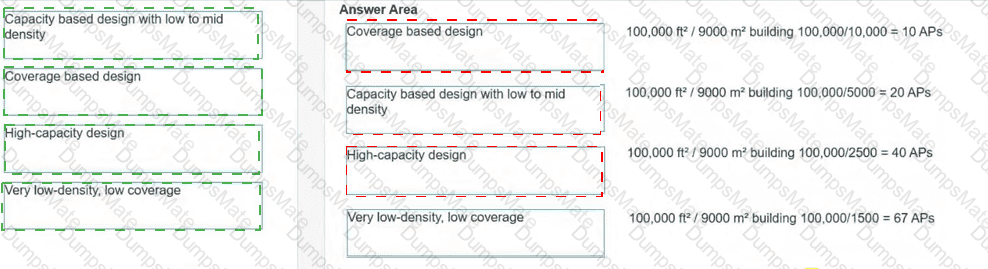
Match each deployment type to its usage scenario.

HPE7-A11 Question 5

Options:

Buy Now
Questions 6

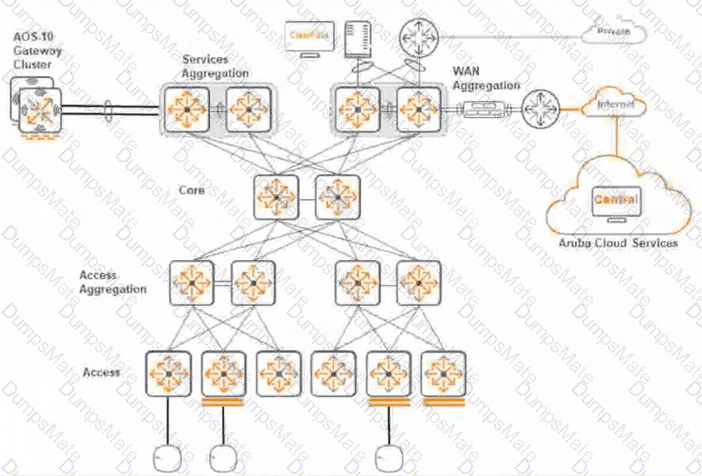
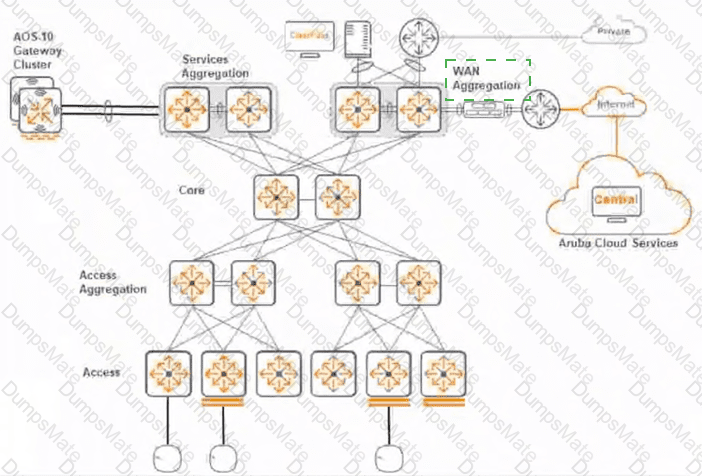
Based on this campus design, select the layer most suitable to be designed as a Border Persona when considering an EVPN VXLAN Fabric.

Original network architecture exhibit

HPE7-A11 Question 6

Options:

Buy Now
Questions 7

XYZ Regional Hospital is an integrated healthcare system comprising hospitals, neighborhood health centers, and small doctor offices. XYZ Regional Hospital recently merged with 4x neighborhood health centers and 125 doctor branch offices. Its wireless, wired-access, and AAA solutions are outdated and must be replaced.

XYZ Regional Hospital wants to future-proof and improve efficiency at every site by enhancing wired and wireless access and migrating to centralized, unified wired/wireless and policy management that provides uninterrupted availability of all systems.

Locations:

    XYZ Regional Hospital is located in New York City.

    Dila Health Center is located in City A.

    Mount Health Center is located in City B.

    Rock Health Center is located in City C.

    Branch clinics are located at different locations across the United States.

Requirements:

    Provide, through management software, a single pane of glass to manage wired and wireless LANs and VPNs across campus, branch, and remote locations through a web/cloud architecture that provides near-real-time insight, troubleshooting tools, and Service Level performance reporting.

    Seamless integration across wired, wireless, WAN, SD-Branch, and IoT.

    Provide secure wireless access for all Regional Hospital employees and partners, and provide wireless Internet access to medical citizens when they visit our facilities.

    All access points must support these features and specifications: 802.11 ax (Wi-Fi 6E Certified).

    Security options including WP2/WPA3 and 802.1X with Radius secure authentication.

    Identify and authenticate every wireless and wired device.

    End-to-end role-based security.

    Seamless mobility across the hospital for medical teams, patients, and visitors.

    Reduce Wi-Fi deployment time from days to hours and enable Zero-Touch deployments across the site.

    Establish a resilient, future-ready network infrastructure with the intelligence, scalability, and intuitive toolsets to meet emerging needs.

    Fully redundant branch solution with dynamic path selection to the hospital.

XYZ Regional Hospital is merging with 125 doctors' branch offices. You are tasked with creating a BoM for this project. Currently, these offices have no connectivity back to the data centers used by the hospital.

The branch-office requirements are listed below:

    SaaS-managed Wi-Fi 6E or greater Certified Access Points (model with an external antenna option).

    Highly available, always-on network to reduce downtime and client traffic disruptions.

    Load-balance traffic across multiple WAN uplinks.

    Support IDS/IPS.

    Perform dynamic segmentation on the edge ports.

    Support zero-touch provisioning (ZTP).

    Cost effectiveness.

Which HPE Aruba Networking switch model best fulfills the stated design and deployment requirements?

Options:

A.

AOS-CX 6100 series switch(s)

B.

AOS-CX4100i series switch(s)

C.

AOS-CX 6200 series switch(s)

D.

AOS-CX 6000 series switch(s)

Buy Now
Questions 8

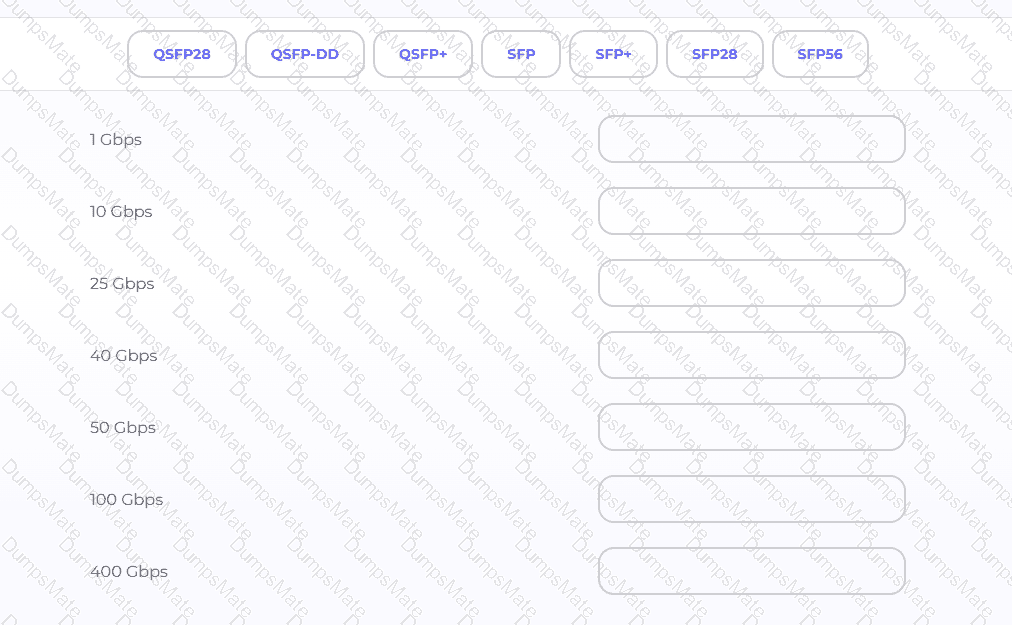
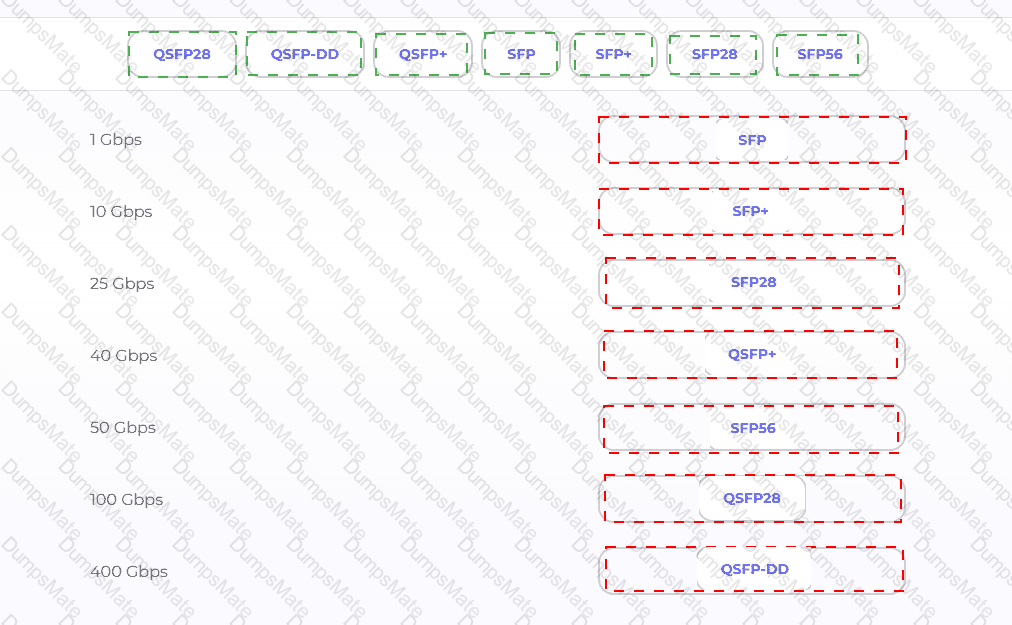
Select the appropriate fiber-optic standard for each listed link speed.

HPE7-A11 Question 8

Options:

Buy Now
Questions 9

As part of several technical proposals for a customer deploying both Wi-Fi 7 high-throughput HD and very high-throughput VHD networks based on HPE Aruba Networking AOS-10, you are identifying key considerations for radio frequency (RF) design and channel optimization.

Which statements are recommended AOS-10 best practices for RF planning and should be included in your proposals to deliver optimal wireless performance?

Choose two.

Options:

A.

The HPE Aruba Networking Central default radio profile has Dynamic Frequency Selection (DFS) channels disabled, as defined by the 802.11h standard.

B.

The Wi-Fi Alliance’s Wi-Fi 6 standard can utilize channel widths from 20 MHz up to 160 MHz without relying on DFS channels.

C.

With 1024-QAM or higher designs, it is common to disable some APs’ 2.4 GHz radios for client use.

D.

To ensure broad client compatibility, custom radio profiles should include channels 169, 173, and 177.

E.

UNII-4 channels in radio profiles should not be enabled in Guest environments in most situations.

Buy Now
Questions 10

Which statement is true regarding device capabilities?

Options:

A.

HPE Aruba Networking’s best practice is to use whatever the AP model supports as a maximum.

B.

You should determine if devices support 2.4 GHz or 5 GHz. No consideration is yet required for 6 GHz as it has yet to be ratified.

C.

Wi-Fi 6E supports 6 GHz for both indoor and outdoor deployments since it was ratified in April of 2020.

D.

HPE Aruba Networking recommends 40-50 devices per radio for a generic office deployment.

Buy Now
Questions 11

You are designing a solution with OS10-based access points and redundant gateways, with these requirements:

    Wi-Fi6E-based access points

    Support for tunneled traffic

    Application visibility

    Rogue APs

    Live upgrades

    Air Slice

    Cloud Guest Authentication

    AI Insights

Which licenses are required?

Choose two.

Options:

A.

AP Foundation

B.

Gateway Foundation

C.

AP Advanced

D.

WLAN Gateway

Buy Now
Questions 12

You are a member of a cross-functional team developing a detailed design proposal for a customer deploying EVPN-VXLAN in a modern campus core and data center fabric. The customer is moving from a traditional VLAN-based Layer 2 design to a VXLAN-based overlay architecture to support segmentation scalability and automation.

As the solution undergoes review, you are asked to contribute by identifying and explaining core technical behaviors and configuration considerations critical to the success of EVPN-VXLAN in this environment.

Which statements accurately describe key characteristics of EVPN-VXLAN in modern campus or data center networks?

Options:

A.

MP-BGP is utilized as the control plane that establishes GRE over UDP between VTEPs. known as VXLAN.

B.

ARP suppression is supported in EVPN-VXLAN fabrics through host route information carried in EVPN Type-2 NLRI.

C.

VTEPs apply unique Route Distinguishers prefixes to NLRI records, enabling selective advertising.

D.

Virtual Network Based Tunneling (VBNT) is a term used to describe static segmentation based on EVPN-VXLAN.

Buy Now
Questions 13

Which uplink oversubscription ratios satisfy A.B.C.'s requirements, assuming they can be adjusted later based on actual performance and capacity requirements?

Choose two.

Options:

A.

12:1

B.

4:1

C.

7:1

D.

24:1

E.

1:10

Buy Now
Questions 14

A colleague has produced a proposed design for a large enterprise customer that uses HPE Aruba Networking AOS-CX 6300 switches at the wired access layer. The customer requires a secure, scalable solution founded on Zero Trust Security (ZTS) principles.

In the current environment, endpoint devices connected to access switches are configured to transmit 802.1Q-tagged frames, and the new design plans to tunnel traffic from the switches to an AOS-10 Gateway cluster by using User-Based Tunneling (UBT) in its default mode.

During a design review, you are asked to determine whether this solution supports the customer requirement to retain endpoint VLAN tags across the tunnel.

You recommend a modification, explaining that the proposed default configuration will not satisfy the customer’s technical requirement.

Which UBT configuration would support the customer requirement to preserve VLAN tagging from the endpoints across the UBT tunnel to the gateway?

Options:

A.

Configure UBT extend VLAN mode, ensure VLAN 10 exists on the 6300 switch and at the cluster.

B.

Configure UBT reserved VLAN mode and assign VLAN 10 to the endpoint aruba user role applied on the switch.

C.

Configure UBT reserved VLAN mode, make no VLAN assignment to the endpoint aruba user role applied on the switch.

D.

Configure UBT extend VLAN mode, VLAN 10 is only required to exist on the GW cluster.

Buy Now
Questions 15

A large multinational financial institution has engaged you to design a new full-stack wired and wireless network for its new 6-story regional office building. The facility’s bottom two floors will be retail space for a large banking branch. The upper floors will be carpeted corporate office space, with each floor approximately 100,000 sq ft (9290 sq m). Data centers are all offsite and are outside this project’s scope. The customer is underserved by its current L2-based network infrastructure and wants to use modern best practices in the new design. The network must be fully resilient and fault-tolerant, with dynamic segmentation at the edge.

The retail space will provide public guest Wi-Fi access. Retail associates will use corporate tablets for customer service, and the retail floors will contain a mixture of wired and wireless devices. Corporate users will primarily connect wirelessly, although several wired clients, printers, and hard VoIP phones will be used.

The customer also plans to renovate the corporate office space to take advantage of ‘smart office’ technology. These upgrades will enable blue-dot wayfinding, presence analytics, and other location-based services.

After further discussions with the customer, the team determined that EVPN-VXLAN will provide dynamic segmentation. The customer wants to ensure that a particular VNI is present only when it is used on that switch.

Which solution is valid and meets this technical requirement?

Options:

A.

Two 8325 switches in a VSX pair as a distribution layer. Two VSF stacks of 6300s as edge switches. The 6300s are configured as the VTEPs.

B.

Two 8320 switches in a VSX pair as a distribution layer. Two VSF stacks of 6300s as edge switches. The 8320s are configured as the VTEPs.

C.

Two 6300 switches in a VSX pair as a distribution layer. Two VSF stacks of 6100s as edge switches. The 6100s are configured as the VTEPs.

D.

A single virtual chassis of four 8325s serves as a collapsed distribution/edge layer. The 8325s provide edge connectivity and serve as the VTEPs.

Buy Now
Questions 16

A global cruise line company needs to modernize its existing fleet. It will refresh the ship’s “insides” to improve cost-effectiveness and sustainability, replacing all WLAN/LAN hardware. During this refresh, the company will retain its existing security requirements. The CIO also wants to minimize unused switch ports. Any future expansion will always involve a hardware refresh. The project begins with the smallest ship, which has a maximum of 800 guests.

Each ship has a LAN infrastructure comprising two core switches, up to 10 redundant distribution switches, and up to 500 access switches (400 cabins and 100 technical rooms). The core switches are in the ship’s MDF, and the distribution switches are in the IDFs. Every cabin and technical room receives one access switch.

The ship’s cabling structure will remain unchanged. Each IDF connects to the MDF through SMF, with two pairs available for the interconnect between core and distribution. The SMF distance between MDF and IDF is under 300 meters (980 ft), and it is OS1. Each cabin connects to the IDF through a single OM2 pair, with a maximum distance of 60 meters (200 ft). Each technical room connects to the IDF through a single OM2 pair, with distances from 100 to 150 meters (320 to 500 ft).

For every cabin and technical room, the customer wants to replace the existing fan-less 2530/2540 switches without changing requirements, except that the uplink to the distribution switch must be upgraded to 10GbE to accommodate increased network traffic, and technical rooms require redundant power.

The WLAN infrastructure will be refreshed 1:1, with no new cabling or AP locations. It uses 200/300 series indoor and outdoor APs running InstantOS (fewer than 300 APs), and the customer has no WLAN requirement changes.

The cruise line company will replace its existing Internet connection before the LAN/WLAN refresh. The new Internet connection will provide 99.8% uptime, needed to keep paid guest Wi-Fi operational. With this new Internet connection, the CIO wants to base the design on Aruba’s ESP architecture because the Internet connection is guaranteed.

Based on best practices, what optic type should be recommended for the connection between the IDF and the cabins?

Options:

A.

10G BASE-T SFP+ RJ-45 30 m Cat6A Transceiver

B.

10G SFP+ LC LRM 220 m MMF Transceiver

C.

10G SFP+ LC SR 300 m MMF Transceiver

D.

10G LC BiDi 40 km-D 1330/1270 XCVR

Buy Now
Questions 17

What is the recommended practice for using VSX at the core of a three-tier design?

Options:

A.

VSX-lags allow the collapsed core to connect directly to services such as gateways and services only so long as spanning tree is used to prevent loops.

B.

You should implement VSX at the core when the aggregation layer is layer 3 only with OSPF-routed traffic forwarding between the core and aggregation layers.

C.

You should never implement VSX at the core of a 3-tier redundancy core.

D.

You should implement VSX at the core when the aggregation layer operates at layer 2 only.

Buy Now
Questions 18

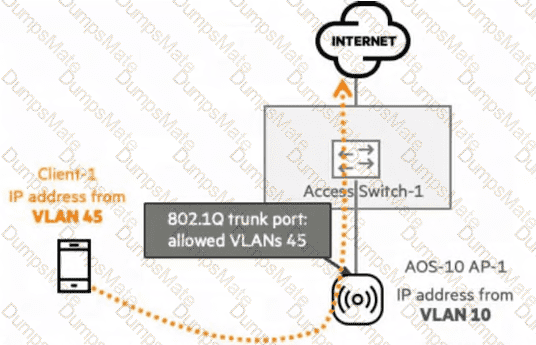
Refer to the exhibit.

Original exhibit — Question 39

HPE7-A11 Question 18

The exhibit shows an AOS-10 access point using VLAN 10 for management and a bridged wireless client receiving an IP address from VLAN 45, with the access switch carrying the client VLAN.

Your client is deploying an HPE Aruba Networking solution in which AOS-10 APs operate in bridged mode and connect directly to AOS-CX access switches in a campus environment.

A leading security priority is to block user traffic to any destination classified by BrightCloud Web Classification as “Bot Nets.” You have been asked to review and confirm the appropriate technical steps for accurate identification, classification, and blocking of this traffic through Central-managed policies and AOS-CX integration.

To block user access to the specified web destination(s) in this deployment model, which action should be taken?

Options:

A.

Add an (access rules) rule type "Access Control" Web Category and select "Bot Nets" action Deny to your APs group.

B.

Configure the switch to enforce auth-node client mode on AP edge ports with an unlimited max client setting'.

C.

Add an (access rules) rule type "Blocked Page URL" and select "Bot Nets" collection action Deny to your AP’s group.

D.

Add an (access rules) rule type "Access Control" Application Category and select "Bot Nets" action Deny to your APs group.

Buy Now
Questions 19

XYZ Regional Hospital is an integrated healthcare system comprising hospitals, neighborhood health centers, and small doctor offices. XYZ Regional Hospital recently merged with 4x neighborhood health centers and 125 doctor branch offices. Its wireless, wired-access, and AAA solutions are outdated and must be replaced.

XYZ Regional Hospital wants to future-proof and improve efficiency across all sites by enhancing wired and wireless access and moving to centralized, unified wired/wireless and policy management that provides uninterrupted availability of all systems.

Locations:

    XYZ Regional Hospital is in New York City.

    Dila Health Center is in City A.

    Mount Health Center is in City B.

    Rock Health Center is in City C.

    Branch clinics are in different locations across the United States.

Requirements:

    Provide, through management software, a single pane of glass to manage wired and wireless LANs and VPNs across campus, branch, and remote locations through web/cloud architecture that delivers near-real-time insight, troubleshooting tools, and Service Level performance reporting.

    Seamless integration across wired, wireless, WAN, SD-Branch, and IoT.

    Provide secure wireless access for all Regional Hospital employees and partners, and provide wireless Internet access to medical citizens when they visit the facilities.

    All access points must support these features and specifications: 802.11 ax (Wi-Fi 6E Certified).

    Security options including WP2/WPA3 and 802.1X with Radius secure authentication.

    Identify and authenticate every wireless and wired device.

    End-to-end role-based security.

    Seamless mobility throughout the hospital for medical teams, patients, and visitors.

    Reduce Wi-Fi deployment time from days to hours and enable Zero-Touch deployments across the site.

    Establish a resilient, future-ready network infrastructure with the intelligence, scalability, and intuitive toolsets to meet emerging needs.

    A fully redundant branch solution with dynamic path selection to the hospital.

XYZ Regional Hospital recently acquired a new outpatient building 900 feet (275 meters) from the main hospital, with a clear line of sight but no feasible fiber connection between the buildings.

The design requirements are:

    Extend the existing wireless SSIDs to the outpatient building.

    Cloud-manage all wired and wireless devices across both buildings.

Which combination of products should the Network Architect recommend?

Options:

A.

HPE Aruba Networking cellular bridges and AOS-CX switches with foundation subscriptions

B.

AOS-10 AP mesh, HPE Aruba Networking AirWave, and AOS-CX switches

C.

AOS-10 AP mesh and AOS-CX switches with foundation subscriptions

D.

Instant AOS-8 AP mesh and AOS-CX switches with advanced subscriptions

Buy Now
Questions 20

You meet with a customer to update the network after the prior network manager has left the company for another role.

Which methods can validate the current network state when the available network documentation is invalid?

Choose two.

Options:

A.

Begin searching through file shares for old documentation and compare the files and drawings to each other.

B.

Use neighbor discovery protocols to learn neighbor relationships, document the connections, and build a topology from the learned information.

C.

Physically examine the network devices to hand-over-hand validate the connections from device-to-device documenting the connections and cabling type if possible.

D.

Interview random company staff to gather the 'tribal knowledge' of how the network functions during normal operations and during degraded states.

E.

Documenting existing network configuration and topology is not required because previous iterations of network designs are considered obsolete.

Buy Now
Questions 21

What bandwidth is recommended for a VSX Inter-Switch Link?

Options:

A.

It should be equal to the sum of the downlink ports' bandwidth.

B.

It should be equal or higher than the speed of the uplink.

C.

It should be equal to the sum of the uplink ports' bandwidth.

D.

It should be the same speed as the one used for VSX Keepalive speed bandwidth.

Buy Now
Questions 22

Identify the stakeholders when collecting information for the network design and the new IDF/MDF design.

Choose two.

Options:

A.

Help desk manager

B.

Network Operations manager

C.

Facility manager

D.

Chief Financial Officer

Buy Now
Questions 23

What should be considered when using existing MMF and upgrading to equipment capable of 10 GbE speeds?

Choose two.

Options:

A.

redundant fiber tube into cabinet

B.

length of MMF fiber

C.

type of MMF fiber

D.

single fiber tube into cabinet

E.

type of fiber connector

Buy Now
Questions 24

A large multinational financial institution has engaged you to design a new full-stack wired and wireless network for its new 6-story regional office building. The facility’s bottom two floors will be retail space for a large banking branch. The upper floors will be carpeted corporate office space, with each floor approximately 100,000 sq ft (9290 sq m). All data centers are offsite and outside this project’s scope. The customer is underserved by its existing L2-based network infrastructure and wants to use modern best practices in the new design. The network must be fully resilient and fault-tolerant, with dynamic segmentation at the edge.

The retail space will provide public guest Wi-Fi access. Retail associates will use corporate tablets for customer service, and a mixture of wired and wireless devices will be deployed throughout the retail floors. Corporate users will mainly use wireless connectivity, although several wired clients, printers, and hard VoIP phones will be used.

The customer also plans to renovate the corporate office space to take advantage of 'smart office' technology. These enhancements will enable blue-dot wayfinding, presence analytics, and other location-based services.

The client chose to authenticate wired headless devices using Mac Authentication, with RADIUS attributes returned to the NAD to assign VLAN and port-access parameters to the authentication session on the switch port.

What would be critical to making this a successful deployment?

Choose two.

Options:

A.

DHCP

B.

ClearPass

C.

Mobility Gateway

D.

Airwave

Buy Now
Questions 25

During a stakeholder interview, an agenda is developed to clarify their expectations for the network design project.

Which two topics emphasize the customer's experience with their network?

Choose two.

Options:

A.

Anticipated business or location growth

B.

Pain points that impact daily operations

C.

The most critical issues reported from users of the network

D.

The most critical needs the new network will provide

E.

Long-term strategies to improve processes

Buy Now
Questions 26

A global cruise-line company needs to refresh its current fleet. It will refresh the ship’s internal infrastructure to be cost-effective and improve sustainability. It will replace all WLAN/LAN hardware on the ship. As part of this refresh, the company will not change its existing security requirements. The CIO also wants to minimize the number of unused switch ports. Any future expansion will always require a hardware refresh. The company will begin with the smallest ship, with a maximum of 800 guests.

Each ship has a LAN infrastructure comprising two core switches, up to 10 redundant distribution switches, and up to 500 access switches (400 cabins and 100 technical rooms). The core switches are in the ship’s MDF, and the distribution switches are in the IDFs. Each cabin and technical room receives a single access switch.

The ship’s cabling infrastructure will not be replaced. Each IDF connects to the MDF over SMF, with two pairs available for the interconnect between core and distribution. The SMF length between the MDF and IDF is less than 300 meters (980 ft), and it is OS1 fiber. Each cabin connects to its IDF with one OM2 pair, with a maximum length of 60 meters (200 ft). Each technical room connects to its IDF with one OM2 pair, with lengths from 100 to 150 meters (320 to 500 ft).

For every cabin and technical room, the customer wants to replace its current fanless 2530/2540 switches without changing the requirements, except that the uplink to the distribution switch must be upgraded to 10GbE to accommodate increased network traffic, and the technical rooms require redundant power.

The WLAN infrastructure will be refreshed 1:1, with no new cabling or AP locations. Its WLAN infrastructure uses 200/300-series indoor and outdoor APs running InstantOS (fewer than 300 APs), and the customer has no changes to WLAN requirements.

The cruise-line company will replace its existing Internet connection before the LAN/WLAN refresh. The new Internet connection will offer 99.8% uptime, needed to keep paid guest Wi-Fi continuously operational. With this new Internet connection, the CIO wants to base the design on Aruba’s ESP architecture because the Internet connection is guaranteed.

Based on best practices, what optic type should be recommended for the connection between the MDF and the IDFs?

Options:

A.

50G SFP56 LC SR 100 m MMF Transceiver

B.

10G SFP+ LC LR 10 km SMF Transceiver

C.

25G SFP28 LC eSR 400 m MMF Transceiver

D.

25G SFP28 LC LR 10 km SMF Transceiver

Buy Now
Questions 27

A large multinational financial institution has engaged you to design a new full-stack wired and wireless network for its new 6-story regional office building. The bottom two floors of the facility will provide retail space for a large banking branch. The upper floors will be carpeted corporate office space, with each floor approximately 100,000 sq ft (9290 sq m). All data centers are offsite and outside this project’s scope. The customer is inadequately served by its existing L2-based network infrastructure and wants to use modern best practices in the new design. The network must be fully resilient and fault-tolerant, with dynamic segmentation at the edge.

The retail space will offer public guest Wi-Fi access. Retail associates will use corporate tablets for customer service, and the retail floors will contain a mix of wired and wireless devices. Corporate users will mainly connect wirelessly, although several wired clients, printers, and hard VoIP phones will also be used.

The customer also plans to renovate the corporate office space to take advantage of “smart office” technology. These enhancements will enable blue-dot wayfinding, presence analytics, and other location-based services.

The client wants redundant RADIUS resources in each of its three geographic regions: AMER, EMEA, and APAC. A large office location in each region has sufficient VMware resources available.

Each region has between 4,481 and 5,692 clients, all of which must perform either 802.1X wired or wireless authentication, as well as 802.1X authentication for one personal Wi-Fi device.

All non-personal devices must also validate health using a local agent.

A total of 500 guests are expected to be connected on average, with a maximum of 700 simultaneous connections using Guest Portal for Internet access.

TACACS authentication will also be configured for 1200 evenly distributed NADs.

How many OnGuard Licenses are required in this scenario?

Options:

A.

5,000

B.

25,000

C.

35,000

D.

15,000

Buy Now
Questions 28

XYZ Regional Hospital is an integrated healthcare system comprising hospitals, neighborhood health centers, and small doctor offices. XYZ Regional Hospital recently merged with 4x neighborhood health centers and 125 doctor branch offices. Its wireless, wired-access, and AAA solutions are outdated and require replacement.

XYZ Regional Hospital wants to future-proof and improve efficiency across every site by enhancing wired and wireless access and moving to centralized, unified wired/wireless and policy management that provides uninterrupted availability of all systems.

Locations:

    XYZ Regional Hospital is located in New York City.

    Dila Health Center is located in City A.

    Mount Health Center is located in City B.

    Rock Health Center is located in City C.

    Branch clinics are located at different locations across the United States.

Requirements:

    Provide, through management software, a single pane of glass to manage wired and wireless LANs and VPNs across campus, branch, and remote sites through a web/cloud architecture that provides near real-time insight, troubleshooting tools, and Service Level performance reporting.

    Seamless integration across wired, wireless, WAN, SD-Branch, and IoT.

    Provide secure wireless access to all Regional Hospital employees and partners, and provide wireless Internet access to medical citizens when they visit the facilities.

    All access points must support these features and specifications: 802.11 ax (Wi-Fi 6E Certified).

    Security options including WP2/WPA3 and 802.1X with Radius secure authentication.

    Identify and authenticate every wireless and wired device.

    End-to-end role-based security.

    Seamless mobility across the hospital for medical teams, patients, and visitors.

    Cut Wi-Fi deployment times from days to hours and enable Zero-Touch deployments across the site.

    Establish a resilient, future-ready network infrastructure with the intelligence, scalability, and intuitive toolsets needed to meet emerging needs.

    A fully redundant branch solution with dynamic path selection to the hospital.

XYZ Regional Hospital is seeking an NAC solution to address its security challenges.

Requirements:

    A fully redundant NAC solution for management and authentication.

    Wireless and wired authentication for the main hospital will be handled locally.

    Wireless and wired authentication for the health centers will be handled locally.

    Wireless and wired authentication for the clinics will be authenticated against the main hospital NAC.

    Staff users/devices must be able to visit any site and have the same experience.

    Support 35k devices.

Locations:

    XYZ Regional Hospital is located in City 1 - 15k devices.

    Dila Health Center is located in City 2 - 8k devices.

    Mount Health Center is located in City 3 - 5k devices.

    Rock Health Center is located in City 4 - 4k devices.

    125 branch clinics are located at different locations across the US - 2k devices.

Which solution fulfills the customer's requirements?

Options:

A.

1x 3010 as a Publisher for the main DC; 1x 3010 as a Standby Publisher for the DR; 2x 3010 as Subscribers for the Main Hospital; 2x C2020 as Subscribers for the Dila Health Center; 2x C2020 as Subscribers for the Mount Health Center; 2x C2020 as Subscribers for the Rock Health Center; 25k + 10k Access licenses.

B.

1x 3010 as a Publisher for the main DC; 1x C2020 as a Standby Publisher for the DR; 2x C2020 as Subscribers for the Main Hospital; 2x C1000 as Subscribers for the Dila Health Center; 2x C1000 as Subscribers for the Mount Health Center; 2x VMs as Subscribers for the Rock Health Center; 15k + 10k Access licenses.

C.

1x C3010 as a Publisher for the main DC; 1x C3010 as a Standby Publisher for the DR; 2x C3010 as Subscribers for the Main Hospital; 2x C1000 as Subscribers for the Dila Health Center; 2x VMs as Subscribers for the Mount Health Center; 2x VMs as Subscribers for the Rock Health Center; 35k Access licenses.

D.

1x 3010 as a Publisher for the main DC; 1x 3010 as a Standby Publisher for the DR; 2x 3010 as Subscribers for the Main Hospital; 2x C1000 as Subscribers for the Dila Health Center; 2x VMs as Subscribers for the Mount Health Center; 2x C2020 as Subscribers for the Rock Health Center; 15k + 10k Access licenses.

Buy Now
Exam Code: HPE7-A11
Exam Name: HPE Network Campus Access Professional Architect Exam
Last Update: Nov 21, 2026
Questions: 94

PDF + Testing Engine

$42.5  $169.99

Testing Engine

$32.5  $129.99
buy now HPE7-A11 testing engine

PDF (Q&A)

$27.5  $109.99
buy now HPE7-A11 pdf
dumpsmate guaranteed to pass

24/7 Customer Support

DumpsMate's team of experts is always available to respond your queries on exam preparation. Get professional answers on any topic of the certification syllabus. Our experts will thoroughly satisfy you.

Site Secure

mcafee secure

TESTED 22 Nov 2026